I’m CTO of DNA Communications and co-founder of FD-IX, an internet exchange, with roughly 20 years in ISP and network infrastructure in Northern Illinois. I have no financial interest in any data center project.
TL;DR
- Brockovich’s map headline number, 9,683 reports as of October 4, is not a count of data centers. Her own vetted list holds 545 projects, only 139 of them operating. 80.5% of the published report records carry no owner or note, only a date, a location, and a facility type, and her largest hotspot, 402 reports, is a project with no building and no committed developer.
- 1,084 reports, 11.2%, come from zip codes within 10 miles of an operating facility on her list, and 482, 5.0%, from near one with no listed project nearby that isn’t operating. 20.7% sit near a campus under construction. Her list leaves out most conventional data centers, and distance can’t say which facility a report is about. Counted per facility, operating campuses average about as many nearby reports as proposed projects.
- Of the operating facilities discussed in this piece, four show documented harm, all of it noise, on different kinds of evidence. An Oregon nitrate settlement came with denied liability and a causal share no one has established. The largest open case, xAI’s gas turbines powering its Memphis-area AI campus, is in court: a judge has ruled the turbine plant wasn’t exempt from air permits, and no remedy or penalty has been decided. Much of the rest is construction-phase risk common to any large project, or concern about facilities not yet built.
- She told Bill Maher an average golf course uses 500 million gallons a year. By my calculation from the Golf Course Superintendents Association of America (GCSAA) national survey, the mean is at most about 38 million per facility, so she was off by at least 13x. Her figure for the largest campuses, up to 1.5 billion gallons a year, is accurate, even conservative: Google’s biggest site withdrew 1.75 billion in 2025. Cooling water use can be zero: Microsoft’s new designs use none.
- Nondisclosure agreements (NDAs) during site selection are real and documented: researchers found them in 25 of 31 Virginia localities with data center activity, and a Houston economic development official said virtually every company scouting that region seeks confidentiality.
- Her own site corrects two exaggerations popular with data center opponents, calling the claim that a ChatGPT query uses ten times the energy of a Google search “outdated” and “AI will collapse the power grid” an overstatement. It labels the industry’s 100% renewable claim nuanced. Her farmland and drought claims are accurate.
How this was checked, and what it doesn’t cover
This piece checks three sources: Brockovich’s July 31, 2026 appearance on HBO’s Real Time with Bill Maher [1], her site brockovichdatacenter.com, and her other public statements where they surfaced in national coverage. I treat government records, peer-reviewed research, and court rulings as authoritative. A court filing tells you what someone alleges, not what happened. I use secondary sources to locate primaries and label them where they’re all I found. I use her site’s figures as of its October 4, 2026, update and cite archived copies, because the live pages keep changing [2]. Where the July 30 snapshot that prompted this piece differs, I give both.
I checked the locations that surfaced through national coverage and her own top-reported-cities list. That sample skews toward whatever is most newsworthy. It is not a census of every operating facility in the country. When I say I didn’t find something, I mean I didn’t find it in what I checked.
What Brockovich gets right
Brockovich’s “Facts vs. Myths” page corrects two claims popular with data center opponents and treats an industry claim more fairly than opponents usually do [3]. It labels the viral claim that a ChatGPT query uses ten times the energy of a Google search “outdated,” citing a reassessment that puts a typical query in the same range as older search estimates [4]. It calls “AI will collapse the power grid” an overstatement. It marks the claim that data centers run on 100% renewable energy as nuanced rather than false, since renewable energy credit accounting makes it technically true, and explains what that accounting doesn’t guarantee. It gives closed-loop cooling a fair hearing. Asked on the same page whether data centers bring real jobs and tax revenue, she acknowledges the tax revenue and construction jobs and notes that a large facility may employ only 20 to 50 full-time workers [3]. Elsewhere she has said plainly that she isn’t “making a blanket argument against data centers”; her target is projects announced after permits are secured and NDAs signed before residents hear about them [5].
On air, she gave Maher the same courtesy. When he raised golf and almond irrigation as bigger water users, she said the comparison holds for small and medium-sized facilities, called it “great question, good argument,” and narrowed her case to the largest campuses [1]. Her bipartisan claim checks out: Oklahoma’s Data Center Customer Ratepayer Protection Act carried 36 co-authors from both parties and a Republican governor’s signature [6], and her legislation tracker, which cites a named source for every entry, shows comparable bills in Florida and South Dakota alongside New York, Maryland, and Washington [7]. Her Noise Impact Simulation labels itself an illustrative model, not measured data, and its advice to residents is sound: ask for an independent acoustic study, ask about low-frequency noise below 200 Hz, and insist on measurements at the property line [8]. Her News page’s claim that a West Virginia flood was caused by data center construction is also substantiated: a silt-retention breach during earthwork in Mason County sent water and sediment onto nearby homes [9][10].
Brockovich’s specific claims, checked
Each entry leads with a verdict: Accurate, Overstated, Imprecise, or Unverified. Where a claim has two parts, each part gets its own.
Water: Accurate on the largest campuses, Overstated on the golf baseline. Up to 1.5 billion gallons a year is a real figure for the biggest campuses. Google’s thirstiest site, Council Bluffs, Iowa, withdrew 1.75 billion gallons in 2025 and consumed 1.35 billion of it, according to Google’s own environmental report [11]. Withdrawal is what a site draws from its source. Consumption is the part that doesn’t go back, mostly lost to evaporation. A data center can use no water for cooling. Since August 2024, all new Microsoft data center designs use no water for cooling beyond filling the closed loop, though the buildings still use water for restrooms and kitchens [12]. The 1.5 billion number belongs to the largest sites, not to the industry. These are direct, on-site figures. They exclude water consumed at the power plants supplying the electricity, and a dry-cooled campus shifts some of its water footprint there by using more electricity.
The golf baseline she used is wrong. She told Maher an average golf course uses 500 million gallons a year. GCSAA’s 2024 national survey reached 13,952 golf facilities and drew 1,766 responses. It projects national irrigation at 1.63 million acre-feet by multiplying each region’s mean use per facility by the number of facilities in that region [13][14]. The projection uses only responses based on water-meter readings [14]. Spread across the 13,952 facilities the survey reached, it works out to about 38 million gallons per facility. GCSAA doesn’t publish the facility count behind the projection, and the true count can’t be smaller than the number of facilities the survey reached, so 38 million is an upper bound on the national average. A facility can be a 9-hole course or a 36-hole club, so individual courses vary around that. Southwest courses use more than double the per-facility water of other regions [14], and even Google, when it converts its data center water into “golf course equivalents,” uses a southwestern course at about 150 million gallons a year [11]. Her 500 million is more than three times that and at least 13 times the national average. The correction helps her argument rather than hurting it. Against that average, Google’s largest campus by water use withdraws at least 46 times what a typical facility does [11]. Her version made them look comparable.
NDAs: Accurate in substance, Overstated in scope. Confidentiality during site selection is common in corporate relocation. A Houston economic development official said virtually every company scouting the region seeks confidentiality [15]. In DeKalb, the 560-acre campus first came before the public as “Project Vector,” filed by a developer rather than the eventual operator [16]. Brockovich’s “everything, everything” claims more than the record shows. Two researchers who filed public-records requests found NDAs in 25 of 31 Virginia localities with data center activity, about 80%, and say the real figure may be higher because some governments kept no copies [17]. That documents NDAs in at least 80% of the localities they checked. The researchers couldn’t settle the rest either way. Public Citizen, an advocacy group opposed to data center NDAs, cites the same 80% from the same source [18]. The sharper complaint isn’t that NDAs exist. It’s that some keep figures out of public view that the public would normally see. In Botetourt County, Virginia, the regional water authority blacked out how much water a Google data center would use, citing an NDA, and released the figure, 2 to 8 million gallons a day, only after court rulings in a local news outlet’s favor [19]. Records for a Google project in Douglas County, Georgia came back with the water requirements redacted [20]. That’s the version of the complaint that holds up, and it’s a question to ask about any local deal.
She has a stronger local-control example available and doesn’t use it. West Virginia’s HB 2014 exempts certified high impact data centers and microgrid districts from county and municipal zoning, noise, and lighting ordinances [21][22]. That isn’t a private agreement. It’s a state legislature removing a county’s authority over a facility inside its own borders.
“It’s taking farmland”: Accurate. In DeKalb County, Illinois, every data center site, built or planned, was in crop production until development started. The loss is permanent. It also needs scale. The three DeKalb projects total roughly 1,200 acres, about 0.34% of the county’s 353,524 acres in farms [23]. The county lost about 5% of its farmland between 2017 and 2022 to all causes combined [23]. The newest site followed the city’s own plan: the 2022 Comprehensive Plan designates it industrial, and when the county’s enterprise zone was expanded, the Illinois Department of Agriculture found that including the property was consistent with the state’s farmland preservation policy [24]. The council then annexed and rezoned it in December 2025 [25]. Her claim is true. Whether farmland is a bigger concern for a data center than for the warehouse or factory that would otherwise sit on that edge of town is a separate question.
“Building them on drought-restricted land… Iowa, Nebraska, Kansas”: Accurate on conditions. When she said it at the end of July, nearly 84% of Nebraska was in drought on the U.S. Drought Monitor, including areas of extreme and exceptional drought [26]. A large area of southwest Kansas was in moderate to severe drought [27]. About a third of Iowa was in moderate drought in early July, concentrated in the north and west [28]. Those are statewide and regional drought classifications, not water-use restrictions on specific parcels. Whether drought explains why particular sites were chosen is a different claim, taken up in the siting section.
Acreage: Accurate for the largest projects, Overstated as a description of the category. Meta’s Hyperion campus in Louisiana started at 2,250 acres, and Meta bought another 1,400 at the end of 2025, about 3,650 in all [29]. The three DeKalb projects run 132, more than 500, and 560 acres [30][31][32]. Headline acreage also usually describes a project boundary rather than buildings. The Stratos project in Box Elder County, Utah, was billed at about 40,000 acres, split into three sites, with the non-data center land earmarked for uses that may include manufacturing, retail, restaurants, and hotels [33]. Utah’s governor said the first-phase permit holds the data center building footprint to under 2,000 acres, about 5% of the original total, and that later phases would need their own approval [34]. In June, the developer dropped about 20,000 acres and said the campus will likely be 10,000 acres or less [35]. When a number like 4,000 acres describes “a data center,” ask whether it’s typical, the biggest ever built, or mostly land that won’t be built on.
“We’ve always had data centers. They’re generally smaller”: Accurate, with a caveat. Most older data centers are smaller, and the gigawatt tier is new. Big older ones exist, though. 350 East Cermak in Chicago, a 1912 R.R. Donnelley printing plant converted to telecom use in 1999, runs about 1.13 million square feet with 109 megawatts (MW) of utility power [36][37]. Edged opened the first 24 MW building of its 96 MW campus in Aurora, Illinois, in February 2025; its second building alone is rated 72 MW [38][39]. Stargate Abilene had 618 MW of computing (IT) capacity delivered across six of its eight buildings as of September 10, 2026, according to Oracle [40]. The campus is planned at 1.2 gigawatts (GW), or 1,200 MW [41], about 11 times Cermak’s utility power, and that tier is the one this debate is actually about. It didn’t appear overnight. An industry analyst firm that tracks hyperscale capacity says the average size of new data centers increased gradually for years before accelerating sharply in late 2024, and the number of hyperscale facilities reached 1,136 at the end of 2024 after doubling over five years [42]. Getting from Cermak to Abilene took steadily larger campuses, not a leap from one kind of building to another. The bigger change is architectural. Cermak is a multi-tenant building in a dense urban core, with dozens of companies running their own equipment in a retrofitted high-rise. A modern AI campus is usually one operator’s purpose-built system on open land, with room for substations and cooling plant.
“People are losing their wells”: Accurate as a complaint, Unverified on cause. Four families near Meta’s Newton County, Georgia data center sued Meta in Gwinnett County Superior Court at the end of August [43]. Meta moved the case to federal court in Atlanta on October 16, and on October 28 the families filed an amended complaint and asked the judge to send the case back to state court [44]. Their central claim is that blasting and excavation during construction pushed sediment into the aquifer feeding their wells; the suit also alleges noise, light, and air emissions. Meta acknowledges limited blasting about 1.1 miles from one family’s property, but says a study by outside experts found the data center is “not likely to be the cause” of the well problems, that groundwater flows away from the homes, and that every gallon the facility used came from the local utility [45]. That dispute is unresolved, and its core is a construction claim, which belongs with the construction section below. Among the cases checked for this piece, none documents an operating data center drawing down neighbors’ wells.
“I now have nine other countries reporting”: Unverified. Her FAQ and stats page describe a U.S.-only map, and neither shows any international data [46][2]. That doesn’t rule out reports she has received and not published.
“New York has banned it”: Imprecise. Executive Order 62, signed July 14, 2026, directs the Department of Environmental Conservation to hold in abeyance discretionary permit applications for building or expanding data centers that use 50 MW or more, excluding manufacturing, research, education, and medical uses. Applications the department had already determined complete before the order are outside the hold, and it doesn’t touch local-government permits. The hold lasts until the state completes a generic environmental impact statement, with no fixed end date [47]. It’s a temporary state permitting hold, not a ban.
“79 municipalities had moratoriums or bans” when she started: Unverified, plausible. The National League of Cities counted at least 76 local governments that had attempted a moratorium or ban when it released its tracker in August [48]. By its October 28 refresh, the tracker listed 218, counting each locality once, with 183 of them adopted or completed [49]. Her own tracker now puts local moratoriums and bans at more than 300 as of September, up from 116 in June, citing SemiAnalysis and Route Fifty [7]. The trackers use different dates and definitions, and a tracker’s count also grows as it catalogs more entries, so these figures don’t show a growth rate. 79 falling between them makes it plausible, not verified.
Maher’s claims, checked
Maher got one of his four checkable claims right, had the direction right on a second, was partly right on a third, and was imprecise on the fourth.
“I don’t think it’s the land. We have the land”: Accurate. Land is not what constrains data center siting nationally. Power availability is, and CBRE calls it “the foremost site selection criterion for greenfield data center developments” [50]. Maher identified the correct binding constraint in an offhand remark.
“Seven times the amount of water” goes to golf: Understated today. Golf’s national water use, about 531 billion gallons a year from GCSAA’s survey [13], is about 30 times data centers’ direct consumption of 66 billion liters, about 17.4 billion gallons, in 2023 [51]. LBNL’s 2028 projections, 325 to 580 TWh at a site water intensity of 0.45 to 0.48 liters per kWh, work out to roughly 39 to 74 billion gallons [51]. With golf flat or declining, the ratio falls to 7x to 14x. Maher had the direction right and lowballed today’s gap; his number describes 2028. Both comparisons use direct, on-site water only. One caveat on the accounting: GCSAA measures irrigation applied, and some of that soaks back into the ground or runs off, while LBNL’s figure is water consumed. Golf’s consumed share is smaller than its applied total, so the 30x overstates the consumptive gap by an amount neither source measures. It doesn’t close it. The totals also hide a per-unit trend both industries share. Golf’s total use fell 31% since 2005 while the number of facilities fell 14%, so use per facility fell about 20% [14]. Microsoft’s water-use effectiveness, a measure of water per unit of energy, improved 39% from 2021 to the figure it reported in December 2024, and about 80% since its first-generation facilities [12]. Those are different measures, golf per facility and Microsoft per unit of energy, but both show efficiency improving while total demand can still rise as data center computing grows.
“Why don’t we build them in our 51st state where it’s cold?”: Partly right. Brockovich answered, “Well, absolutely” [1]. Cold climates do cut cooling load. Dry coolers work best where outside temperatures stay below about 80°F, which favors northern sites [52]. But climate doesn’t outrank power. A cold site without transmission capacity and fiber doesn’t get built [50].
“A $500 billion data center”: Imprecise. $500 billion is the total, multi-year Stargate program across seven planned sites [41]. The flagship Abilene site sits on just over 1,000 acres [53]. Its developers formed a $15 billion joint venture to finance the eight-building, 1.2 GW campus [54], and Oracle is reportedly set to spend about $40 billion on Nvidia chips for it [55]. No total cost for the site is published, but those two figures together are about a ninth of the headline number.
Maher also asked the sharpest question of the segment. After she said New York had banned data centers, he asked whether New Yorkers would still use what data centers produce: “Everybody’s a hypocrite. Oh, we can’t have it, but I will use it.” She answered “Well, yes,” pivoted to where data centers should go, and he didn’t press [1].
The map: what’s checked, and what just has a zip code
Brockovich’s map layers two kinds of data: a vetted list of projects, labeled by status, and a layer of community reports. Only the second produces the headline number, and no individual report on it is tied to a facility or a status.
As of its September 27 update, the vetted layer lists 545 projects: 139 operational, 166 under construction, 175 proposed, 39 permitted, and 26 cancelled, drawn from two open datasets, Compute Atlas and Epoch AI [56]. It covers major AI campuses and isn’t complete: of the three DeKalb projects, only Meta’s is on it. The “Community Reported” layer is something else, and it produces the headline figure: 8,837 on July 30 in my screenshot of the map, and 9,683 on October 4 [2].
“Does every ‘Community Reported’ data point represent an AI data center? No. Reports fall into several categories: AI data centers already operating, facilities under construction, and rumored or proposed projects.” brockovichdatacenter.com, FAQ
That’s her own documentation [46]. A reader looking at the map can’t tell which category a pin belongs to. By her own description, each report is read; reports without a zip code, city, or enough detail aren’t plotted; and duplicates are removed [46]. Nothing in that description checks whether a report describes a real facility.
The volume clusters hard. Across 2,447 zip codes, the average is about 4 reports. Her top 20 cities total 1,540 reports, 16% of the national figure [2]. The remaining 8,143 are spread across the other 2,427 zip codes, most in single digits.
The largest number on the map belongs to a project with no building, no committed developer, and a trial more than a year away. Sulphur Springs, Texas, has 402 reports, more than three times second-place Marshall, Michigan, at 127 [2]. Construction there has been halted amid lawsuits since at least February 2026 [57]. The litigation is a deed-restriction fight between the city and the former landowner, Vistra, plus a resident’s claim that the city violated the Open Meetings Act [58]. None of the litigation concerns water, noise, or health. In June, the mayor announced that MSB Global would no longer lead the project, and, as of July, no replacement had been named [58][59]. In September, the court reissued an injunction barring construction of facilities that generate or store electricity for sale on the property and set trial for November 15, 2027 [60]. CyrusOne held a community meeting that month on a possible campus at the site and says the project is still in due diligence [61][62]. The raw file shows how the count got so high: 158 of the 402 carry the same date, May 1, and 376 carry no note at all [63]. By the file’s own dates, 350 of the 402 arrived in May alone, and 389 were in by May 28 [63]. The count has nearly stopped moving since: comparing the author’s July 30 screenshot of the map with the October 4 stats page, Sulphur Springs added 5 reports while the national total added 846. That fits a one-time burst of filing better than an ongoing stream of new complaints. It also shows how much one town’s filing can move the map: Sulphur Springs alone is 4% of the national total.
A layer called “Community Reported” measures public sentiment, and sentiment about an unbuilt facility is real. In a town of about 17,000 people [64], 402 reports say something true about that community, though the published file doesn’t show whether one person can file more than once.
On air, she introduced the map about 30 seconds after telling Maher that data centers are “very destructive.” Then came “every single state in the United States of America was reporting to me,” followed less than a minute later by “it’s the whole country” and “it’s risking and taking all of that” [1]. She never said the reports document damage. She never drew the distinction her own FAQ draws, either. Heard in that sequence, the number reads to me as evidence of widespread damage, not widespread worry. Those call for different policy responses, and the count can’t tell them apart.
The map also can’t support the case it’s used for. To document harm from operating data centers, it would need reports that can be tied to running facilities. Her site publishes the reports themselves as a data file, so this can be checked. Each record holds a date, a place, a zip code, a type, and optional owner and notes fields. Of the 9,683 records, 7,799, 80.5%, have neither an owner nor a note in the published file: a date, a place name, a zip code, and a facility type, and nothing about what the report concerns [63]. Her FAQ says submissions arrive through a form and each one is read [46], so the submissions may say more than the published file does. The public record doesn’t.
I compared each report’s location to her own vetted list. The site’s zip-code file gives one coordinate for each zip code, and the vetted file gives coordinates for each project. I counted a report as near a project when that coordinate falls within 10 miles of it, and assigned each report to the most advanced project nearby: operating first, then under construction, then permitted, proposed, or cancelled. By that measure, 1,084 reports, 11.2%, are within 10 miles of an operating facility. Another 2,000, 20.7%, are near a campus under construction but no operating one. Another 2,374, 24.5%, are near only proposed, permitted, or cancelled projects, and 4,220, 43.6%, aren’t within 10 miles of anything on her list. Five had no usable zip code.
602 of the 1,084 are also within 10 miles of a project on her list that isn’t operating, and the file doesn’t say which project those reports concern. That leaves 482 reports, 5.0%, near an operating facility and no listed project of another status; if cancelled projects don’t count, it’s 510. Counted per facility, with each report counted once for every facility within 10 miles of it, operating campuses average about 14 reports, the same as proposed projects, and campuses under construction about 18. So operating sites do draw reports. The 5% is small mostly because 67 of the 139 operating campuses on her list have a non-operating project within 10 miles, and the test drops every report that shares a circle with one.
A zip code’s coordinate can sit miles from a rural reporter’s home, and the size and direction of that error vary. Her list leaves out many conventional data centers, so “near nothing” means only that no listed facility is within 10 miles. And proximity says nothing about which facility a report concerns. A resident who has lived next to a running facility for years may never have heard of her map, so a shortage of reports near operating sites isn’t proof of no harm. Reports also track approval fights: neighbors organize when a project is proposed, so a map built from voluntary submissions will cluster around proposals, whatever happens after a facility opens. The distance test only speaks to local effects like noise, light, and wells; electricity costs and water supply reach well past 10 miles. Across every radius from 1 to 30 miles, the operating-only share stays between 1.2% and 5.4%: 442 reports (4.6%) at 5 miles, 482 (5.0%) at 10, and 211 (2.2%) at 25, lower at wide radii because a wider circle catches more new projects. These counts lean low: the test drops every report that shares a circle with another project, and operating facilities missing from her list can’t count at all. More reports sit near projects that aren’t running yet, 4,374 or 45.2%, than near running ones, and the map can’t say which facility any of them concern. The full method, code, and file hashes are in a separate article, “How I Checked Erin Brockovich’s Community-Report Map.”
Leaving conventional data centers off the list also shapes the story. She acknowledged them on air: “We’ve always had data centers. They’re generally smaller” [1]. They’ve operated for decades, and in my experience they draw few complaints, though most of the ones I know sit in urban cores and business parks, not next to farmhouses. Her FAQ is open about the omission: it says more than 4,000 data centers operate in the U.S., many built before the AI boom, and the map isn’t meant to show them [46]. Both of her source datasets track AI compute, not data centers in general. Leaving them off still sets the old record aside: a reader of the map sees the new facilities with nothing to compare them against, including the decades of conventional facilities that, in my experience, drew few complaints. Scale has grown, steadily rather than overnight, as the Cermak comparison above shows. Old and new facilities share the same core parts, computers, cooling equipment, and backup power, while their scale, layout, cooling design, and power supply can differ a great deal.
The complaint categories rest on about 1,600 categorized submissions, not the full total. Her stats page builds them from a keyword analysis: the raw counts behind the percentages (663 water reports at 41.2%) imply that base, and one submission can match more than one category. The same percentages appeared in Fast Company’s coverage on May 28, when the map held 2,716 reports [65], and they were unchanged on October 22 at 9,733 [2]. Identical percentages after the total grew more than threefold mean the categories haven’t been rerun since late May; the site doesn’t say so. With that understood: water leads at 41.2%, then electricity and grid at 22.2%, health at 18.1%, wildlife and land at 14.6%, and noise at 13.7% [2]. Health is the largest category this piece doesn’t otherwise address. Her site’s health claims run through noise: her noise simulation, which she labels an illustrative model of a hypothetical facility, pairs modeled noise levels with “sleep disruption, stress response, cardiovascular risk with chronic exposure” and cites the World Health Organization’s night-noise guideline of 40 dB [8]. This piece doesn’t test those health effects; it checks the noise cases. Her Facts vs. Myths page discusses health through sleep disruption from noise and light at night [3]. The health pathways documented in this piece’s operating cases are noise and emissions from on-site generation, covered below. Claims linking the power lines and substations that serve data centers to childhood leukemia and other disease come from other advocacy groups, which concede that the health effects of electromagnetic fields from data centers specifically haven’t been extensively studied [66]. Property values come in last at 1.2% [2]. That doesn’t settle whether this is NIMBY opposition, since NIMBY concerns include noise, traffic, and neighborhood character, all of which rank higher. It does show that the most directly financial complaint a homeowner could make is the one that shows up least in her own categories.
I checked one zip code by hand, my own, and the map can’t say what its reports describe. DeKalb, Illinois, 60115, carries 8 community reports [63]. On the ground, there are three projects. Meta declared its campus, on more than 500 acres, operational in November 2023 [67][31]. The city council approved Edged’s 560-acre campus on December 8, 2025, in Ordinances 2025-050, 2025-051, and 2025-052, covering the development agreement, annexation, and rezoning [25][32]. On July 22, 2024, the council amended Ordinance 2023-038 to allow a seven-building data center on a 132-acre Karis site, after a planning and zoning recommendation a week earlier [68][69]. One of the three is operating. By Meta’s own figures, it withdrew 105 megaliters of water in 2024, about 28 million gallons [70].
In August 2026, DeKalb’s city manager told WGLT that the city hasn’t had to deal with complaints about the operating Meta facility over noise or any other pollution issue, and the reporter who visited called it “completely silent” [71]. That’s a complaint record and one visit, not a measurement, and complaints to a city undercount for the same reasons reports to a map do. The documented objection in DeKalb is to Edged, which hasn’t been built: a resident raised habitat, light, and sound concerns at the December hearing [71].
In her data file, one of the 8 reports in 60115 names Meta as the owner, and the only notes on the other seven say “pics” twice [63]. They could be about Edged, Karis, or the operating Meta campus. The difference matters to anyone trying to use that number. Checking took an afternoon with city council records and one local news story. I haven’t seen anyone do it for the other 2,446 zip codes.
A verification process built on location and duplicates also can’t sort out cause. A report can be accurate about a problem, such as flooding, and say nothing reliable about what caused it.
Construction is not operation
Some of the clearest documented harm in the cases I checked comes from construction, not from a running facility. Her map doesn’t separate the two: about 21% of its reports sit near a campus under construction, and distance can’t say whether they describe the construction or the facility to come. Construction-phase risk is common to any large land-disturbing project.
The West Virginia flooding on Brockovich’s News page is the clearest example. During earthwork at the Monarch Cloud Campus in Mason County, a silt-retention breach sent water and sediment onto neighboring homes in May [9][10]. After heavy rain on July 11 pushed stormwater past the site’s erosion controls again, the state Department of Environmental Protection issued an enforcement order [72]. The developer has pledged to cover cleanup and repair costs [9]. In July, he put his home purchases at 30, about six closed and around 20 under commitment, and the project’s communications team said 38 homes had been bought out [73]. That’s an erosion and sediment control failure. A federal jury in Georgia returned a $135.5 million verdict in 2023 against a solar developer and its contractors for the same failure mode after runoff turned a neighbor’s 21-acre lake into a mud hole [74]. The judge later found the award excessive and ordered a second trial on damages, and in January 2025 the case settled, on terms neither side disclosed, weeks before that trial [75]. Warehouses, subdivisions, highways, and solar farms all produce it. One erosion-control vendor’s analysis put 29% of the solar projects it reviewed at risk of increased erosion [76]. The Georgia well lawsuit above alleges the same kind of construction-phase harm, though there, causation is disputed. Scale matters, and it cuts both ways. The solar developer graded nearly 1,000 acres, according to the lawsuit [75], the size of a large data center campus, and the bigger the disturbed area, the bigger the erosion-control obligation. A data center under construction behaving like any other large construction site is not evidence that data centers are uniquely hazardous.
That doesn’t make construction harm irrelevant to an approval. Developers build big campuses in phases: Edged opened its first Aurora building in February 2025 and topped out its second in 2026 [38][39]. Damaged drainage can outlast the construction. The point is where the fix lives: erosion and sediment control permits, bonding, inspection, and enforcement, the same tools that govern any large site.
Noise works the same way. One resident near a data center under construction in Ahwatukee, in Phoenix, has sent the city about 10 noise complaints since April, describing construction noise early in the morning [77]. The complaint is real, and limits on work hours are enforceable. It’s a different claim from what the facility will sound like once it runs, and both get filed under the same heading.
Siting: what drives it
I found no evidence that developers target vulnerable water supplies. New campuses are going up in states with drought, including the three she named, but drought maps show regional conditions, not why a site was chosen.
Site selection screens on power availability first; CBRE calls it the foremost criterion for greenfield developments [50]. Land, water, and permitting get evaluated within markets that pass that screen. Rural farmland is attractive because it’s cheap, has room to expand, and sometimes comes with water rights and infrastructure from decades of irrigation. None of that requires a drought in the year a site gets picked. Drought status changes from year to year; the power, land, and water rights that drew a developer don’t change with it.
The stronger version of the concern is externality, not malice. Where local water is priced below its scarcity value, ordinary cost minimization pushes demand toward the cheapest input. Whether that depletes a supply depends on withdrawals, recharge, and permit limits. That’s a pricing and permitting problem, and it would produce the same pattern with any water-intensive industry.
Midwest milkweed fell 58% from 1999 to 2010, with the loss of milkweed in corn and soybean fields a major contributor, and Midwest monarch production fell 81% over the same period [78]. Herbicide-treated corn and soybean fields have lost most of the milkweed that monarch butterflies depend on, so the claim that a campus is worse for wildlife than the farmland it replaces can get the baseline backwards. Whether a specific campus improves on that baseline depends on whether its stormwater and buffer areas get native plantings or mowed turf.
The cooling trade-off: water, power, and noise
Cutting a data center’s water use usually costs something on two other fronts.
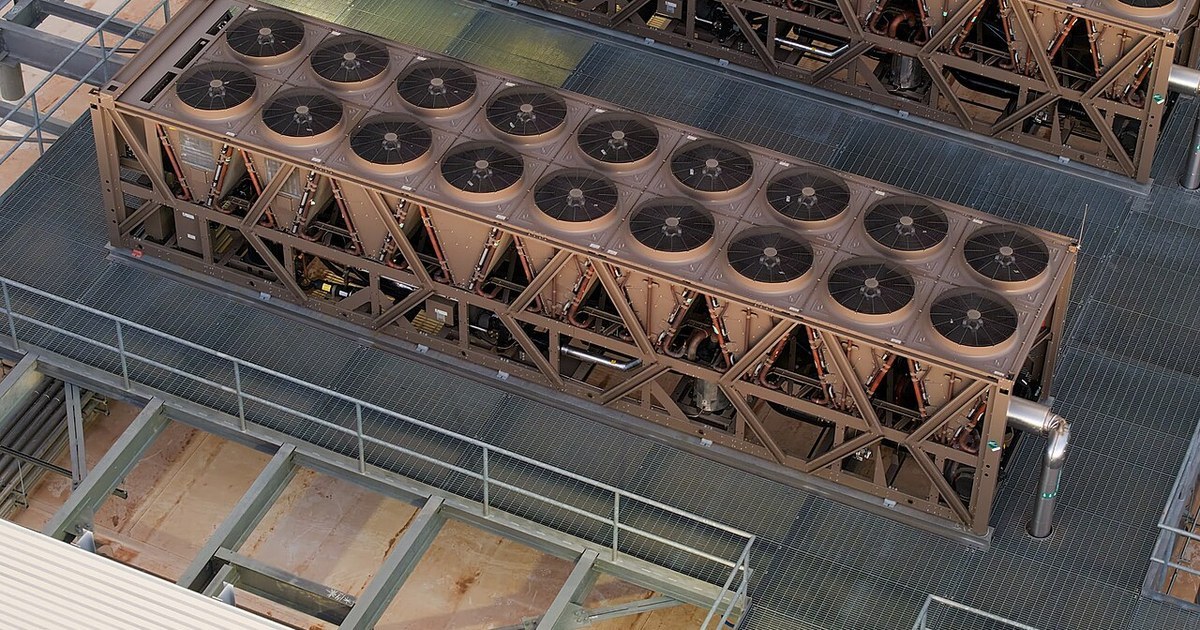
Evaporative cooling can cut a campus’s electricity demand 25% to 35% at peak summer load compared with dry cooling, according to an operator figure cited in a 2026 preprint [79]. The annual gap is smaller: the same preprint cites one company’s dry-cooled Nevada site running a 6.4% to 10.2% higher annual power usage effectiveness (PUE), the ratio of total facility energy to computing energy, than its evaporative-cooled sister site [79]. Air also holds far less heat than water, so rejecting the same heat with dry coolers takes more fans moving more air, and those fans are where most of dry cooling’s added noise comes from. EPA’s review of dry cooling at power plants names the fans as dry cooling’s largest operating energy load and lists increased noise among its disadvantages [80]. That review covers power-plant cooling, not data centers, so it supports the mechanism, not a noise estimate for any data center. A separate article will cover the engineering.
Microsoft’s Fairwater campus in Mount Pleasant, Wisconsin shows the trade-off in practice. More than 90% of its capacity is cooled by a closed loop that Microsoft says has no evaporation losses, rejecting heat through 172 twenty-foot fans; the remaining servers use outdoor air and switch to water only on the hottest days [81]. Microsoft acknowledged the result on its own site:
Residents to the north of the facility “have noticed a tonal humming sound.” Microsoft website update, April 15, 2026, which tied the sound to the facility’s cooling fans [82]
That’s an admission against interest from the operator, which makes it one of the best-evidenced complaints in this debate. It backs up the humming Maher described on air and Brockovich endorsed, “it’s very disturbing to them and I get it,” more cleanly than anything on her map [1]. The order of events matters. Microsoft adjusted the fans in mid-April and said the facility met the local noise ordinance. In June, it said the mitigations had “fully resolved the issue,” and it has kept working on additional sound reduction since [82]. The village reported no formal complaints after the adjustments [83]. Three residents filed a federal class action on July 1, alleging noise from generators and heating, ventilation, and air-conditioning (HVAC) equipment, including low-frequency sound they say A-weighted (dBA) readings understate [83]. A problem the operator says it fixed, a facility it says meets the ordinance, and a lawsuit can all exist at once. Microsoft made zero-water cooling its standard for new data center designs [12], and Fairwater, in the Great Lakes basin, is mostly built that way. Fairwater doesn’t prove an evaporative design would have been quieter; fan selection, speed, and layout matter too. It does show a mostly zero-water design and a noise problem arriving together in a region where water is comparatively plentiful.
A board weighing a cooling design should ask for its water use, electricity demand, and property-line noise estimates together, because cutting one can raise the others.
What the noise record shows
Noise complaints come in two kinds the map doesn’t distinguish, and the difference isn’t about legitimacy. Anticipating harm is what environmental review, zoning hearings, and permit conditions exist for. Worrying about a facility before it’s built is rational. The problem is counting anticipated harm as experienced harm, which is what happens when both land in the same total.
For a site that isn’t built, a noise complaint describes an expectation, not an observation. In Pittsburg, California, where the city approved an AVAIO Digital data center in November 2024, and opponents were still trying to keep shovels out of the ground in August 2026 [84][85][86], one resident at an opposition meeting described how neighbors form their views: “They read what’s on the outside, you know, different towns, different cities” [87]. That’s a reasonable thing for a resident to do. A dataset shouldn’t count it as a measurement.
Forecasts and observations need different kinds of evidence. For an unbuilt facility, a resident’s concern and a developer’s promise are both forecasts, and both deserve the same scrutiny. What settles either one is a modeled noise study, a stated water source and volume, and conditions written into the permit.
For running facilities, the record is thinner than the volume suggests. As of July, WilmerHale found no data center noise nuisance suit that appears to have reached summary judgment or trial [88]. Cases settle, operators mitigate, and many neighbors never sue. The newest class of campus, gigawatt-scale, dry-cooled, sometimes with on-site gas, is only now coming online: Stargate Abilene had six of eight buildings delivered as of September 2026 [40].
I count a case as documented harm from an operating facility when the operator admits the problem, the operator spends to fix it, or measurements show it. Four of the operating facilities discussed here meet that bar, all on noise. Fairwater rests on the operator’s own admission. An older case in Chandler, Arizona, rests on the operator’s response: in 2018, after neighbors near CyrusOne’s campus petitioned the city over a high-pitched hum from its chillers, CyrusOne spent about $2 million on noise-attenuation blankets. The city said the facility complied with its noise ordinance before, during, and after the work. The retrofit helped, and residents still said the hum bothered them two years later [89][90][91].
Amazon’s facility near the Great Oak subdivision in Prince William County, Virginia, outside Manassas, rests on reported measurements and county records: a real complaint about an operating facility that produced a 10-decibel reduction after 18 months of pressure [92][93]. A March 2025 presentation by a Great Oak resident to the county’s data center ordinance advisory group, posted on the county’s website and made after both fixes were complete, still described the facility as generating continuous low-frequency noise [94]. That’s what a substantiated complaint followed by a partial fix looks like.
The most recent is in Aurora, Illinois, and rests on the operator’s response. In April 2025, a failed transformer at CyrusOne’s campus on Diehl Road put one data hall on nine backup generators for several days, and the company apologized to neighbors for the noise. It then started a campus-wide chiller noise project: temporary walls around the chiller plants in June 2025, then permanent rooftop sound walls and chiller attenuators, described as reducing “noise impacts for nearby residents,” with community meetings along the way. CyrusOne reported finishing that work at two buildings by September 30, 2026, and was still adding measures in late October [95].
A settlement involving a fifth doesn’t meet it. Amazon settled a $20.5 million class action over nitrate contamination in eastern Oregon [96][97]. The case involves operating facilities, not construction. The nitrate problem also predates the data centers. Oregon’s Department of Environmental Quality declared the Lower Umatilla Basin a groundwater management area for nitrate in 1990, decades before the data centers arrived [98]. The other defendants include the Port of Morrow, which oversees the county’s wastewater system; Lamb Weston; large farm and dairy operators; and Portland General Electric. Amazon settled while denying the allegations [96]. With a preexisting nitrate problem and a long list of co-defendants, no one has established Amazon’s share. I don’t count it as documented data center harm, and I don’t leave it out either.
The biggest open operational case isn’t about cooling at all. xAI powers its Colossus 2 AI campus near Memphis with gas turbines at a plant across the state line in Southaven, Mississippi: 69 of them, according to the NAACP’s lawsuit as reported in October [99]. The count has grown as units were added; emails obtained through a public records request put it at 46 in May [100]. Mississippi regulators let the early turbines run without air permits under an exemption of up to a year for temporary, mobile engines, and in March the state permit board approved 41 permanent turbines to replace 27 that had been running unpermitted [101][102]. The NAACP sued under the Clean Air Act. On October 19, a federal judge refused the Justice Department’s request to dismiss the case [99][103], and on October 30 she denied xAI’s own motion to dismiss, ruling that the plant is not a “mobile source” and “was not (and is not) exempted from permitting requirements” [104]. That ruling came on the pleadings. It sets no penalty and orders nothing yet, and the NAACP’s request for a preliminary injunction is still pending. Three residents have also filed a nuisance class action over noise and vibration [105][106]. Backup generators draw complaints too. During a July 2026 power failure, Vantage’s campus in Sterling, in Loudoun County, Virginia, ran on diesel generators. Nearby residents complained to county supervisors about noise and fumes. Vantage says state regulators reviewed its data and found emissions well below permitted levels [107]. On-site generation is an operational issue that belongs in any honest accounting, and it isn’t hypothetical where I live: DeKalb’s Edged campus plans to run on natural gas generators until regional grid upgrades are finished [24].
The litigation, and who benefits from it
A filing is not a finding. Crowell & Moring, a defense firm tracking data center cases, describes plaintiffs’ firms building a replicable complaint, advertising for clients, and filing in multiple jurisdictions at once. It compares the pattern to the growth of litigation over PFAS, the “forever chemicals” [108]. That’s a defense firm’s characterization, but the mechanics aren’t unique to data centers, and they produce volume whether or not a given claim is true.
Readers should know Brockovich’s own ties, as they should know the author’s. Her speakers bureau describes her as a consultant to Weitz & Luxenberg and to Shine Lawyers in Australia [109]. The Weitz relationship dates to 2008 [110]; I found nothing from either firm confirming it’s current, and the firm’s data center page doesn’t mention her. That page solicits clients for data center pollution and noise claims [111]. Her Substack, The Brockovich Report, lists more than 42,000 subscribers, hundreds of them paid [112].
Incentives run the other way too. Developers, site-selection consultants, utilities chasing load growth, and economic development agencies all have money riding on approvals. Their claims about an unbuilt facility are forecasts as well, and they need the same checking.
Electricity and e-waste
Electricity: Accurate. Her site’s figures, about 4.4% of U.S. electricity in 2023 and 7% to 12% by 2028, match the Department of Energy’s 2024 Lawrence Berkeley National Laboratory report, which put them at 4.4% and 6.7% to 12% [3][51]. Her site credits the International Energy Agency for them rather than the LBNL report, but the numbers aren’t inflated. LBNL published an update in June 2026 [113]; the figures she uses match the 2024 edition.
E-waste: no number to check, and that’s to her credit. Her site lists e-waste as a concern without a figure. A newer peer-reviewed estimate puts AI hardware waste at 131,000 to 225,000 metric tons a year by 2030 [114], about 90% below an earlier projection of up to 2.5 million tons a year by 2030 [115]. (That earlier study’s figure of 5 million tons is a total for 2023 to 2030, not a yearly one [115].) For scale, U.S. construction and demolition debris came to about 600 million tons in 2018 [116], more than 90% of it from demolition rather than new building [117]. That doesn’t make AI hardware disposal a non-issue. It does mean her map, which tracks new buildings, isn’t tracking the larger waste stream.
Quick Compare: claims vs. the record
| Claim | What was said | The record shows |
|---|---|---|
| Average golf course water use | 500 million gal/year | At most ~38 million gal/year national average (2024); ~150 million for a southwestern course |
| Largest campus water use | Up to 1.5 billion gal/year | Accurate; Google Council Bluffs withdrew 1.75 billion and consumed 1.35 billion gal (2025); range starts at zero |
| Golf vs. data center water | “Seven times” (Maher) | About 30x today; 7x to 14x by 2028 |
| New York policy | “Has banned it” | State permit hold on new 50 MW+ applications pending an environmental study; no fixed end date |
| Map reports vs. vetted sites | 9,683 reports | 545 vetted projects, 139 operating; 80% of records carry no owner or note |
| Map reports near running facilities | 9,683 reports, shown alongside operating, planned, and proposed sites | 1,084 (11%) within 10 miles of an operating facility on her list; 482 (5%) near one with no non-operating project nearby; the file can’t say which facility a report concerns |
| DeKalb data center acreage | “Taking farmland” | True; roughly 1,200 acres, 0.34% of county farmland |
Quick Compare: national water use, golf vs. data centers
| Latest | 2028 (projected) | Trend | |
|---|---|---|---|
| Golf (national) | ~531 billion gal/yr (2024) | Flat or declining | Down 31% since 2005 |
| Data centers (direct, national) | ~17.4 billion gal/yr (2023) | 39 to 74 billion gal/yr | Rising sharply |
Closing
The map Brockovich leads with on national television can show where people are reporting concern. It can’t separate a rumor from an operating facility, a construction complaint from an operational one, or a correct grievance from a misattributed one. In the on-air sequence above, it reads as evidence of nationwide harm, and its own data can’t show that.
The rest of her case mostly holds up. Farmland is being lost, the Plains states she named were in drought, and her one clean numerical miss, the golf baseline, makes her argument stronger once it’s fixed.
A blanket moratorium blocks a well-designed, well-conditioned project as readily as a badly designed one, because it can’t tell them apart. A short, time-limited pause to write standards is defensible where a community has none. Where state law leaves zoning to local boards, as Illinois does and West Virginia no longer does for certified projects, a city council or county board can write them into a special-use permit or development agreement, within what state law allows and alongside the permits state agencies issue: property-line noise limits that cover low-frequency sound, a stated water source and volume, proof of state air permits for any on-site generation, erosion and sediment control bonding, and monitoring after opening with remedies that can be enforced.
Rates and cost allocation sit with the state. Oklahoma’s HB 2992 shows what that looks like, and it bans nothing. It defines a large load as 75 MW or more, requires that costs be allocated under cost-causation principles, with separate tariffs and 10-year terms for large loads, and requires a developer buying land outside a city or industrial park to notify adjacent owners, county commissioners, and the Corporation Commission within 60 days [118]. That goes after cost allocation and secrecy without blocking anything. This piece doesn’t measure how much cost shifting has happened; a future piece will sort which complaints hold everywhere, which hold only at specific sites, and which don’t hold at all.
Her form already asks whether a facility is running or coming soon. A version of the map that published that answer, showed how many reports name a specific facility, and showed the count of distinct facilities alongside the report total would be a useful public tool. She has the audience and the submissions to build it.
Until then, anyone evaluating a project in their own community will get further with city council minutes, state environmental filings, and utility rate cases than with a number from either side. Ask which facility a claim describes, whether it’s built, and whether the complaint is about construction or operation.
Cover photo: Theodore Christopher / Wikimedia Commons, CC0
Sources
[1] Real Time with Bill Maher, HBO, episode 736, July 31, 2026, Erin Brockovich interview (author’s recording and transcript on file; quoted passages at about 9:22 to 10:57, 13:45 to 14:36, and 16:06 to 16:33 of the recording); guest lineup per BroadwayWorld, July 30, 2026: https://www.broadwayworld.com/bwwtv/article/REAL-TIME-WITH-BILL-MAHER-Sets-Guest-Lineup-20260730
[2] brockovichdatacenter.com, Community Reports Statistics, data through October 4, 2026 (advocacy source; live page has since updated): https://www.brockovichdatacenter.com/community-stats.html (archived October 10, 2026: https://web.archive.org/web/20261010001648id_/https://www.brockovichdatacenter.com/community-stats.html)
[3] brockovichdatacenter.com, AI Data Centers: Facts vs. Myths: https://www.brockovichdatacenter.com/facts-myths.html (archived October 10, 2026: https://web.archive.org/web/20261010001652id_/https://www.brockovichdatacenter.com/facts-myths.html)
[4] Epoch AI, How much energy does ChatGPT use?: https://epoch.ai/gradient-updates/how-much-energy-does-chatgpt-use
[5] TechCrunch, Anthony Ha, Erin Brockovich takes aim at data center secrecy, May 31, 2026: https://techcrunch.com/2026/05/31/erin-brockovich-takes-aim-at-data-center-secrecy/
[6] Oklahoma House of Representatives, Boles and Green applaud governor for signing HB 2992, May 13, 2026: https://www.okhouse.gov/posts/News-20260513_1
[7] brockovichdatacenter.com, Communities & Legislation (advocacy source; each entry cites a named source): https://web.archive.org/web/20261026191653id_/https://www.brockovichdatacenter.com/community-and-legislation.html (archived October 26, 2026: “300+ Local Moratoriums & Bans in effect nationwide as of Sept 2026, up from 116 in June”; live page: https://www.brockovichdatacenter.com/community-and-legislation.html)
[8] brockovichdatacenter.com, Noise Impact Simulation: https://www.brockovichdatacenter.com/noise-impact.html (archived October 11, 2026: https://web.archive.org/web/20261011053702id_/https://www.brockovichdatacenter.com/noise-impact.html)
[9] WSAZ, Severe flooding in Mason County relating to data center construction, May 24, 2026: https://www.wsaz.com/2026/05/24/data-center-construction-causes-severe-flooding-mason-county-residents-be-reimbursed/
[10] WV MetroNews, Mason County community impacted by flooding from data center construction site, May 24, 2026: https://wvmetronews.com/2026/05/24/mason-county-community-impacted-by-flooding-from-data-center-construction-site/
[11] Google, 2026 Environmental Report, water use by data center location, 2025, p. 97 (Council Bluffs, IA: 1,746.4 million gallons withdrawn, 1,346.0 million consumed), and endnote 78, p. 113 (average annual irrigation for a Southwest U.S. golf course is 459 acre-feet, around 150 million gallons, citing USGA 2012): https://sustainability.google/reports/google-2026-environmental-report/ (PDF: https://sustainability.google/files/1699a2e19277e478b38a659f00cb38398a836e8c/download-1699a2e1.pdf)
[12] Microsoft, Sustainable by design: Next-generation datacenters consume zero water for cooling, December 9, 2024: https://www.microsoft.com/en-us/microsoft-cloud/blog/2024/12/09/sustainable-by-design-next-generation-datacenters-consume-zero-water-for-cooling/
[13] GCSAA, Golf courses reduce water usage by 31 percent according to national survey, December 30, 2025 (1.63 million acre-feet; the 531 billion gallon conversion is the author’s): https://www.gcsaa.org/who-we-are/media/news-release/2025/12/30/golf-courses-reduce-water-usage-by-31-percent-according-to-national-survey
[14] Golf Course Management (GCSAA), J. Bryan Unruh and Travis Shaddox, From acre-feet to outcomes: Interpreting the 2024 GCEP Water Survey, December 2025 (survey reached 13,952 facilities; 1,766 responses): https://www.gcmonline.com/research/news/from-acre-feet-to-outcomes-interpreting-the-2024-gcep-water-survey
[15] Bisnow, Jarred Schenke, Amazon HQ2 search likely won’t upend economic development secrecy, January 30, 2018: https://www.bisnow.com/news/national/economic-development/amazon-hq2-search-likely-wont-upend-economic-development-secrecy-84260
[16] WNIJ, Bear Savage and Jenna Dooley, Public can weigh in on proposal for 500-acre data center in DeKalb, November 24, 2025: https://www.northernpublicradio.org/wnij-news/2025-11-24/public-can-weigh-in-on-proposal-for-500-acre-data-center-in-dekalb
[17] Virginia Mercury, Eric Bonds and Viktor Newby (guest commentary), Data centers, non-disclosure agreements and democracy, April 30, 2025: https://virginiamercury.com/2025/04/30/data-centers-non-disclosure-agreements-and-democracy/
[18] Public Citizen, The Secret Data Center Buildout (advocacy organization): https://www.citizen.org/news/the-secret-data-center-buildout-how-states-can-stop-big-techs-abuse-of-ndas/
[19] WVTF / Radio IQ, Data center water fight spotlights non-disclosure agreements, February 26, 2026: https://www.wvtf.org/news/2026-02-26/data-center-water-fight-spotlights-non-disclosure-agreements
[20] WHIO-TV I-Team, Data centers, water, and secrets: Companies using NDAs to hide their names, water usage, November 24, 2025: https://www.whio.com/news/local/i-team-data-centers-water-secrets-companies-using-ndas-hide-their-names-water-usage/SWT7F3PMZZGI7KOHKDQZSKZFSU/
[21] West Virginia Legislature, Enrolled Committee Substitute for H.B. 2014 (2025), §5B-2-21b(c) and (d): https://www.wvlegislature.gov/Bill_Text_HTML/2025_SESSIONS/RS/bills/hb2014%20sub1%20enr.pdf
[22] Broadband Breakfast, Jericho Casper, New West Va. Law Grants Sweeping Exemptions to Attract Data Centers, May 2, 2025 (final bill exempts qualifying data centers from local land-use rules “including municipal zoning, permitting, and noise and lighting regulations”): https://broadbandbreakfast.com/new-west-va-law-grants-sweeping-exemptions-to-attract-data-centers/
[23] USDA NASS, 2022 Census of Agriculture County Profile, DeKalb County, Illinois (archived September 26, 2026; the original address now returns 404): https://web.archive.org/web/20260926110822/https://www.nass.usda.gov/Publications/AgCensus/2022/Online_Resources/County_Profiles/Illinois/cp17037.pdf
[24] City of DeKalb, Edged Development Approved, December 2025: https://www.cityofdekalb.com/CivicAlerts.aspx?AID=964
[25] City of DeKalb, Regular City Council Meeting Minutes, December 8, 2025 (Ordinances 2025-050, 2025-051, and 2025-052, Project Vector, approximately 560 acres): https://www.cityofdekalb.com/DocumentCenter/View/20217/2-120825-Regular-Minutes
[26] Nebraska State Climate Office, July 2026 Monthly Climate Summary: https://nsco.unl.edu/news/july-2026-monthly-climate-summary/
[27] National Weather Service Dodge City, Drought Information Statement, August 3, 2026 (U.S. Drought Monitor data released July 28, 2026): https://www.weather.gov/media/ddc/DGT/DGT_DDC_08032026.pdf
[28] Iowa Department of Natural Resources, Water Summary Update: Drought expands in areas of northern and western Iowa, July 9, 2026: https://www.iowadnr.gov/news-release/2026-07-09/water-summary-update-drought-expands-areas-northern-and-western-iowa-east-returns-normal-conditions
[29] DataCenterDynamics, Meta purchases additional 1,400 acres for Hyperion mega data center expansion, February 9, 2026: https://www.datacenterdynamics.com/en/news/meta-purchases-additional-1400-acres-for-hyperion-mega-data-center-expansion/
[30] DataCenterDynamics, Seven-building data center campus gets preliminary OK from Illinois planning commission: https://www.datacenterdynamics.com/en/news/seven-building-data-center-campus-gets-preliminary-ok-from-illinois-planning-commission/
[31] Shaw Local, Meta expands DeKalb data center, totaling $1B investment, April 27, 2022: https://shawlocal.com/daily-chronicle/news/2022/04/27/meta-expands-dekalb-data-center-totaling-1b-investment
[32] Shaw Local, Unanimous yes to 560-acre DeKalb data center, December 9, 2025: https://www.shawlocal.com/daily-chronicle/2025/12/09/unanimous-yes-to-560-acre-dekalb-data-center
[33] Utah News Dispatch, Renderings show vision for massive data center proposed in Utah, May 19, 2026: https://utahnewsdispatch.com/2026/05/19/renderings-show-massive-data-center-box-elder-utah-permits-could-take-years/
[34] KUTV, Utah governor posts answers to questions, concerns about Box Elder County data center, May 8, 2026 (“the initial permit in phase one of the project will be fewer than 2,000 acres in the data center building footprint”): https://kutv.com/news/local/utah-governor-posts-answers-to-questions-concerns-about-box-elder-county-data-center
[35] KPCW, Kevin O’Leary to scale back Utah project, says it won’t be the largest data center in the world, June 5, 2026: https://www.kpcw.org/state-regional/2026-06-05/kevin-oleary-to-scale-back-utah-project-says-it-wont-be-the-largest-data-center-in-the-world
[36] DataCenterDynamics, Digital Realty files to build 565,000 sq ft data center in Chicago (350 E Cermak history and capacity): https://www.datacenterdynamics.com/en/news/digital-realty-files-to-build-565000-sq-ft-data-center-in-chicago/
[37] Digital Realty, 350 East Cermak Road property factsheet (8 levels; 1,133,000 sq ft), on Digital Realty’s site: https://go2.digitalrealty.com/rs/087-YZJ-646/images/DS_Digital_Realty_2308_ORD10_Property_Factsheet_EN.pdf (an earlier version of the same factsheet, hosted by Data Center Map, also lists 109,000 kW utility power and 70,000 kW UPS: https://static.datacentermap.com/company/digital-realty-trust/datacenter980/DS_Digital_Realty_2308_ORD10_Property_Factsheet_EN.pdf)
[38] DataCenterDynamics, Edged launches first phase of 96MW Chicago data center campus, February 27, 2025: https://www.datacenterdynamics.com/en/news/edged-launches-first-phase-of-96mw-chicago-data-center-campus
[39] DataCenterDynamics, Edged tops out second building at Chicago data center campus, June 5, 2026: https://www.datacenterdynamics.com/en/news/edged-tops-out-second-building-at-chicago-data-center-campus-illinois/
[40] Epoch AI, OpenAI Stargate Abilene, AI Data Centers directory (timeline entry for September 10, 2026, quoting Oracle’s Q1 FY27 earnings call: “618 megawatts and 75% of total capacity have now been delivered to the customer”; six of eight buildings): https://epoch.ai/data/ai-data-centers/directory/openai-stargate-abilene
[41] Epoch AI, OpenAI Stargate: where the US sites stand, April 2026: https://epoch.ai/publications/openai-stargate-where-the-us-sites-stand
[42] Synergy Research Group (TechInsights), Hyperscale Data Center Count Hits 1,136; Average Size Increases; US Accounts for 54% of Total Capacity, March 19, 2025 (industry analyst): https://srgresearch.com/articles/hyperscale-data-center-count-hits-1136-average-size-increases-us-accounts-for-54-of-total-capacity
[43] Atlanta Journal-Constitution, Georgia families sue Meta, accuse its data center of tainting their water, September 1, 2026: https://www.ajc.com/news/2026/09/georgia-families-sue-meta-accuse-its-data-center-of-tainting-their-water/
[44] U.S. District Court for the Northern District of Georgia, Morris v. Meta Platforms, Inc., No. 1:26-cv-06273-SDG, docket (removed from Gwinnett County Superior Court, No. 26-A-07974-11; notice of removal filed October 16, 2026, ECF 1; first amended complaint and motion to remand, October 28, 2026, ECF 26 and 27), retrieved from PACER October 29, 2026; public copy: https://www.courtlistener.com/docket/74996593/morris-v-meta-platforms-inc/
[45] WSB-TV, 4 Georgia families sue Meta, claim data center construction contaminated well water, October 21, 2026: https://www.wsbtv.com/news/local/4-georgia-families-sue-meta-claim-data-center-construction-contaminated-well-water/FVX726UR7FGJTLEAOYTQ4MDZ2Y/
[46] brockovichdatacenter.com, FAQ: https://www.brockovichdatacenter.com/faq.html (archived October 20, 2026: https://web.archive.org/web/20261020235820id_/https://www.brockovichdatacenter.com/faq.html)
[47] New York State, Executive Order No. 62, Establishing a Temporary Moratorium on Data Centers in New York While the State Develops Standards, July 14, 2026: https://www.governor.ny.gov/executive-order/no-62-establishing-temporary-moratorium-data-centers-new-york-while-state-develops
[48] Route Fifty, Many localities have tried data center moratoriums, tracker finds (National League of Cities tracker), August 28, 2026: https://www.route-fifty.com/artificial-intelligence/2026/08/many-localities-have-tried-data-center-moratoriums-tracker-finds/415696/
[49] National League of Cities, Data Center Local Action Tracker (dashboard last refreshed October 28, 2026; counts of localities with a moratorium or ban entry by the author): https://www.nlc.org/resource/data-center-local-action-tracker/
[50] CBRE, North America Data Center Trends H1 2025, September 8, 2025: https://www.cbre.com/insights/reports/north-america-data-center-trends-h1-2025
[51] Shehabi et al., 2024 United States Data Center Energy Usage Report, Lawrence Berkeley National Laboratory, December 2024, doi:10.71468/P1WC7Q (water figures pp. 55-56): https://web.archive.org/web/20261022090909/https://escholarship.org/content/qt32d6m0d1/qt32d6m0d1.pdf
[52] Data Center Knowledge, Christopher Tozzi, The pros and cons of dry coolers for data centers, July 9, 2025: https://datacenterknowledge.com/cooling/the-pros-and-cons-of-dry-coolers-for-data-centers
[53] Texas Standard, Stargate data center poised to complete construction this year in Abilene: https://texasstandard.org/stories/stargate-data-center-abilene-texas-construction-ai-artificial-intelligence/
[54] Crusoe, Crusoe, Blue Owl Capital and Primary Digital Infrastructure enter second phase of $15 billion joint venture for the 1.2 GW Abilene, Texas data center, May 21, 2025: https://www.crusoe.ai/resources/newsroom/crusoe-blue-owl-capital-and-primary-digital-infrastructure-enter-joint-venture
[55] DataCenterDynamics, Oracle to spend $40bn on Nvidia chips for OpenAI Texas data center (Abilene; JPMorgan loans of $9.6 billion and about $5 billion from Crusoe and Blue Owl): https://www.datacenterdynamics.com/en/news/oracle-to-spend-40bn-on-nvidia-chips-for-openai-texas-data-center/
[56] brockovichdatacenter.com, vetted facility data file (data-centers-map.json, updated September 27, 2026; sources Compute Atlas and Epoch AI): https://www.brockovichdatacenter.com/data-centers-map.json (archived version analyzed: https://web.archive.org/web/20261010001606id_/https://www.brockovichdatacenter.com/data-centers-map.json?v=20260927)
[57] KLTV, Judge denies major motion from City of Sulphur Springs in data center lawsuits, February 10, 2026: https://kltv.com/2026/02/10/judge-denies-major-motion-city-sulphur-springs-data-center-lawsuits/
[58] KLTV, New developer to take over data center project in Sulphur Springs amid legal battles, June 2, 2026: https://www.kltv.com/2026/06/03/new-developer-take-over-data-center-project-sulphur-springs-amid-legal-battles/
[59] KLTV, Vistra seeks dismissal of key claims in Sulphur Springs legal fight over data center site, July 7, 2026: https://www.kltv.com/2026/07/07/vistra-seeks-dismissal-key-claims-sulphur-springs-legal-fight-over-data-center-site/
[60] District Court of Hopkins County, Texas, 62nd Judicial District, City of Sulphur Springs v. Luminant Mining Company, LLC, et al., Cause No. CV45943, Order Granting Temporary Injunction, signed September 14, 2026 (copy from re:SearchTX, posted by East Texas Radio): https://drive.google.com/file/d/165w-r6rg7bwOUtSLBx53Jf70q2LM5Q7y/view (East Texas Radio report, September 15, 2026: https://easttexasradio.com/judge-rules-in-favor-of-vistra-and-luminent-over-restrictive-covenant-on-thurmo-property/)
[61] KLTV, Data center developer holds community meeting on potential Sulphur Springs project, September 25, 2026: https://www.kltv.com/2026/09/25/data-center-developer-holds-community-meeting-potential-sulphur-springs-project/
[62] CyrusOne, Sulphur Springs Data Center project page (“still in the due diligence and planning phase”): https://www.cyrusone.com/data-centers/north-america/sulphur-springs-texas
[63] brockovichdatacenter.com, community reports data file (community-reports.json, version October 4, 2026, 9,683 records; the live file has since grown; zip-code coordinates from zip-geocodes.json; analysis by the author; full method in the companion article “How I Checked Erin Brockovich’s Community-Report Map”): archived version analyzed: https://web.archive.org/web/20261010001606id_/https://www.brockovichdatacenter.com/community-reports.json?v=20261004; zip-code coordinates: https://web.archive.org/web/20261010001607id_/https://www.brockovichdatacenter.com/zip-geocodes.json?v=20260927
[64] U.S. Census Bureau QuickFacts, Sulphur Springs city, Texas (15,941 in the 2020 Census; 17,054 estimated July 1, 2025): https://www.census.gov/quickfacts/fact/table/sulphurspringscitytexas/PST045224
[65] Fast Company, Jennifer Mattson, This map tracks 4,000 AI data centers being built, May 28, 2026 (2,716 reports; water 41.2%, grid 22.2%, health 18.1%): https://www.fastcompany.com/91549212/ai-data-center-map-reveals-where-biggest-boom-is-erin-brockovich
[66] Environmental Health Sciences, Is it safe to live near a data center? (advocacy organization), March 14, 2026: https://ehsciences.org/data-centers-increase-electromagnetic-fields-emf-exposure/
[67] FOX 32 Chicago, Meta’s new Illinois data center operational, November 29, 2023: https://www.fox32chicago.com/news/meta-new-illinois-data-center-operational
[68] City of DeKalb, Planning and Zoning Commission Minutes, July 15, 2024 (recommendation to amend Ordinance 2023-038 for Karis Acquisitions, 132 acres at Peace and Gurler roads, adding data center as a permitted use): https://www.cityofdekalb.com/AgendaCenter/ViewFile/Minutes/_07152024-2555
[69] City of DeKalb, Development Projects List as of July 15, 2026 (Karis: recommended 7/15/24, approved 7/22/24; Edged/Project Vector: recommended 12/1/25, approved 12/8/25): https://www.cityofdekalb.com/DocumentCenter/View/21222/Development-Projects-List-7-15-26-
[70] Meta, 2025 Environmental Data Index, Water Withdrawal by Facility, p. 9 (DeKalb, IL: 105 megaliters in 2024; the megaliter-to-gallon conversion is the author’s): https://sustainability.atmeta.com/wp-content/uploads/2025/10/Meta_2025-Environmental-Data-Index.pdf
[71] WGLT / Illinois Public Radio, Ben Howell, How Aurora and DeKalb are dealing with data centers, August 2026: https://www.wglt.org/local-news/2026-08-03/how-aurora-and-dekalb-residents-are-dealing-with-data-centers (republished: https://ipmnewsroom.org/how-aurora-and-dekalb-are-dealing-with-data-centers/)
[72] West Virginia Department of Environmental Protection, WVDEP issues enforcement order following stormwater violations at Monarch Cloud Campus construction site, July 14, 2026: https://dep.wv.gov/news/Pages/WVDEP-Issues-Enforcement-Order-Following-Stormwater-Violations-at-Monarch-Cloud-Campus-Construction-Site.aspx
[73] WSAZ, Flooding continues near construction of Mason County data center, July 13, 2026: https://www.wsaz.com/2026/07/13/flooding-continues-near-construction-mason-county-data-center/
[74] FOX 5 Atlanta, Georgia couple awarded $135.5M over damages by solar company, contractor, May 4, 2023: https://www.fox5atlanta.com/news/georgia-couple-awarded-damages-solar-company-contractor
[75] Atlanta Journal-Constitution, Silicon Ranch settles with Georgia couple in muddy runoff case, January 14, 2025: https://www.ajc.com/news/business/silicon-ranch-settles-with-georgia-couple-in-muddy-runoff-case/VFW4S4KO3ZF6VB6PGROV2YCERU/ (archived July 14, 2026: https://web.archive.org/web/20260714163128/https://www.ajc.com/news/business/silicon-ranch-settles-with-georgia-couple-in-muddy-runoff-case/VFW4S4KO3ZF6VB6PGROV2YCERU/)
[76] Informed Infrastructure, Ross Bruno (Profile Products), From the ground up (erosion-control vendor analysis): https://read.informedinfrastructure.com/articles/from-the-ground-up
[77] Cronkite News, Attorney General Kris Mayes holds town hall to hear about data center concerns, October 15, 2026: https://cronkitenews.azpbs.org/2026/10/15/kris-mayes-data-centers-town-hall/ (archived October 23, 2026: https://web.archive.org/web/20261023001923/https://cronkitenews.azpbs.org/2026/10/15/kris-mayes-data-centers-town-hall/)
[78] Pleasants and Oberhauser, Milkweed loss in agricultural fields because of herbicide use: effect on the monarch butterfly population, Insect Conservation and Diversity 6:135-144 (2013) (peer-reviewed), doi:10.1111/j.1752-4598.2012.00196.x; abstract, archived February 25, 2024: https://web.archive.org/web/20240225040930/https://onlinelibrary.wiley.com/doi/abs/10.1111/j.1752-4598.2012.00196.x
[79] Small Bottle, Big Pipe: Quantifying and Addressing the Impact of Data Centers on Public Water Systems (preprint): https://arxiv.org/pdf/2603.02705
[80] U.S. EPA, Technical Development Document for the Final Regulations Addressing Cooling Water Intake Structures for New Facilities, EPA-821-R-01-036, November 2001, Chapter 4, pp. 4-5 to 4-6: https://www.epa.gov/sites/production/files/2015-04/documents/cooling-water_phase-1_tdd_2001.pdf
[81] Microsoft, Inside the world’s most powerful AI datacenter, September 18, 2025: https://blogs.microsoft.com/blog/2025/09/18/inside-the-worlds-most-powerful-ai-datacenter/
[82] Microsoft, Update on our investigation of humming sound at our Mount Pleasant datacenter (updates April 10, April 15, June 18, and July 20, 2026): https://local.microsoft.com/blog/testing-underway-to-understand-noise-at-our-mount-pleasant-datacenter/
[83] Wisconsin Public Radio, Microsoft sued over noise complaints at new Mount Pleasant data center, July 2, 2026: https://www.wpr.org/news/microsoft-sued-noise-complaints-at-new-mount-pleasant-data-center
[84] City of Pittsburg, Perseus Data Center project page: https://www.pittsburgca.gov/services/perseus-data-center
[85] Contra Costa News, Pittsburg launches webpage on AVAIO data center, June 30, 2026 (“the AVAIO Perseus Data Center”; council approval in November 2024): https://contracosta.news/2026/06/30/pittsburg-launches-webpage-on-avaio-data-center/
[86] NBC Bay Area, Pittsburg residents protest approved data center, August 3, 2026: https://www.nbcbayarea.com/news/local/pittsburg-residents-protest-approved-data-center/4123100/
[87] CBS San Francisco, Planned data center in Pittsburg brings residents out in force in opposition, 2026: https://www.cbsnews.com/sanfrancisco/news/planned-data-center-in-pittsburg-brings-residents-out-in-force-in-opposition/
[88] WilmerHale, Data centers in court: the emerging wave of nuisance, environmental, and land-use litigation, July 13, 2026: https://www.wilmerhale.com/en/insights/client-alerts/20260713-data-centers-in-court-the-emerging-wave-of-nuisance-environmental-and-land-use-litigation
[89] ABC15 Arizona, Chandler residents annoyed with humming noise, April 20, 2018: https://www.abc15.com/news/region-southeast-valley/chandler/chandler-residents-frustrated-over-humming-noise
[90] DataCenterDynamics, CyrusOne forced to take action following noise complaints in Chandler, Arizona, April 16, 2018: https://www.datacenterdynamics.com/en/news/cyrusone-forced-to-take-action-following-noise-complaints-in-chandler-arizona/
[91] Phoenix Magazine, Douglas Towne, Land Zo: Chandler’s Bad Buzz, April 25, 2020: https://www.phoenixmag.com/?p=95601
[92] Engadget, How to fight a data center (Amazon Manassas noise reduction), 2026: https://www.engadget.com/2227325/how-to-fight-a-data-center/
[93] Potomac Local, Amazon tones down its data center noise after residents sound the alarm, October 25, 2023: https://www.potomaclocal.com/2023/10/25/amazon-tones-down-its-data-center-noise-after-residents-sound-the-alarm
[94] Prince William County, Data Center Ordinance Advisory Group, Great Oak status and proposed ordinance levels, March 19, 2025: https://pwcva.gov/assets/2025-03/DCOAG%20Great%20Oak%20Status%20Proposed%20Ordinance%20Levels%20PowerPoint%2020250319.pdf
[95] CyrusOne, Aurora, IL: CHI1-CHI3 noise mitigation communication and back-up generator schedule (operator page; updates April 24, 2025 to October 26, 2026): https://www.cyrusone.com/data-centers/north-america/aurora-il-back-up-generator-schedule
[96] FERN, Sean Patrick Cooper, Amazon to pay $20.5 million to settle class action suit over pollution in eastern Oregon, March 31, 2026: https://thefern.org/2026/03/breaking-amazon-to-pay-20-5-million-to-settle-class-action-suit-over-pollution-ineastern-oregon/
[97] Oregon Capital Chronicle, Amazon to pay $20.5 million settlement over northeast Oregon nitrate pollution, March 31, 2026: https://oregoncapitalchronicle.com/2026/03/31/amazon-to-pay-20-5-million-settlement-over-northeast-oregon-nitrate-pollution/
[98] Oregon Department of Environmental Quality, Groundwater Management Areas: https://www.oregon.gov/deq/wq/programs/Pages/GWP-Management-Areas.aspx
[99] Mississippi Today, Judge rejects Trump DOJ request to dismiss NAACP xAI lawsuit, October 21, 2026: https://mississippitoday.org/2026/10/21/judge-trump-administration-xai-naacp-lawsuit-southaven/
[100] DataCenterDynamics, xAI deploys 19 natural gas turbines at Colossus 2 data center in Southaven, Mississippi (citing Wired and MDEQ emails obtained by the Southern Environmental Law Center), May 14, 2026: https://datacenterdynamics.com/en/news/xai-deploys-19-natural-gas-turbines-at-colossus-2-data-center-in-southaven-mississippi-report/
[101] Mississippi Free Press, report on the NAACP’s motion to shut down xAI’s Southaven turbines, May 8, 2026 (updated June 25, 2026): https://mississippifreepress.org/xai-gas-turbines-causing-harm-in-southaven-naacp-argues-in-motion-to-shut-them-down
[102] Mississippi Free Press, Mississippi permit board grants xAI’s request for 41 Southaven gas turbines, March 10, 2026: https://www.mississippifreepress.org/mississippi-permit-board-grants-xais-request-for-41-southaven-gas-turbines-to-power-memphis-data-center/
[103] DeSoto County News, Judge lets NAACP lawsuit over Southaven xAI turbines proceed, October 20, 2026: https://desotocountynews.com/mississippi-news/southaven-xai-turbines-lawsuit-proceeds/
[104] U.S. District Court for the Northern District of Mississippi, NAACP v. X.AI Corp., No. 3:26-cv-00074, Opinion and Order denying motion to dismiss, ECF 139, October 30, 2026: https://storage.courtlistener.com/recap/gov.uscourts.msnd.52261/gov.uscourts.msnd.52261.139.0_1.pdf (Earthjustice release on the ruling, plaintiffs’ counsel: https://earthjustice.org/press/2026/court-denies-xais-motion-to-dismiss-air-pollution-lawsuit-against-elon-musks-company)
[105] Mississippi Free Press, report on residents’ class-action nuisance suit over xAI’s Southaven turbines, June 10, 2026 (updated June 25, 2026): https://www.mississippifreepress.org/?p=359745
[106] PCMag, Mississippi residents sue xAI over near-constant noise from data centers, 2026: https://www.pcmag.com/news/mississippi-residents-sue-xai-over-near-constant-noise-from-data-centers
[107] WJLA, Data center noise, fumes create flood of complaints in Loudoun County, July 23, 2026: https://wjla.com/news/local/story/data-center-noise-fumes-create-flood-of-complaints-in-loudoun-county-virginia-board-of-supervisors-sterling
[108] Crowell & Moring, Data centers in the crosshairs: the plaintiffs’ bar has begun filing new claims using old tricks (defense counsel), 2026: https://www.crowell.com/en/insights/client-alerts/data-centers-in-the-crosshairs-the-plaintiffs-bar-has-begun-filing-new-claims-using-old-tricks
[109] Aurum Speakers Bureau, Erin Brockovich speaker profile: https://aurumbureau.com/speaker/erin-brockovich/
[110] ABA Journal, Erin Brockovich signs on with NYC law firm, September 26, 2008: https://www.abajournal.com/news/article/erin_brockovich_signs_on_with_nyc_law_firm
[111] Weitz & Luxenberg, Data center pollution litigation (plaintiffs’ firm): https://www.weitzlux.com/environmental/pollution/data-center-pollution-litigation/
[112] The Brockovich Report (Substack), home page (“Over 42,000 subscribers”) and Substack’s ranking label in the page data (“Hundreds of paid subscribers”): https://www.thebrockovichreport.com/ (archived October 26, 2026: https://web.archive.org/web/20261026191126id_/https://www.thebrockovichreport.com/)
[113] Lawrence Berkeley National Laboratory, United States Data Center Energy Usage Report: 2025 Update, June 2026: https://eta-publications.lbl.gov/publications/united-states-data-center-energy-2025
[114] Vrije Universiteit Amsterdam, New estimate of AI e-waste (university release on Alex de Vries-Gao, Resources, Conservation and Recycling), February 27, 2026: https://vu.nl/en/news/2026/new-estimate-of-ai-e-waste
[115] Physics World, Generative AI has an electronic waste problem, researchers warn (Wang, Tzachor et al., Nature Computational Science, 2024): https://physicsworld.com/a/generative-ai-has-an-electronic-waste-problem-researchers-warn
[116] U.S. EPA, Construction and Demolition Debris: Material-Specific Data: https://www.epa.gov/facts-and-figures-about-materials-waste-and-recycling/construction-and-demolition-debris-material
[117] U.S. EPA, Sustainable Management of Construction and Demolition Materials: https://www.epa.gov/smm/sustainable-management-construction-and-demolition-materials
[118] Oklahoma Legislature, Enrolled House Bill 2992 (Data Center Customer Ratepayer Protection Act of 2026): https://www.oklegislature.gov/cf_pdf/2025-26%20ENR/hB/HB2992%20ENR.PDF