Mike Hammett

How things actually work.

Tag: Telecommunications

  • The FAA Leases a Fragile Network, and the November 13 Ground Stop Was the Latest Proof

    The FAA Leases a Fragile Network, and the November 13 Ground Stop Was the Latest Proof

    Mike Hammett has spent more than 20 years building and operating ISP, voice, internet exchange, and colocation networks.

    This article is part of a series on government network outages. The other pieces will be published as they are completed.

    TL;DR

    • The November 13, 2026, ground stop halted U.S. departures for more than four hours and disrupted communications at up to 17 of the FAA’s 22 en route centers [1][2]. The FAA’s initial investigation points to two remote sites, including one where L3Harris, its network contractor, was deploying a new router [2].
    • By this article’s count, it was at least the thirty-fourth FAA telecom or network failure since 1988 to take service down. In each of the 30 with a published cause, counting November 13’s preliminary one, one failure alone took service down, or two failures shared a cause, or a second failure came before the first was repaired.
    • The FAA leases its network, and the contract sets the design. In 2008, 16,400 of 21,871 planned services, including en route air-to-ground communications, were in a single-path class [3]. Replacing copper with fiber does not fix that.
    • The FAA can write diversity audits, staged changes, out-of-band management, and a third path that is not wireline into its new AT&T contract, and it should require the same of L3Harris, which runs today’s network, until the AT&T network replaces it.

    November 13, 2026

    Shortly after 3:30 p.m. Eastern on November 13, 2026, the FAA saw instability in radar and communications at its centers and terminal radar approach controls (TRACONs) [1]. At 3:54 p.m., it stopped departures nationwide [1]. The FAA later said instability began at 17 of its 22 Air Route Traffic Control Centers and spread into several TRACONs [2], and FAA Administrator Bryan Bedford said “no facilities went dark” [4]. The stop lifted at 8:15 p.m. [1]. FlightAware counted more than 9,000 U.S. flights canceled that day and about 6,700 the next [4], though the FAA says not all of the day’s cancellations were directly caused by the ground stop [2]. That day, Transportation Secretary Sean Duffy said the routers “got overloaded with data” and blamed “analog telecom” [1].

    At a briefing on November 14, Duffy said a preliminary investigation found that an L3Harris contractor was switching old copper wire to fiber at a remote FAA location while replacing a router [5]. The router “started flooding other routers in our air traffic control system,” he said, with “over 1,000 connection attempts every four to five seconds” [4][6]. CBS reported that the router flooded the system for 45 minutes and that the FAA could not determine the cause of the instability [5]. “Once we’re able to isolate what was being done at this remote location, all of our systems came back online,” Duffy said [4]. Nick Daniels, who heads the controllers’ union, said, “We know we didn’t have communications with airplanes, or that we were switching airplanes to different frequencies because their communications were being disrupted” [4].

    Duffy put the open question as whether it was “user error or install error from L3Harris” or a faulty router, and said, “We haven’t determined what the fault was” [6]. He said that “L3Harris actually owns that network” [7] and that he did not believe the outage was a cyberattack [4][6]. Asked why the work was done at 3 p.m. on a Friday, he said, “It shouldn’t have that kind of impact,” and that there would be “a reevaluation of when we do this work” [4][6]. In May, when L3Harris announced it had passed the halfway mark of its rebuild of the FAA network, it said the work was being done with “zero operational disruptions” [8].

    On November 15, The Wall Street Journal reported that the router was a new Juniper Networks device L3Harris had installed at an FAA radio site in El Dorado, Arkansas, and that data from it, and possibly from a router at a radar site in Amarillo, Texas, overwhelmed the system [9]. The same day, Duffy said the Amarillo router, replaced about three weeks earlier, had also flooded the network, and that both routers were at an L3Harris lab in Florida for testing with engineers from the FAA, Juniper, and Cisco [10][11]. He put the number of routers of that type at 69 [10], and the Journal reported about 60 Juniper routers in the FAA’s network [9]. Officials identified a router feature that appeared to cause the overload, which a government official described as a broadcasting feature that sent data “more broadly than necessary,” and the FAA has disabled it on all its Juniper routers [9]. A spokesman for Hewlett Packard Enterprise, which owns Juniper, said the devices did not fail and appeared to have been working as intended [9]. After CenturyLink’s 2018 outage, which spread over a management channel that was enabled by default and unused, the FCC concluded that system features not in use “should be turned off or disabled” [12].

    Duffy is right that the work shouldn’t have that kind of impact, at any hour. Night work would have put fewer aircraft in the air when it failed, but it would not have kept the trouble at the sites where it started. More than 1,000 connection attempts every four to five seconds is roughly 200 to 250 a second. The reason for outage should say what kind of traffic that was and why it was enough to destabilize the system, whether control-plane policing or storm control was configured on these routers, whether the feature the FAA switched off was on by default, and whether L3Harris could reach the affected routers over a path that did not run through them.

    Two months before the outage, GAO concluded that “the FAA is buying delivery speed at the risk of cost uncertainty and potential disruptions,” and warned that installations scheduled at the same sites without addressing conflicts risked “excessive disruptions to air traffic control operations” [13]. With 5,170 lines to cut over in all, every cutover is a change on a live network, and the program has to make each one unable to reach past its own site.

    The FAA has published a preliminary account but not a final reason for outage, and it says it and L3Harris “continue to investigate the root cause” [2]. Duffy said the findings would be shared when the review is done, and Bedford said he expected “a very transparent hearing” [4]. Representatives Rick Larsen and André Carson, the top Democrats on the House Transportation and Infrastructure Committee and its aviation subcommittee, said they expect to hear from Bedford at a hearing by early December [14]. On a properly designed network, a change reaches one half of a redundant pair, proves itself, and only then reaches the other half. A change that can reach every center in one step is a single point of failure, however old the routers are.

    The FAA Leases Its Network

    The FAA Telecommunications Infrastructure (FTI) program, awarded in 2002, put the agency’s communications on a contracted network [15]. The DOT Inspector General described FTI in 2015 as owned and maintained by Harris Corporation and leased to the FAA [16].

    The successor program, FAA Enterprise Network Services (FENS), went to Verizon Business Network Services on March 27, 2023 [17], with a 15-year value of $2.4 billion [15][17]. On August 11, 2026, the FAA used waiver authority to make a direct award to AT&T Enterprise Services [18], with an initial $74.3 million task order while the long-term contract is negotiated [19][20]. Verizon moved to a supporting role [19]. FTI still carries the FAA’s traffic: the FAA’s account of November 13 says its legacy equipment became unstable when data began flooding “the FAA FTI network” [2].

    That makes these outages failures of carrier-grade network engineering, delivered by carriers and defense contractors under federal contracts. The FAA’s part is what it specifies, what it pays for, and what it verifies. The public record does not show whether the FAA now verifies physical path diversity on its leased circuits.

    1988 to 1991: The Template

    On May 8, 1988, fire broke out at Illinois Bell’s Hinsdale central office, west of Chicago [21]. The circuits between Chicago Center in Aurora and O’Hare’s tower ran through that one building, and the fire crippled the center’s communications with O’Hare and Midway [22][23]. Controllers at both airports widened the spacing between flights to 20 miles, and O’Hare, which could handle 150 aircraft an hour, took only 50 arrivals an hour [22].

    On May 4, 1991, four of the FAA’s major air traffic control centers shut down for 5 hours and 22 minutes, and the cause was logged as “Fiber cable cut by farmer burying dead cow. Lost 27 circuits” [24]. Later that year, in a report to a House subcommittee, the FAA counted 114 major telecommunications outages that led to flight delays between August 1990 and August 1991 [24].

    On September 17, 1991, AT&T moved its Thomas Street switching center in lower Manhattan from Con Edison power to its own diesel generators under a load-shedding agreement. A voltage surge during the transfer disabled the equipment powering the transmission facilities and the alarm system with it, according to the FCC’s report [25]. A burned-out indicator lamp, a muted alarm bell, and a power crew sent to an off-site training class meant nobody noticed until the batteries were nearly drained [26]. GAO reported in 1993 that the outage caused a significant loss of the FAA’s radar sites, radio channels, and computer links, along with 1,174 canceled or delayed flights [27].

    2009: One Router Error, 129 Facilities

    On November 19, 2009, an FTI routing failure took down flight plan processing nationwide from about 5:15 a.m. to 9 a.m. Eastern. The failure also took down the second national node in Hampton, Georgia [28]. The National Airspace Data Interchange Network (NADIN) ran there and in Salt Lake City, so the geographic redundancy between Utah and Georgia did not help [28].

    The DOT Inspector General’s review of the 2009 outage traced the cause to Harris. During FTI’s transition from the old network to the new fiber network, Harris had installed temporary “bridge” routers at 26 core sites. On October 21, 2009, an engineer misconfigured the one at Los Angeles Center, and the error sat dormant for four weeks. On November 19, an engineer put a replacement router in service at Los Angeles and copied over a route map that lacked a needed “no” statement [29]. The error blocked about 75 percent of routes across the FTI fiber network for five hours. It reached 129 facilities instead of the 21 it should have affected, and it delayed 820 flights [29].

    Restoration took five hours partly because Harris’s automated alert tool was misconfigured, and its filter “caused the alarms to be filtered for all routers on the FTI network” [29]. When the fix came, it waited on a technician to reach Salt Lake City and pull a router card [30].

    The Inspector General’s letter also covered what the outage exposed. Harris had confirmed “either the complete lack or inadequate proof of diversity” between primary and alternate paths at several critical facilities, including the FAA’s William J. Hughes Technical Center and the Baltimore tower, and some FTI sites had lost their diversity after AT&T or Sprint upgraded their networks [29]. FAA had three representatives on site at Harris but had “limited ability to oversee FTI,” could not directly monitor the FTI network, and took a reactive approach to network vulnerabilities [29]. As of December 2009, 8.19 percent of FTI services did not meet their availability requirements, and the FAA’s Automatic Dependent Surveillance-Broadcast (ADS-B) program had chosen not to use FTI because of reliability and security concerns [29].

    One latent error, introduced during a network transition, hidden by the alarms meant to catch it, and copied into new equipment, reached six times as many facilities as it should have.

    2014: Two Fiber Paths Into One Room

    On September 26, 2014, an FAA contract employee deliberately started a fire that destroyed FTI equipment at Chicago Center in Aurora, Illinois [16][31]. The center could not control traffic for more than two weeks [16].

    Outside the building, FTI had two independent primary and backup fiber pathways. Inside, all FTI equipment racks, primary and backup, were located close to one another [16]. Water from the fire suppression system destroyed about half of them [16]. Chicago TRACON lost its long-range radar because that feed was routed through Chicago Center [16]. Rerouting communications to other facilities took days rather than hours, and the backup facility could not be used because its equipment was incompatible [16]. Diverse fiber that lands in one room is a single point of failure.

    Newark and Philadelphia: The Same Facility Three Times

    The FAA moved Newark approach control from the New York TRACON to the Philadelphia TRACON in 2024 [32]. Radar data for Newark still came from an FAA facility in Westbury, on Long Island, over a remote line to Philadelphia [33]. On April 28, 2025, controllers working Newark lost radar and radio for about 90 seconds because of a burnt copper wire, and it happened again on May 9, when primary and redundant communication infrastructure both failed [34]. Duffy said that on April 28, “the primary communication line went down, the backup line didn’t fire” [35]. GAO later reported the FAA’s own attribution, which named old copper wiring and moving the airspace “without adequately testing the reliability of the commercial telecommunications lines used for critical data” [13].

    The FAA said later that on September 20, 2026, after a series of error messages on a telecommunications circuit, it had moved the Philadelphia TRACON onto its backup fiber at the request of its contractor, L3Harris, so the primary could be troubleshot [36]. The next morning, a contractor on NJ Transit’s Delco Lead project severed that backup near New Brunswick at about 9:45 a.m. [36][37]. Bedford called the primary one of the “old L3 Verizon circuits” [38], and Verizon said its fiber running beside the rail line had been cut [39]. More than 600 flights into and out of Newark alone were canceled [40]. Two days later, Bedford said replacing the remaining copper with fiber would not be enough to prevent future outages [36].

    L3Harris’s FTI page says the network uses multiple local exchange carriers and that the approach “ensures redundancy and reliability across the system” [41]. That describes the network as a whole. At Philadelphia, both paths were Verizon facilities [38][39]. Taking one half of a pair out of service makes the other half a single point of failure until the first comes back, and that window needs its own protection. A same-carrier backup left as the only path, with nothing standing by behind it, breaks the rules of a properly designed network.

    Dallas 2025: Primary and Secondary, Cut Together

    On September 19, 2025, the FAA’s Dallas TRACON lost radar, frequencies, and automation, and both Dallas airports went into ground stops for hours [13][42]. The FAA blamed “multiple failures of the TDM data telecommunications service provided by Frontier” [42]. American Airlines said the FAA told it two cut fiber cables affected the primary and secondary data paths [43]. Frontier said a third-party contractor in Argyle, Texas, cut its fiber lines, and L3Harris said a fault in the local carrier’s switching gear and a fiber cut both played a part [44]. The FAA itself said an oversight by L3Harris failed to make sure the redundancies in the system functioned properly [43]. More than 1,800 flights were delayed or canceled [13].

    By the companies’ own accounts, one afternoon of damage inside one local carrier’s network reached both the primary and secondary paths for the TRACON serving both Dallas airports [43][44]. Whether the two paths also shared a trench, a carrier office, or a TDM switch is what a diversity audit exists to find.

    Old Copper Is the Wrong Diagnosis

    The FAA attributed Newark to old copper wiring [13], and on November 13 Duffy blamed “analog telecom” [1]. Asked whether its upgrades and modernization efforts caused the ground stop, the FAA said no, that it was “due to the legacy TDM system causing instabilities” [2]. The copper is from the 1960s, the technology is no longer supported by the carriers, and modernization needs money [13]. Congress approved $12.5 billion in 2025 [45], and after the November 13 ground stop, Duffy raised the administration’s request to $50 billion [46]. As of May 2026, the FAA had replaced 2,560 of 5,170 copper lines with fiber [13].

    Age explains why components fail more often. It does not explain why a cut on the only working path stops five airports. The Philadelphia backup that was cut in September was fiber, and so were the Dallas paths. On November 13, the change that went wrong was a new router installed during the copper replacement, and data from routers at two sites overwhelmed the system [5][9][10]. Duffy said the telecom provider had forced the move from copper to fiber, and that the cutover work had been done thousands of times and “this has never happened” [47]. Transition work took most of the network down in 2009, when a replacement router put in service during FTI’s move to a new fiber network blocked about 75 percent of the network’s routes [29]. Duffy said on November 15 that disruptions could continue until the last copper lines are replaced at the end of 2028 [9]. A new fiber circuit from the same carrier, in the same right-of-way, landing in the same room, inherits the single points of failure of the copper it replaced. Funding without a diversity requirement buys newer single points of failure.

    The Contract Is the Design

    When an agency leases its network, the contract decides how diverse it has to be. The DOT Inspector General’s 2008 audit of FTI laid this out. FTI services were sorted into reliability classes. Classes RMA-1 through RMA-3 were built on dual paths. RMA-4 and RMA-5 were single-path, and RMA-4, which included en route air-to-ground communications, made up 16,400 of 21,871 planned services [3]. RMA-4 services had to be restored within 3 hours. In March 2008, the contractor averaged 5 hours and 47 minutes [3].

    The same audit found that the Kennedy tower, the New York TRACON, and New York Center had all of their FTI services routed through one switching center run by one telephone company, with no alternate [3]. It found the September 25, 2007, Memphis Center outage, which caused 566 delays over 3 hours, would have been prevented if the alternate path had been routed differently [3]. The audit also counted 21 unscheduled FTI outages with flight delays between December 2006 and August 2007 [3]. FAA told the auditors that FTI was already performing regularly scheduled diversity audits [3]. The contract’s remedy for a missed specification was credits paid back to the FAA [3]. A credit refunds part of the bill. It does not move a circuit out of a shared conduit.

    The FAA made its August 2026 award to AT&T without a new competition. Its justification called AT&T the “only Tier-1 provider currently willing and able” to meet the program’s timeline and said a competitive procurement “would require a minimum of 22 months,” too long for the December 2028 deadline [18][20]. It defined a Tier-1 provider as one that “owns core network infrastructure” and said direct engagement with one provides “superior network resiliency” [18]. A buyer that has told one carrier it is the only option has less bargaining power to demand diversity audits, tagging, and penalties. In the industry, Tier-1 describes a network that reaches the whole internet without paying anyone for transit. Neither definition says anything about whether two paths into a center share a trench.

    The chain of middlemen makes all of it harder to verify. Under FTI, the FAA contracts with L3Harris; L3Harris buys circuits from Verizon, Frontier, and other local carriers; and those carriers’ outside plant is dug up by other parties’ contractors [39][41][44]. Under FENS, AT&T is prime, Verizon still runs core network functions, and Peraton is the integrator for the wider overhaul [19].

    Chaining carriers is a legitimate way to build a diverse route, and it holds up only when someone maps the whole chain to the trench and checks it again after every change. The party that owes the FAA diversity is rarely the party that holds the conduit maps, so every layer between the agency and the trench is another place where a regroomed circuit goes unnoticed. The Defense Department’s rule for its own sites requires the two circuits that connect a site to its core network to stay separate along their entire length, end at two geographically diverse core nodes, and use different “cables, demarks, and digital cross connects” [48].

    What a Properly Designed Network Does

    Components fail. Fiber gets cut, rectifiers trip, line cards die, and people push bad configurations. A properly designed network accepts that and never lets one failure become a service outage. Two independent failures can still overlap, but two failures that share a cause are a design defect. A “diverse” circuit in the same cable, the same conduit, the same carrier office, or the same equipment room was never diverse. Failures also line up in time, when a backup fails unnoticed or a failed half of a pair stays out of service, and a redundant design runs single-threaded until someone fixes it.

    In a properly designed network, primary and backup paths run in separate conduits and through separate building entrances, from different carriers or with documented proof that they share no facility, into equipment in different rooms. The backup carries live traffic or is tested continuously, and a failed half of a pair is repaired as an outage in progress. Every critical device can be reached out of band, over a path that shares nothing with the network it manages. Changes go to one half of a pair at a time, and the reach of any one failure stays small enough that a cut, a card, a power plant, or a change in one place takes down service only where it sits.

    The FAA has had its own diversity order since November 1995, when it issued Order 6000.36A, “Communications Diversity”; it was replaced in November 2021 by Order JO 6000.36B, “National Airspace System Service Survivability” [49]. The FAA’s own radio communications order requires engineering for “diversity, redundancy and no single point of failure” based on service criticality [50]. The failures in this record that have a published cause are what those orders are written to prevent.

    The Strongest Case for the FAA

    The best defense is scale. FTI connects about 5,000 FAA facilities, radars, voice systems, and flight data links, and controllers manage up to 45,000 flights a day [13]. Ground stops are the system failing safe, which is what it should do. Some FAA sites sit where only one carrier or one conduit exists, and true diversity there costs real money.

    The ground stops were the right call. Still, at least 29 of the 34 events in the table hit an en route center, a TRACON, a major airport, or the national flight-plan system, and the 2008 audit gives only a location for the other five. The FAA has 22 en route centers [2]. Those buildings and the large TRACONs carry the national system, and most of them sit in or near large metro areas, where a second carrier or a second route is easiest to buy. The 2015 Inspector General report already said the limits seen in Chicago would be similar at many of the centers [16].

    What Would Change the Record

    The first step is for the FAA to publish a reason for outage for every failure that stops traffic, with an initial report within 72 hours and a final report within 30 days, the same clock its carriers already follow with the FCC [51]. Its carriers already have to file outage reports with the FCC when a primary and backup both fail at a center or airport for at least 30 minutes [51][52], and the FCC’s rules presume those reports are confidential [53]. The public record for most of these events is a press conference and a few sentences. Officials say November 13 began inside L3Harris’s own routers. If so, no carrier may have had an outage to report, and the public record will depend on what the FAA and L3Harris disclose, at the hearing and after.

    On August 6, 2026, the FAA paused flights into and out of Minneapolis Center’s airspace over what it called telecommunications issues, and the airport said the ground stop at Minneapolis-St. Paul ran from about 2 p.m. to 4 p.m. [54]. The same day, a power failure at the 511 Building, a downtown Minneapolis carrier hotel and data center, reached the building’s backup power [55]. MPR News reported it was unclear whether the same failure caused the flight pause [55]. The FAA has not said what failed, so the public cannot tell. If the link holds, it is 1991 again, with a federal safety service riding through a single building’s power plant.

    The DOT Inspector General suggested in 2010 that the FAA require independent periodic reviews of its network architecture [29], and publishing the findings would let the public see whether the fixes held. The reviewer should be a network engineer who works for the FAA or for a firm with no stake in the contract, and who writes the physical requirements, reads the route maps, and witnesses the failover tests.

    The second is to hold FAA circuits to at least the annual audit standard the FCC set for 911 carriers in 2013, which its June 2026 order still accepts from legacy providers even as it ends the annual certification [56], and to the diversity audits the FCC has urged on every provider since at least 2020 [57]. That means an annual physical diversity audit of every critical circuit feeding a center or major TRACON, tagging so carriers cannot regroom those circuits onto a shared route without notice, re-audit after any rearrangement, and certification by an accountable official. The audit has to cover the power behind each path, including where the generators sit and who sees the battery alarms, because Thomas Street and AT&T’s Nashville office both failed on power [25][58].

    The third is to write the rest of the design into the contract. The August award to AT&T was undefinitized, with the long-term contract still to be negotiated [18][19]. Terms written into that award reach the FAA’s traffic only as it moves to FENS, so the same requirements belong in L3Harris’s FTI work until then. Carrier diversity, separate building entrances, separate equipment rooms, continuous monitoring of backup paths, and alarms that reach the FAA directly can all be requirements. So can out-of-band management that does not ride the network it manages, limits that keep one site’s routing or management failure at that site, and changes staged one half at a time, with remedies that go beyond service credits. New equipment can also be required to pass tests on a lab network that mirrors production, with unused features turned off, before it reaches the live network. Work that takes one half of a pair out of service should start only after the other half is verified, and that half should be protected until the work is done. Repair times belong on the redundant half as well as the primary, since the Telecommunications Service Priority program sets only the order of repairs [59]. A cap on how many facilities any single element can affect would turn the 129-instead-of-21 problem from 2009 into a contract term [29]. The cap only means something if the contractor has to prove it, by failing elements on a schedule and after major changes, showing the FAA what actually went down, and fixing any domain that turns out larger than the drawing.

    For the centers and the largest TRACONs, two wireline paths are not enough. A third path that is not wireline at all, such as licensed microwave or satellite, cannot share a trench, a conduit, or a central office with the other two. It only has to carry the critical minimum, the controllers’ voice to their radio sites and the radar feeds, but it has to be independent in every other way, with its own building entrance, power, carrier, and management. On November 13, a third path that rode FTI’s routers would have shared their failure. In 2018, the FTI program proposed commercial microwave to give the long-range radar at Elwood, Illinois, “telecommunications diversity,” replacing the FAA’s own 2 GHz microwave link [60]. In July 2025, Bedford told lawmakers the FAA would not rely on Starlink “or any satellite service” as the sole technology for safety-critical air traffic services, and that FTI was testing a few dozen Starlink terminals [61]. A third path earns its place only if it fails for reasons the other two do not share. One satellite network can serve every center on those terms, because an outage of that network leaves the two wireline paths up.

    The fourth is to finish what the 2015 report asked for, so that any center’s airspace and data can move to a neighboring center in minutes [16]. After the Chicago fire, the center’s automation could not hand its airspace to a neighbor automatically, and the workaround took days [16].

    Quick Compare: The FAA Record

    The table counts every FAA telecom or network failure since 1988 that this article found documented and that took a service down, even briefly. Rows without a published cause stay in the count, and the pattern claim in the TL;DR covers only the rows that have one. The last column is this article’s reading of each cited cause. Where a row’s source gives only the trigger, the reading is that one trigger was enough to take the service down.

    DateServiceReported causeWhat was single
    May 8, 1988Chicago Center lines to O’Hare and MidwayHinsdale central office fire [21][22]One central office
    October 15, 1990O’Hare tower, delays up to two hoursTree-planting contractor cut a line [62]One cable
    About November 1990Kansas City air traffic center, 4 hours 16 minutesBeaver chewed a fiber cable [24]One cable
    January 4, 1991New York ATCAT&T crew cut fiber in Newark [63]One cable route
    May 4, 1991Four en route centers, 5 hours 22 minutesFarmer cut a fiber cable [24]One cable
    September 17, 1991New York ATC, 1,174 flightsPower transfer, alarms missed, batteries ran flat [25][26][27]One building’s power plant
    September 28, 2006Atlanta tower, 8 delaysDefective equipment [3]One equipment failure
    December 4, 2006San Juan Center, 20 hours, 60 delaysUnderwater cable cut [3]One cable
    December 11, 2006Orlando tower, 63 delaysImproper configuration [3]One configuration error
    January 9, 2007Salt Lake Center, 92 delaysMaintenance procedures not followed [3]One maintenance error
    March 30, 2007Los Angeles tower, 25 delaysFTI troubleshooting [3]Troubleshooting work
    May 23, 2007Chicago, 77 delaysMisconfigured FTI equipment [3]One configuration error
    July 27, 2007FTI en route communications over North CarolinaPrimary and backup lost; no cause stated [3]Unknown
    September 25, 2007Memphis Center, 566 delaysInadequate physical diversity [3]Alternate path routing
    November 9, 2007Jacksonville Center, 85 delaysInadequate physical diversity [3]Primary and alternate together
    December 4, 2007Merrimack, New Hampshire, 49 delaysCables dislodged from a patch panel [3]One patch panel
    March 24, 2008Leesburg, Virginia, 60 delaysNo cause identified [3]Unknown
    April 12, 2008San Diego, 5 delaysTelco failure [3]One carrier
    May 15, 2008Chamblee, Georgia, 41 delaysFTI circuit failure [3]One circuit
    August 2008Memphis Center communications with aircraftCar hit a pole and cut fiber [64]One cable
    November 19, 2009Flight plans, nationwide, 129 facilitiesDormant router misconfiguration, alarms filtered [29]One change, one alarm filter
    September 26, 2014Chicago Center, 2+ weeksArson in telecom room [16]One room for primary and backup
    September 20, 2017FAA San Juan Center, Puerto Rico radarsHurricane Maria destroyed a key generator; two FAA radars inoperable [65][66]One generator
    December 25, 2020Memphis Center frequenciesNashville bombing cut central office power and generators [58][67]One central office
    April 28, 2025Newark approach via Philadelphia TRACON, about 90 secondsBurnt copper wire; backup line did not take over [34][35]Backup did not take over
    May 9, 2025Newark approach via Philadelphia TRACON, about 90 secondsPrimary and redundant infrastructure both failed [13][32][34]Untested commercial lines
    May 12, 2025Denver Center sector frequenciesBoth transmitters for a sector failed; cause unpublished [68]Unknown
    June 20, 2025Jacksonville Center radar, brieflyFiber line cut; backup kicked in [69]One fiber line, until the backup took over
    September 19, 2025Dallas TRACONPrimary and secondary paths cut [42][43]One local carrier
    August 6, 2026Minneapolis Center airspaceTelecom issue, cause unpublished [54]Unknown
    September 21, 2026Philadelphia TRACON, 5 airportsPrimary out for troubleshooting, Verizon backup cut [36][39]One working path, one carrier
    October 12, 2026Raleigh-Durham arrivals, hours of restrictionsPlumbing contractor cut fiber [70]One cable cut
    October 13, 2026Houston Intercontinental communicationsConstruction contractor damaged fiber [71]One cable cut
    November 13, 2026Up to 17 of 22 en route centersNew routers at two sites flooded the network, one installed during copper-to-fiber work (preliminary) [5][9][10]One router feature, network-wide

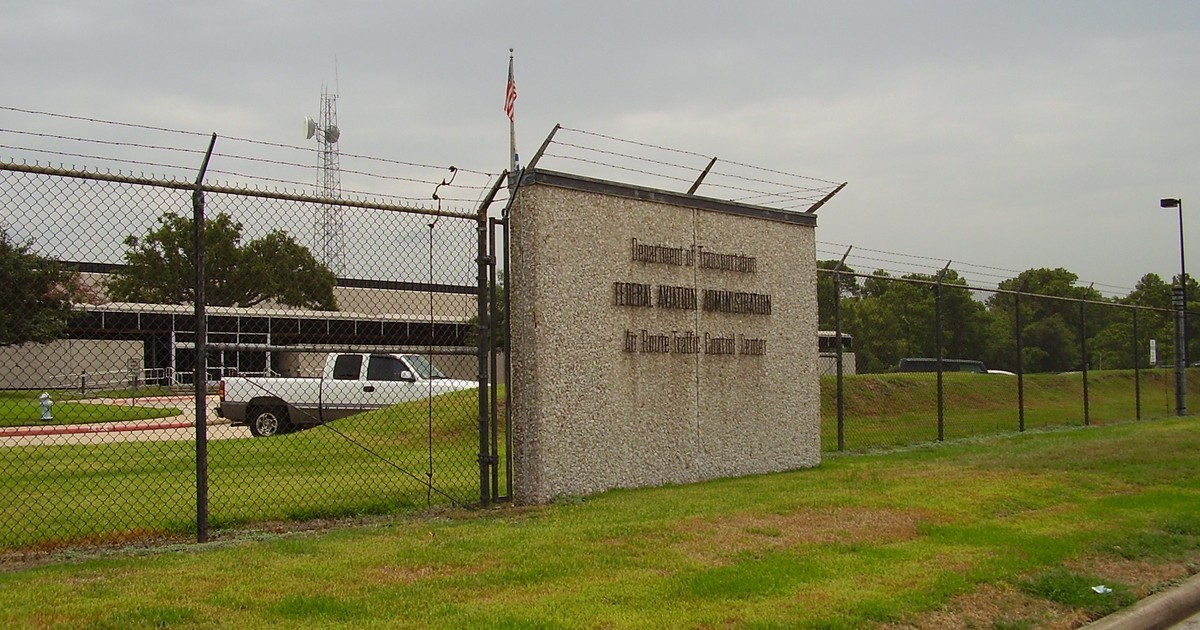
    Cover photo: WhisperToMe / Wikimedia Commons, public domain

    Sources

    [1] ABC News, “Nationwide ground stop lifted after more than 4 hours as Trump administration blames old, overloaded tech,” November 13, 2026. https://abcnews.com/US/nationwide-ground-stop-ordered-airports-faa/story?id=138121848

    [2] FAA, “Nationwide Ground Stop: Questions and Answers,” November 15, 2026 (the address of the FAA’s November 13 statement now redirects here). https://www.faa.gov/newsroom/nationwide-ground-stop-questions-and-answers

    [3] DOT Office of Inspector General, FAA’s Progress and Challenges in Meeting FTI Transition Goals, Report AV-2008-089, September 30, 2008. https://govinfo.gov/content/pkg/GOVPUB-TD-PURL-gpo27442/pdf/GOVPUB-TD-PURL-gpo27442.pdf

    [4] Yahoo News, “FAA ground stop latest updates,” live coverage, November 14 and 15, 2026 (headline updated during coverage). https://www.yahoo.com/news/us/live/faa-ground-stop-latest-updates-duffy-blames-contractor-l3harris-thousands-more-flights-canceled-saturday-no-sign-of-cyberattack-161329174.html

    [5] CBS News, “Travelers stranded and thousands of flights canceled after FAA ground stop. Here’s what we know,” updated November 15, 2026. https://www.cbsnews.com/amp/news/faa-ground-stop-canceled-flights-travelers-what-we-know/

    [6] U.S. Department of Transportation, “ICYMI: U.S. Transportation Secretary Sean P. Duffy Provides Update on Restoration of Airspace Following Nationwide Ground Stop,” November 14, 2026. https://www.transportation.gov/briefing-room/icymi-us-transportation-secretary-sean-p-duffy-provides-update-restoration-airspace

    [7] Fox Business, account of Duffy’s November 14 briefing on L3Harris, November 14, 2026. https://www.foxbusiness.com/fox-news-air-space/who-l3harris-federal-contractor-sec-duffy-says-may-have-caused-faa-outage

    [8] L3Harris, “L3Harris Reaches Over 50% in FAA Telecommunications Modernization,” May 11, 2026. https://www.l3harris.com/newsroom/editorial/2026/05/l3harris-reaches-over-50-faa-telecommunications-modernization

    [9] Andrew Tangel and Drew FitzGerald, “The Single Router in Southern Arkansas That Ground Air Travel to a Halt,” The Wall Street Journal, November 15, 2026 (republished by To Vima). https://www.tovima.com/wsj/the-single-router-in-southern-arkansas-that-ground-air-travel-to-a-halt

    [10] Quinn Scanlan, ABC News, “Transportation Secretary Duffy says ATC routers’ ability to broadcast data turned off, being investigated,” November 15, 2026. https://abcnews.com/Politics/transportation-secretary-duffy-atc-routers-ability-broadcast-data/story?id=138155545

    [11] FOX 4 Dallas-Fort Worth, “FAA ground stop: Routers in Texas, Arkansas being tested after outage,” November 15, 2026. https://www.fox4news.com/news/faa-ground-stop-routers-texas-arkansas-being-tested-after-outage

    [12] FCC Public Safety and Homeland Security Bureau, December 27, 2018 CenturyLink Network Outage Report, August 19, 2019. https://docs.fcc.gov/public/attachments/DOC-359134A1.pdf

    [13] GAO, Air Traffic Control Systems: Ambitious New Modernization Effort Needs to Improve Cost and Schedule Planning, GAO-26-107992, September 14, 2026. https://files.gao.gov/reports/GAO-26-107992/index.html

    [14] CNN, “US flight ground stop latest,” live coverage, November 15, 2026 (headline updated during coverage). https://www.cnn.com/2026/11/15/politics/live-news/trump-administration-ground-stop

    [15] Washington Technology, “FAA selects Verizon for $2.4B telecommunications contract,” March 2023. https://www.washingtontechnology.com/companies/2023/03/faa-selects-verizon-24b-telecommunications-contract/384517/

    [16] DOT Office of Inspector General, FAA’s Contingency Plans and Security Protocols Were Insufficient at Chicago Air Traffic Control Facilities, Report AV-2015-112, September 29, 2015. https://www.durbin.senate.gov/imo/media/doc/FAA%20contingency%20plans%20and%20security%20protocols%20at%20Chicago%20ATC%20facilities.pdf

    [17] SAM.gov, FAA Enterprise Network Services (FENS) award notice 693KA8-23-D-00010. https://sam.gov/opp/7e58b8f050ef40f59761aa3b334528a5/view

    [18] SAM.gov, FAA Enterprise Network Services (FENS) award notice 693KA8-26-D-00016 to AT&T, contract award date August 11, 2026, published August 12, 2026. https://sam.gov/opp/89275702a17c4bc4a1906fd596fe8828/view

    [19] Washington Technology, “FAA brings in AT&T for network modernization program,” August 2026. https://www.washingtontechnology.com/contracts/2026/08/faa-brings-t-network-modernization-program/415412/

    [20] MeriTalk, “FAA Awards AT&T $74M to Kick Off Network Overhaul,” August 14, 2026. https://meritalk.com/articles/faa-awards-att-74m-to-kick-off-network-overhaul/

    [21] Office of the State Fire Marshal and Illinois Commerce Commission Staff, Hinsdale Central Office Fire, Final Report, Executive Summary, March 1989. https://archive.decromancer.ca/vtda.org/docs/telephony/Ameritech/The_Hinsdale_Challenge_1988_Executive_Summary.pdf

    [22] UPI, “Bell puzzles over cause of crippling blaze,” May 9, 1988. https://www.upi.com/Archives/1988/05/09/Bell-puzzles-over-cause-of-crippling-blaze/6390579153600/ Archived copy: https://archive.ph/9A19S

    [23] TELECOM Digest, May 1988 issues on the Illinois Bell Hinsdale fire (archive). https://bio.nic.funet.fi/pub/mirrors/lcs.mit.edu/telecom-archives/TELECOM_Digest_Online/1309.html

    [24] RISKS Digest, Volume 12, Issue 62, November 12, 1991 (quoting the Associated Press, November 10, 1991). https://catless.ncl.ac.uk/Risks/12/62

    [25] UPI, “FCC orders AT&T to study communications system in wake of outage,” November 8, 1991. https://www.upi.com/Archives/1991/11/08/FCC-orders-ATT-to-study-communications-system-in-wake-of-outage/7189689576400/ Archived copy: https://archive.ph/mSFHD

    [26] UPI, “AT&T discloses cause of power failure,” September 20, 1991. https://www.upi.com/Archives/1991/09/20/ATT-discloses-cause-of-power-failure/8379685339200/ Archived copy: https://archive.ph/20261116200152/https://www.upi.com/Archives/1991/09/20/ATT-discloses-cause-of-power-failure/8379685339200/

    [27] GAO, Telecommunications: Interruptions of Telephone Service, RCED-93-79FS, March 5, 1993. https://www.gao.gov/assets/rced-93-79fs.pdf

    [28] eWeek, “FAA Flight-Plan System Crashes Again, Delays Hundreds of U.S. Flights,” November 19, 2009. https://www.eweek.com/storage/faa-flight-plan-system-crashes-again-delays-hundreds-of-u.s.-flights/

    [29] DOT Office of Inspector General, letter to Chairmen Oberstar and Costello on the November 19, 2009, FAA Telecommunications Infrastructure outage, June 17, 2010. https://www.oig.dot.gov/sites/default/files/WEB%20FILE2_FTI%20%20Nov%2019%20outage-6-18-10_Final%20Signature%28a%29%20%282%29.pdf

    [30] eWeek, “The Story Behind the FAA Flight-Plan System Crash,” November 20, 2009. https://www.eweek.com/networking/the-story-behind-the-faa-flight-plan-system-crash

    [31] CBS News, “Report slams FAA response to fire at Chicago air traffic facility,” September 30, 2015. https://www.cbsnews.com/news/report-slams-faa-response-to-fire-at-chicago-air-traffic-facility

    [32] Flying, “Newark Airport Suffers Another 90-Second Radar Outage,” May 2025. https://www.flyingmag.com/newark-airport-suffers-another-90-second-radar-outage/

    [33] Pete Muntean, Rene Marsh, TuAnh Dam, and Amanda Musa, CNN, via KVIA, “Newark Airport systems outage was ‘most dangerous situation,’ air traffic controller says,” May 6, 2025. https://kvia.com/cnn-national/2025/05/06/newark-airport-systems-outage-was-most-dangerous-situation-air-traffic-controller-says/

    [34] DOT Office of Inspector General, Audit Announcement, FAA’s Relocation of Newark-Area Terminal Radar Approach Control (TRACON) Responsibilities, Project No. 25A3005A000, July 28, 2025. https://www.oig.dot.gov/sites/default/files/library-items/Audit%20Announcement%20-%20FAA%20N90%20Review%207.28.25.pdf

    [35] Andrea Margolis and Grady Trimble, Fox Business, “Newark air traffic controllers lost radar, radio communications with planes for over a minute, sparking chaos,” May 5, 2025. https://www.foxbusiness.com/fox-news-travel/newark-air-traffic-controllers-lost-radar-radio-communications-planes-minute-sparking-chaos

    [36] Reuters via WHBL, “US FAA says error messages in telecommunications circuit prompted shift to backup on Sunday,” September 23, 2026. https://whbl.com/2026/09/23/us-faa-says-error-messages-in-telecommunications-circuit-prompted-shift-to-backup-on-sunday/

    [37] Airways, FAA Northeast ground stops and NJ Transit statement, September 2026. https://airwaysmag.com/new-post/faa-northeast-ground-stops-severed-fiber-philadelphia-tracon

    [38] AirlineGeeks, “ATC Outage Cancels, Delays Hundreds of Flights on East Coast,” September 21, 2026. https://airlinegeeks.com/2026/09/21/atc-outage-cancels-delays-hundreds-of-flights-on-east-coast/

    [39] Newsweek, Philadelphia TRACON outage and Verizon statement, September 21, 2026. https://www.newsweek.com/hundreds-of-flights-impacted-at-major-us-airports-over-equipment-failure-12469404

    [40] Associated Press via WSMV, “Flights disrupted across US Northeast due to technical problems at key air traffic center,” September 21, 2026. https://www.wsmv.com/2026/09/21/flights-disrupted-across-us-northeast-due-technical-problems-key-air-traffic-center/?outputType=amp

    [41] L3Harris, “FAA Telecommunications Infrastructure (FTI),” service page. https://www.l3harris.com/all-capabilities/fti-network-managed-services

    [42] FOX 4 Dallas, “Aviation expert says outdated infrastructure could cause more airport ground stops,” September 22, 2025. https://www.fox4news.com/news/dfw-love-field-ground-stop-experts

    [43] CBS Texas, “Outdated infrastructure is to blame for hours long ground stop at Dallas airports, FAA says,” September 20, 2025. https://www.cbsnews.com/amp/texas/news/outdated-infrastructure-faa-dallas-airport-ground-stops

    [44] Reuters via ARY News, “Dallas airports return to normal after over 2,000 flights disruption,” September 22, 2025. https://arynews.tv/dallas-airports-return-to-normal-after-over-2000-flights-disruption

    [45] FOX 9, “FAA head says billions more needed to modernize air traffic control,” September 16, 2026. https://www.fox9.com/news/faa-head-billions-modernize-air-traffic-control

    [46] The Air Current, “U.S. ends halt on flight departures after nationwide air traffic communications outage,” November 13, 2026. https://theaircurrent.com/feed/dispatches/u-s-halts-flight-departures-nationwide-on-air-traffic-communications-outage/

    [47] Kaia Hubbard, CBS News, “Ground stop proves ‘we have to get off old network,’ Transportation Secretary Sean Duffy says,” November 15, 2026. https://www.cbsnews.com/news/ground-stop-faa-telecom-network-sean-duffy-face-the-nation/

    [48] DISA, Enterprise Voice, Video, and Messaging Policy Security Requirements Guide, Version 1, Release 4, finding V-259917, December 23, 2025 (STIG Viewer). https://www.stigviewer.com/stigs/enterprise_voice_video_and_messaging_policy_security_requirements_guide/2025-05-29/finding/V-259917

    [49] FAA, Order JO 6000.36B, National Airspace System Service Survivability (cancels Order 6000.36A, Communications Diversity, 1995). https://www.faa.gov/regulations_policies/orders_notices/index.cfm/go/document.information/documentID/1037633

    [50] FAA, Order JO 6500.28, Radio Communications Requirements for Air Traffic Control Facilities. https://www.faa.gov/documentLibrary/media/Order/FAA_Order_JO_6500.28.pdf

    [51] 47 CFR § 4.9, Outage reporting requirements, threshold criteria (Legal Information Institute). https://www.law.cornell.edu/cfr/text/47/4.9

    [52] 47 CFR § 4.5, Definitions of outage, special offices and facilities, 911 special facilities, and 988 special facilities. https://www.law.cornell.edu/cfr/text/47/4.5

    [53] 47 CFR § 4.2, Availability of reports filed under this part (Legal Information Institute). https://www.law.cornell.edu/cfr/text/47/4.2

    [54] MPR News, “Flights resume at Minneapolis-St. Paul International Airport after ‘telecommunication issues’,” August 6, 2026. https://www.mprnews.org/story/2026/08/06/flights-halted-at-minneapolisst-paul-international-airport

    [55] MPR News, “Outage at Minneapolis data center behind last week’s telecommunications disruptions,” August 10, 2026. https://www.mprnews.org/story/2026/08/10/how-an-outage-at-unassuming-building-in-minneapolis-sent-waves-through-the-midwest

    [56] FCC, Facilitating Implementation of Next Generation 911 Services; Improving 911 Reliability, Second Report and Order, FCC 26-39, adopted June 25, 2026. https://docs.fcc.gov/public/attachments/FCC-26-39A1.pdf

    [57] FCC Public Safety and Homeland Security Bureau, “Public Safety and Homeland Security Bureau Encourages Communications Service Providers to Implement Important Network Reliability Practices,” Public Notice DA 20-1406, November 25, 2020. https://docs.fcc.gov/public/attachments/DA-20-1406A1.pdf

    [58] Data Center Frontier, “Nashville Explosion: AT&T Repairs Damage to its Building and Network,” December 2020. https://www.datacenterfrontier.com/featured/article/11428484/nashville-explosion-at038t-repairs-damage-to-its-building-and-network

    [59] CISA, “Telecommunications Service Priority: Priority for Emergency Communications.” https://www.cisa.gov/sites/default/files/publications/TSP%20Priority%20for%20Emergency%20Communications.pdf

    [60] NTIA, DOT\FAA 1755-1780 (Rev. 1), Freq-Geo Transition Timeline, FTI Last Mile Microwave for the Elwood ARSR, approved October 3, 2018. https://www.ntia.gov/sites/default/files/publications/releasable_dot_faa_1755-1780_rev-1_sufficient_10_26_2018_0.pdf

    [61] David Shepardson, Reuters, “US FAA not considering replacing L3Harris, Verizon contracts with Musk’s Starlink,” July 2025 (via Yahoo News). https://www.yahoo.com/news/us-faa-not-considering-replacing-161335458.html

    [62] RISKS Digest, Volume 10, Issue 62, “Telephone cable cut eliminates O’Hare tower communications,” November 19, 1990 (reprinting The New York Times, October 16, 1990). https://catless.ncl.ac.uk/Risks/10/62

    [63] RISKS Digest, Volume 10, Issue 75, “NY area fiber-optic telephone cable severed,” January 5, 1991. https://catless.ncl.ac.uk/Risks/10/75

    [64] Associated Press via Fox News, “FAA Outage Exposes Odd Computing Practices at Agency,” August 2008 (the page shows January 13, 2015). https://www.foxnews.com/story/faa-outage-exposes-odd-computing-practices-at-agency.print

    [65] Air University, “Air National Guard restores air traffic control in Puerto Rico,” October 2017. https://airuniversity.af.edu/News/Display/Article/1331249/air-national-guard-restores-air-traffic-control-in-puerto-rico

    [66] NOAA, “Federal collaboration yields radar coverage for Puerto Rico, USVI in wake of Hurricane Maria,” October 2017. https://www.noaa.gov/media-release/federal-collaboration-yields-radar-coverage-for-puerto-rico-usvi-in-wake-of-hurricane

    [67] CNN via ABC 17, “Nashville explosion causes AT&T outages and disrupts flight,” December 25, 2020. https://abc17news.com/news/national-world/2020/12/25/nashville-explosion-causes-att-outages-and-disrupts-flight/

    [68] Colorado Public Radio, “FAA investigating outage that interfered with communication between pilots and Denver air traffic control,” May 15, 2025. https://www.cpr.org/2025/05/15/faa-investigation-dia-air-traffic-control-outage/

    [69] Associated Press via WUSF, “Cut fiber line near Jacksonville briefly disrupts air traffic controllers around Southeast,” June 20, 2025. https://wusf.org/text/local-state/2025-06-20/cut-fiber-line-near-jacksonville-briefly-disrupts-air-traffic-controllers-around-southeast

    [70] AVweb, “Severed Fiber Line Disrupts Raleigh-Durham Flights,” October 13, 2026. https://avweb.com/aviation-news/severed-fiber-line-disrupts-raleigh-flight/

    [71] AVweb, report on fiber damage and the ground stop for Houston Intercontinental, October 14, 2026. https://www.avweb.com/aviation-news/severed-fiber-line-disrupts-houston-flight/

  • The FCC’s Chinese Carrier Bans Never Touched BGP

    The FCC’s Chinese Carrier Bans Never Touched BGP

    I work at a local ISP in Northern Illinois and have worked in internet infrastructure here for two decades. I co-founded FD-IX, an internet exchange. Before I joined, DNA Communications, where I am now CTO, bought IP transit from PCCW Global from 2008 to 2010.

    TL;DR

    • The FCC pulled Chinese carriers’ US licenses with section 214, a Title II telephone law, while saying in the same order that BGP routing, how networks tell each other which addresses they can reach, “is not a service subject to section 214 authority” [1].
    • In RIPE RIS, the RIPE NCC’s public collection of routing data, China Telecom Americas and China Unicom Americas still show the same four upstream neighbors each, and the international networks of China Telecom, China Unicom and China Mobile have two to three times as many BGP neighbors as when the FCC acted. Over the same years, ten other international carriers ranged from 35% fewer neighbors to 39% more [8][9][10].
    • Revocation ended China Telecom Americas’ authority to sell the private lines and VPNs behind the FCC’s passive-monitoring finding as common carriage. Its website offered them in the US until mid-2023; when its sales ended is not public. China Mobile’s US arm, which never held a license, sold or resold private lines and VPNs in 2025. China Telecom Americas’ routing stayed, and so did ten of its US PoPs, down from 23 in 2021 [1][3][64][65].
    • The revocations rested on state ownership, findings that the companies could not be trusted and, for China Telecom, Pacific Networks and ComNet, broken security agreements. Other breaches of security agreements, by companies no foreign adversary controls, ended in payments: Marlink, a satellite operator, agreed to pay $175,000 to settle with the FCC, and CFIUS fined T-Mobile $60 million [1][17][18][24][36].
    • In January 2025, the Sixth Circuit set aside the FCC’s 2024 broadband order, which claimed power over whom ISPs exchange traffic with. The FCC’s last document on its 2024 BGP proposal is a September 2024 notice. Its newest rule maps land crossings to Canada and Mexico and filters nothing, and its pending interconnection proposal never mentions peering or IP transit [2][7][19][22][42][50].

    Section 214 is a telephone law, not a BGP rule

    Washington used telephone law against Chinese carriers it describes in internet terms: hijacked routes, traffic detoured through China, points of presence inside US networks. Section 214 sits in Title II of the Communications Act, the common-carrier rules written for the phone network. It licenses carriers to provide regulated telecom service.

    The FCC knows the difference. Its 2021 order against China Telecom Americas says “while interdomain routing, as supported by BGP, is not a service subject to section 214 authority, it is critical in supporting various services that may require such authority” [1]. In the same order, it says “forwarding of IP traffic and BGP routing do not require section 214 authority and could continue to be offered by CTA or CT irrespective of section 214 authority” [1]. Then it devotes a paragraph to BGP hijacking and route leaks as evidence in the case for revocation, not as something revocation would fix, noting that new tools make detecting false origins “increasingly feasible, but their deployment is limited” [1].

    What the revocations actually rested on

    The FCC denied China Mobile USA an international license in 2019 [4]. In 2021, it revoked China Telecom Americas’ domestic and international authority on ownership, candor, and compliance findings, and in 2022 it revoked the authority of China Unicom Americas, Pacific Networks, and ComNet [1][36][24]. HKT and PCCW agreed in October 2026 to exit all 214 services by September 1, 2027, with no admission and no finding against them; the decree says nothing about PCCW Global’s IP transit or peering [5].

    The FCC terminated China Telecom Americas’ international authority on its “willful violation of two of the five provisions” of a 2007 letter of assurances with the Executive Branch agencies [1]. It also found inaccurate statements to the Commission and other agencies, and noncompliance with its requirements for international signaling point codes, the SS7 gateway addresses its International Bureau reclaimed in November 2020 [1]. The D.C. Circuit held that the agreement breach “independently supports” revocation [14].

    China Unicom Americas, which had no security agreement to break, lost its authority on state ownership, Chinese law obligating its parents to cooperate with the government, a lack of candor, and a finding that mitigation would not work [36]. The Ninth Circuit upheld the revocation 2-1 in December 2024, over a dissent arguing the Act gives the FCC no power to revoke a 214 on its own [37]. Pacific Networks and ComNet lost theirs on similar grounds plus a breach of their 2009 letter of assurances, and the D.C. Circuit upheld the revocation in August 2023 [24][38].

    Those findings are real. The harms the FCC tied to the license itself fall on the license’s own customers. CTExcel, China Telecom Americas’ mobile reseller, held US subscriber records and SIM provisioning [1]. It had to stop service by January 3, 2022 [16]. The FCC also listed international private lines and MPLS VPNs among the services that “appear to be offered pursuant to CTA’s section 214 authority” [1]. With those, the FCC said, the company “can monitor, observe, and collect traffic sent to and/or from its customers,” including content on private lines where customers had not added their own end-to-end encryption [1]. And the Executive Branch agencies warned that, through least-cost routing, US agencies’ international calls could cross a licensed carrier’s network even when the agencies were not its customers [4].

    For Pacific Networks and ComNet, the FCC said outright that the companies “appear not to have the ability to misroute communications using Border Gateway Protocol (BGP).” Its concern was their ability to “access, monitor, store, and in some cases disrupt and/or misroute U.S. communications” [24].

    The government-calls risk is the weakest of these. Least-cost routing can send a government call bound for an ally across a Chinese carrier that no agency chose, but that is a procurement problem. The government can write a clause into the carrier contracts it already pays for that bars those carriers from handing its calls to a named network. It already bars contractors that rely on Huawei or ZTE gear in any of their systems, even outside government work, so the clause would be one more term of the same kind [70]. The customer-data risk is narrower than it sounds: CTExcel marketed to Chinese Americans, Chinese students and visitors, and Chinese enterprises, people who chose a carrier owned by the Chinese state. The private-line risk falls on enterprises that bought circuits from a Chinese state carrier and sent traffic over them unencrypted. As for calls to China, Chinese carriers were always going to handle them, and the FCC itself said US customers “generally have many low-cost options for international calls, including to China” [1].

    What the revocations left untouched

    I pulled RIPE RIS data for every licensed company and for each group’s international network, and apart from ComNet, the networks kept their BGP neighbors. RIS sees an adjacency only when paths reach its collectors, so it cannot show that a link is gone.

    Quick Compare: the licensed companies’ own networks (RIPE RIS)

    NetworkASNUpstream neighbors at revocationNov 2026
    China Telecom AmericasAS36678Lumen, Arelion, ChinaNet, CN2Same four
    China Unicom AmericasAS19174Cogent, Lumen, Verizon, China UnicomSame four
    ComNetAS14923Cogent, GTT, CITICSame three in Dec 2022; gone by mid-2023

    Quick Compare: the groups’ international networks (RIPE RIS neighbor counts)

    NetworkASNWhen the FCC acted2026
    China Telecom GlobalAS23764215 (Oct 2021)641 (Nov)
    China Unicom GlobalAS10099128 (Jan 2022)277 (Nov)
    China Mobile InternationalAS58453247 (May 2019)707 (Nov)
    PCCW GlobalAS3491725 (Oct 2025)692 (Nov)

    Sources: [8][9][10][25][26][55]. Upstream neighbors are RIS’s left neighbors, the networks that pass each company’s routes toward the collectors; RIS does not say which are transit providers and which are peers. ComNet and Pacific Networks named their ASNs in their own 2021 filing; since April 2024, ARIN has listed ComNet’s under a different company, Graham Technology Solutions. Pacific Networks said AS4058 belonged to a wholesale customer, which PeeringDB lists as CITIC Telecom International CPC; that network had 57 neighbors at revocation and 69 now [25][26]. The counts in the second table are global and move from week to week; China Mobile International’s was 995 on September 25. The rise far outpaces RIS’s own growth and that of other carriers: RIS had 576 IPv4 peers in May 2019, 765 in October 2021 and 786 in November 2026, and over the same periods NTT, Tata, Telstra, GTT, KDDI, KT, Singtel, HGC, Sparkle and Arelion, most of them far larger, ranged from 35% fewer neighbors to 39% more [10].

    China Telecom Americas did shrink. It originated 15 prefixes at revocation and five now, all valid under RPKI, the system that records which network may originate a block of addresses [10]. It went from 23 US points of presence in 2021 [1] to ten across seven metro areas in the records it gave the House committee in 2025, and it told the committee it has “free peering arrangements in the U.S. with major ISPs” [3]. Settlement-free peering is not a common-carrier telecom service, and the FCC said BGP routing could continue “irrespective of section 214 authority” [1].

    Losing the license did not end those arrangements. The parent’s backbone, ChinaNet (AS4134), had adjacencies with Cogent, Lumen, Hurricane Electric, NTT America, GTT, Zayo, Verizon, Arelion and Tata at the 2021 vote and still has them [10]. ComNet’s routes stayed up with the same upstreams for most of a year after its revocation and were gone by mid-2023. A House select committee put it plainly in 2026: existing law “did not require them to remove infrastructure or terminate peering or interconnection relationships” [3].

    The advertising outlasted the license. In December 2021, China Telecom Americas told the FCC it would keep offering its business services “on a private-carrier basis” after the deadline, and Chairwoman Jessica Rosenworcel replied that staff would “pursue all available remedies” [62][63]. Whether a service is private carriage is, the FCC says, “a fact-based inquiry”: section 214 reaches telecom offered to the public or to classes of users broad enough to make it effectively public, and “minor differences in price or other terms of service” do not make it private [19]. Archived copies of its product pages offered US coverage for private lines and IP-VPN as late as May 2023 [64]. Since a mid-2023 redesign, they have said “Coverage not available in US,” and the IP-VPN page adds that a carrier-built MPLS VPN “is not available in the US” [39][64]. I found no public record of when its US sales of those services ended. The House committee called a 214 order “strictly a commercial sales license” [3].

    The orders’ strongest internet claim, the passive-monitoring finding, is about those services, not BGP. It covered traffic sent to or from the company’s own customers on them; for MPLS VPNs, it added that the company could derive metadata and attempt to decrypt encrypted traffic [1]. Revocation did not close every PoP: China Telecom Americas still reported ten in 2025, and China Mobile International’s US arm, denied a license in 2019, lists “39 U.S. PoP entries” [3]. A PoP sees the traffic routed to it or through it, nothing else.

    The FCC knows the business continued. In March 2025, Chairman Carr opened an investigation into Covered List companies, saying there was “reason to believe” some were “continuing to do business in America on a private or ‘unregulated’ basis” [48]. China Telecom Americas said as much in its June 2026 comments: since revocation, it has provided “a more limited set of information and private carrier services,” and it is “peered with more than 30 Tier 1 and Tier 2 U.S. ISPs” [49]. It told the House committee it “currently provides exclusively enterprise and carrier business services in the U.S.” [3]. China Unicom Americas told the FCC its services “are limited to internet interconnection” and that it “no longer routes or transmits telecommunications traffic within or through the United States” [53].

    In June 2025, the FCC’s Enforcement Bureau cited China Mobile International’s US arm for incomplete answers about its US business. The company “sells or resells” international Ethernet private lines, MPLS VPNs, IP transit and dedicated internet access, the Bureau wrote, and because it holds no FCC authorization, the law required a citation before any fine [65].

    Stretching phone law over the internet, for everyone

    The FCC’s next answers aimed at every US broadband provider, through the same telephone law.

    The 2024 Open Internet order reclassified broadband as a Title II telecommunications service. Among its stated benefits: it “will enable the Commission to exercise authority when necessary to prohibit a BIAS provider from exchanging internet traffic with third parties that present threats to U.S. national security and law enforcement, such as CTA” [6]. The Sixth Circuit held that broadband is “only an ‘information service’” and set the whole order aside on January 2, 2025 [7].

    The 2024 BGP rulemaking proposed routing security plans for broadband providers and rested on the same footing: Title II, wireless license conditions, section 706 of the Telecommunications Act of 1996 and the Communications Assistance for Law Enforcement Act (CALEA) [22]. Title II is gone. In 2025, the FCC called its own January 2025 CALEA ruling “unlawful” because it adopted “an erroneously broad reading of section 105 of CALEA” [23]. As of November 10, 2026, the FCC’s last document in that rulemaking is a September 2024 notice on ex parte rules [50].

    The 2026 interconnection proposal, FCC 26-29, tries again. It concedes that IP-based services and facilities “are not covered by section 214(a) as currently interpreted, except as specifically extended by the Commission through additional authority” [2]. Its first proposal would strip blanket domestic 214 authority from every Covered List company and its current and future affiliates; the 2021 and 2022 revocations had left the affiliates’ authority in place [2]. The FCC grants that section 214 “generally addresses only common carrier telecommunications services,” so that proposal alone would not end anyone’s peering [2]. Then it asks whether carriers should be barred from interconnecting with Covered List companies, including at “Points of Presence (PoPs) and data centers,” tentatively calling such interconnection an unreasonable practice under section 201(b) and reading the section 251(a) duty to interconnect as not reaching them, without mentioning peering or IP transit [2][42]. CTIA, the wireless industry’s trade group, told the FCC that peering and transit at PoPs “fall outside the scope of Section 201” [41]. China Telecom Americas argued there is “no evidence that an entity on the Covered List has any means of affecting the networks with which it is interconnected, or their customers” [49].

    The international 214 order, adopted October 29 and released November 5, 2026, follows the same habit [19]. It rests on section 214(a) and (c), which let the FCC put conditions on a carrier’s license; on section 201(b), which bans unjust and unreasonable carrier practices; and on section 4(i), the FCC’s general powers [19]. CTIA, Verizon and others objected that collecting information on facilities used for non-common-carrier services exceeds section 214. The FCC answered that it “is not directly regulating non-common carrier services, but rather, is requiring this information in connection with its regulation of common carrier services” [19]. The phone license is the hook again.

    The order requires applicants for facilities-based authority, and every existing holder through a one-time filing, to report each facility that crosses “the U.S.-Mexico border or U.S.-Canada border over land.” That includes the IP prefixes and AS numbers it carries, whether it sits in a data center, and whether the US side is public or private peering; applicants that only resell name their wholesale providers instead [19]. That duty reaches every international 214 holder, including US-owned ones. Submarine cables, including short ones under the Rio Grande and through a tunnel under the Detroit River, already need cable landing licenses [19].

    Chairman Carr’s statement says these border facilities “are often directly exposed to cartels and other hostile foreign actors looking to gain access to U.S. networks” [19]. For foreign-adversary presence, the order points to news reports of China Unicom’s 30-year Mexican license and Huawei’s growth in Mexico [19]. Verizon’s view, quoted in the order, is that Canada and Mexico are “two close U.S. partners whose security interests regarding cross-border facilities are directly aligned” [19].

    For routing, the order gives the FCC a confidential map of land crossings. It does not filter a route or require anyone to end a peering session, and it leaves out submarine cables such as New Cross Pacific, a US-China system whose landing license names China Telecom, China Unicom and China Mobile [56]. A rule presuming companies controlled by a foreign adversary unfit for an international 214 is still only a proposal [19][20].

    The same kinds of conduct, treated differently

    License actions have not tracked routing behavior.

    Routing incidents with no license consequence. The Internet Society counted 13,935 routing incidents in 2017, 38% of them leaks, hijacks, and other attacks, and wrote that “U.S. and Brazil, followed by Russia and China, lead the list of countries in which networks caused incidents” [12]. Those are raw counts, which track how many networks a country has. In 2019, a BGP optimizer at DQE generated more-specific routes that DQE’s customer Allegheny Technologies passed to Verizon, which announced them to the internet; Cloudflare lost about 15% of its global traffic at worst and wrote, “If Verizon had used RPKI, they would have seen that the advertised routes were not valid” [27]. In April 2020, Rostelecom, Russia’s largest ISP and partly state-owned, announced 8,870 prefixes belonging to almost 200 networks, including Akamai, Cloudflare, and Amazon AWS, for about an hour; Rascom, then Cogent and Level3, carried them onward [28][57]. ICFS shows no application from Rostelecom, so there was no international 214 to revoke [58].

    On February 24, 2008, PCCW Global passed Pakistan Telecom’s hijack of a YouTube prefix to the rest of the internet for two hours and 14 minutes [40]. The FCC’s 2025 show-cause order against HKT and its PCCW Global units cites no routing incident at all. Its routing questions ask which AS numbers the companies use, whether they run BGP, and whom they peer with at US PoPs [35]. The FCC’s own 2021 order concedes the point: “any service provider has the opportunity to engage in traffic path diversions or intentional misrouting,” but “other such providers are not identified like CTA” [1].

    Agreement breaches, settled with payments. In January 2026, the FCC took its first-ever enforcement action on a Team Telecom mitigation agreement against Marlink, a satellite operator that “failed to submit at least 186 foreign employees for DOJ vetting.” Marlink agreed to pay $175,000 [17]. In 2024, CFIUS fined T-Mobile $60 million because it “failed to take appropriate measures to prevent unauthorized access to certain sensitive data” and “failed to report some incidents of unauthorized access promptly to CFIUS” under its national security agreement [18]. China Telecom Americas lost its licenses partly for breaching its agreement. These are not matched cases: neither company is controlled by a foreign adversary, and T-Mobile’s agreement was with CFIUS, not Team Telecom.

    Foreign state ownership, licensed. “Foreign government control of a U.S. carrier in and of itself is not grounds for denial,” the FCC wrote in 2019, citing licenses held by carriers owned by the governments of Indonesia, Aruba and French Polynesia [4].

    Same Chinese law, no license, no action. In PeeringDB, Alibaba lists 1,300G of ports at US exchanges and Tencent 400G, against 30G for ChinaNet [29]. Both are subject to the same Chinese laws. Neither has applied for an international 214 [58], and the 2026 interconnection proposal reaches only Covered List companies unless the FCC widens it to every company it counts as controlled by a foreign adversary, which it asks about [2].

    State-carrier control, no license. China Mobile Hong Kong, which the FCC ordered in December 2025 to fix its robocall filing, took control of HKBN, a Hong Kong broadband provider, in September 2025 and held about 74.84% of it in May 2026 [51][66][67]. HKBN and its enterprise arm list ports at Equinix Los Angeles, Any2West, and Equinix New York [29]. The enterprise arm files in the Robocall Mitigation Database so US carriers can take its voice traffic directly; neither company holds an FCC authorization [58][68]. FCC 26-29’s first proposal would reach listed companies’ current and future affiliates, which, as written, would take in HKBN as part of the China Mobile group [2]. PCCW, which held licenses, drew a show-cause order that cited China Unicom’s 18% stake [35].

    A private owner’s passport. In July 2026, the FCC denied Digitalsystem Technology’s application, and its international services went on the Covered List the same day [30][59]. It has no state owner. The FCC found it subject to Chinese government control through its majority owner, a Chinese citizen who lives in the US. It also cited the company’s Hong Kong partners, its plans for US records and doubts that it would keep a mitigation agreement, and said citizenship alone is not disqualifying [30].

    The Chinese intrusions on record came through other doors. Salt Typhoon, the Chinese campaign inside US telecom networks [3], got in through US carriers’ own network equipment, in most cases with legitimate login credentials [31]. For signaling attacks on US mobile subscribers, mostly while they traveled abroad, a researcher found China the largest source in 2018, with the vast majority of its attacks routed through China Unicom. In 2019, he said, most attacks over 3G networks came from Barbados while China’s volume fell, which he read as likely use of Caribbean proxy networks. China Unicom denied it [32].

    The House select committee’s report says the carriers’ remaining footprint “could have facilitated” Salt Typhoon; its chairman’s October 27 letter to the FCC drops the “could have” [3][54]. The evidence is routing. China Mobile International’s AS58453 appeared in the routing paths to 58 prefixes tied to CISA-confirmed Salt Typhoon servers “at least 192 times” over four days in September 2024, and the committee says the patterns “do not definitively attribute the underlying cyber campaign to the company” [3]. AS58453 is China Mobile’s global network from the second table; the 2019 denial of its US arm’s application did not touch its routing.

    What actually fixes route leaks

    The fix is filtering by the networks that accept the routes.

    Doug Madory, then at Oracle, spent months in 2017 cleaning up a China Telecom detour that sent “US-to-US traffic via mainland China.” It began as “a peer leak” by South Korea’s SK Broadband that China Telecom passed on, with the origin unchanged. When Telia and GTT stopped accepting those routes from China Telecom, the footprint fell by 90%. It “couldn’t prevent them from reaching those who were peering directly with China Telecom” [11]. He declined to address motive.

    Route origin validation would not have caught that one, because the origin was correct. Checks on the AS path are built for leaks like it: peer locking, which dates to 2016, and ASPA, a newer check that is still an IETF draft. Origin validation is older; the IETF standardized it in 2013 [45][46][69]. On APNIC Labs’ 28-day average, networks that drop RPKI-invalid routes served 40.5% of US users when the FCC voted on China Telecom Americas in October 2021, 72.7% at the October 2024 peak, and 53.1% on November 2, 2026 [47]. That measure covers origin validation only.

    RPKI is a fix Qrator called for after Rostelecom’s leak, and Cloudflare said it would have shown Verizon the leaked routes were invalid [28][27]. On September 28, 2026, 47.9% of US routed IPv4 addresses were in RPKI-valid routes, against 65.0% worldwide and 83.0% in China, up from 3.7% a year earlier [33]. Without the Department of Defense, which began announcing most of its space in 2021 to watch for misuse, the US figure would be 62% [33]. By address count, the US holds 59.1% of the world’s routed IPv4 space outside valid routes [33].

    The agencies that recommended the revocations want rules for everyone. DoD and DOJ told the FCC in 2022 that RPKI “can help mitigate this risk,” that requirements to report peering and interconnection partners and to audit routing “may also be necessary and appropriate,” and that, while their actions in license reviews “addressed the specific national security concerns raised in each case,” they “doubt that a license-by-license, case-by-case approach is the most effective way to address the industry-wide issue of BGP vulnerabilities.” Case-by-case activity, they wrote, is “the least desirable way to address systemic risks” [13].

    Same owners, new policy

    China Telecom’s ultimate owner, the Chinese state, never changed; the FCC’s view of it did. The FCC first licensed China Telecom in the US on July 20, 2001, granting the authorization to the state-owned parent itself, China Telecommunications Corporation, which still sat atop CTA’s ownership chain when the license was revoked in 2021 [1]. The FCC called ownership and control the “fundamental concerns in this proceeding” and pointed to “the changed national security environment with respect to China since the Commission authorized CTA” [1].

    PCCW shows the same thing over a longer span. The FCC granted all twelve of PCCW’s international authorizations from 1998 to 2003 [35]. China Netcom, a Chinese state carrier later merged into China Unicom, held a 20% stake in PCCW by mid-2005 [21][60]. The FCC moved 20 years later. Its October 2025 show-cause order rested on ownership. It said “the Commission’s findings in the CUA Order on Revocation indicate that any affiliate of CUA poses a threat,” and treated China Unicom’s roughly 18% stake as a “dominant minority” under a 10% threshold from the FCC’s 2025 submarine cable rules [35]. It counted Hong Kong as part of China, a foreign adversary, citing Commerce’s list and a 2020 executive order ending Hong Kong’s preferential treatment [35]. It added that even without that stake, HKT, “as a company with substantial ownership by PRC interest holders and primary operations in the PRC,” which for HKT means Hong Kong, would still be exposed to exploitation by the Chinese government [35]. It made no finding about PCCW’s own conduct, saying only that HKT’s conduct and representations “may require” a separate review of its character and citing an open staff inquiry into its answers to a 2023 information collection [35]. The trigger was a 2022 finding about China Unicom and 2025 rules.

    The strongest argument against this piece is that something changed on China’s side too. The D.C. Circuit noted that China’s 2017 Cybersecurity Law “requires Chinese companies to cooperate with state agencies on cybersecurity supervision and inspection,” and that a 2018 regulation lets the Ministry of Public Security conduct “on-site and remote inspections” of Chinese telecom companies [14]. Both came after the licenses were granted. That is a fair reason to reassess. But the timing follows Washington more than Beijing. The law is nearly ten years old. The revocations came four to five years after it and the PCCW order eight. DoD and DOJ dated the change themselves: by 2019, they wrote, the national security picture “had changed dramatically,” with cyber issues at the top of that year’s intelligence threat assessment [13]. And the law binds the owner, whatever licenses it holds. It binds Alibaba and Tencent too, whose US networks no license reaches.

    What’s coming

    Voice gets voice tools. In December 2025, the FCC ordered China Telecom Global, China Mobile Hong Kong and China Unicom Hong Kong to fix their Robocall Mitigation Database filings and show why they should not be removed [15][51][52]. Removal would stop US providers from accepting their calls directly when the calls carry a US number in the caller ID field [15]. The FCC’s tentative agenda for its meeting on November 19, 2026, includes “Securing Phone Numbers Against National Security Threats” [34][61]. The public draft covers interconnected VoIP providers with direct access to US phone numbers and would make them certify that they are not on the Covered List and do not use equipment or services from listed producers, or explain, and that they have never been denied a 214 or had one revoked on national security or law enforcement grounds [44]. These fit a telephone concern, and they reach Hong Kong companies that never held a 214 [58].

    FCC 26-29. If adopted as written, the interconnection ban binds telecommunications carriers. Whether it reaches an ISP’s peering session is the open question. NTCA, the rural carriers’ association, told the FCC the proposal “fails to indicate whether any prohibited connections with other entities would extend beyond formal interconnection agreements and include peering, transit arrangements, cloud services, or even connections to content delivery networks” [43].

    What this means for your network

    No FCC action requires you to drop a BGP session with any network named here; whether to keep one is your call. Route leaks, interception, and intrusion can come from any network, so the defenses (AS-path and origin filtering, encryption, locked-down management) apply to all of them. The FCC paperwork that applies to you does not depend on who you peer with. The companion piece, “What Actually Protects Your Network, and What the FCC Actually Requires,” covers the defenses and the filings.

    Cover photo: Owen CL / Wikimedia Commons (via Unsplash), CC0

    Sources

    1. FCC, China Telecom (Americas) Corp., Order on Revocation and Termination, FCC 21-114 (Nov 2, 2021), paras. 2, 7, 8, 71, 72, 82, 83, 86, 92, 100, 116, 142 and 155 and fns. 19 and 391. https://docs.fcc.gov/public/attachments/FCC-21-114A1_Rcd.pdf
    2. FCC, Protecting Against National Security Threats in Domestic Telecommunications Service, Notice of Proposed Rulemaking, FCC 26-29, WC Docket No. 26-82 (adopted Apr 30, 2026), paras. 6, 10, 14 and 15 and fns. 23, 24 and 28. https://docs.fcc.gov/public/attachments/FCC-26-29A1.pdf
    3. House Select Committee on the CCP, “Stranger Pings” (Aug 2026), pp. 3, 6, 14, 16 to 18, 21, 29 and 30; the committee’s report page links the PDF. https://chinaselectcommittee.house.gov/media/reports/stranger-pings-chinese-telecom-companies-infiltrate-us-infrastructure and https://files.constantcontact.com/f0eecb46901/f655c442-2d93-45ea-8cab-9d58a3a04052.pdf
    4. FCC, China Mobile International (USA) Inc., Memorandum Opinion and Order, FCC 19-38 (May 2019), paras. 20 and 29 and fn. 64. https://docs.fcc.gov/public/attachments/FCC-19-38A1.pdf
    5. FCC, HKT (International) Limited et al., Order and Consent Decree, DA 26-1163 (Oct 30, 2026). https://docs.fcc.gov/public/attachments/DA-26-1163A1.txt
    6. FCC, Safeguarding and Securing the Open Internet, FCC 24-52, 89 FR 45404 (May 22, 2024), Federal Register doc. 2024-10674. https://www.govinfo.gov/content/pkg/FR-2024-05-22/pdf/2024-10674.pdf
    7. Ohio Telecom Ass’n v. FCC, No. 24-7000 (6th Cir. Jan 2, 2025). https://www.opn.ca6.uscourts.gov/opinions.pdf/25a0002p-06.pdf
    8. RIPEstat, AS36678 neighbours, Nov 8, 2026. https://stat.ripe.net/data/asn-neighbours/data.json?resource=AS36678&query_time=2026-11-08T00:00:00
    9. RIPEstat, AS19174 neighbours, Jan 27, 2022 and Nov 8, 2026. https://stat.ripe.net/data/asn-neighbours/data.json?resource=AS19174&query_time=2022-01-27T00:00:00 and https://stat.ripe.net/data/asn-neighbours/data.json?resource=AS19174&query_time=2026-11-08T00:00:00
    10. RIPEstat data API, queried Nov 3 to 10, 2026. Unique neighbor counts (asn-neighbours) for AS23764 (https://stat.ripe.net/data/asn-neighbours/data.json?resource=AS23764&query_time=2021-10-26T00:00:00 and https://stat.ripe.net/data/asn-neighbours/data.json?resource=AS23764&query_time=2026-11-08T00:00:00), AS10099 (https://stat.ripe.net/data/asn-neighbours/data.json?resource=AS10099&query_time=2022-01-27T00:00:00 and https://stat.ripe.net/data/asn-neighbours/data.json?resource=AS10099&query_time=2026-11-08T00:00:00), AS58453 (https://stat.ripe.net/data/asn-neighbours/data.json?resource=AS58453&query_time=2019-05-09T00:00:00 and https://stat.ripe.net/data/asn-neighbours/data.json?resource=AS58453&query_time=2026-11-08T00:00:00) and AS3491 (https://stat.ripe.net/data/asn-neighbours/data.json?resource=AS3491&query_time=2025-10-15T00:00:00 and https://stat.ripe.net/data/asn-neighbours/data.json?resource=AS3491&query_time=2026-11-08T00:00:00); the same query at the dates in the notes for AS14923 and AS4058, and on Nov 10, 2026 at the same dates for the controls AS2914, AS6453, AS4637, AS3257, AS2516, AS4766, AS7473, AS9304, AS6762 and AS1299; RIS peer counts (ris-peer-count) at the same dates (https://stat.ripe.net/data/ris-peer-count/data.json?starttime=2021-10-26T00:00&endtime=2021-10-26T00:00); asn-neighbours-history for AS4134 (https://stat.ripe.net/data/asn-neighbours-history/data.json?resource=AS4134); and announced-prefixes and rpki-validation for AS36678 (https://stat.ripe.net/data/announced-prefixes/data.json?resource=AS36678&starttime=2021-10-26T00:00:00&endtime=2021-10-27T00:00:00 and the two weeks to Nov 10, 2026, when all five prefixes were RPKI-valid).
    11. Doug Madory, “China Telecom’s Internet Traffic Misdirection,” Oracle Internet Intelligence (Nov 5, 2018), archived copy. https://web.archive.org/web/20190718193106/https://blogs.oracle.com/internetintelligence/china-telecoms-internet-traffic-misdirection
    12. Internet Society, “14,000 Incidents: A 2017 Routing Security Year in Review” (Jan 9, 2018). https://www.internetsociety.org/blog/2018/01/14000-incidents-2017-routing-security-year-review/
    13. DoD and DOJ, Comments, PS Docket 22-90 (Sept 14, 2022), pp. 4, 5 and 10. https://www.fcc.gov/ecfs/document/1091496862125/1
    14. China Telecom (Americas) Corp. v. FCC, No. 21-1233 (D.C. Cir. Dec 20, 2022). https://media.cadc.uscourts.gov/opinions/docs/2023/01/21-1233-1981233.pdf
    15. FCC Enforcement Bureau, China Telecom Global Ltd., Order, DA 25-1022 (Dec 8, 2025), para. 11. https://docs.fcc.gov/public/attachments/DA-25-1022A1.txt
    16. FCC, CTExcel consumer guide (Nov 12, 2021). https://www.fcc.gov/sites/default/files/cta_consumer_guide.pdf
    17. FCC, Marlink news release (Jan 8, 2026). https://docs.fcc.gov/public/attachments/DOC-417571A1.pdf
    18. Committee on Foreign Investment in the United States, Enforcement (2024 penalty, T-Mobile US, Inc.). https://cfius.gov/monitoring-enforcement/enforcement/
    19. FCC, Review of International Section 214 Authorizations, Report and Order and Further Notice, FCC 26-74 (adopted Oct 29, released Nov 5, 2026), paras. 17 to 24, 32, 35, 39, 40, 124 to 126, 159 to 164 and 192, n. 151, and Chairman Carr’s statement (DOC-426302A2). https://docs.fcc.gov/public/attachments/FCC-26-74A1.pdf and https://docs.fcc.gov/public/attachments/DOC-426302A2.pdf
    20. FCC, “FCC Bolsters Security for Cross-Border Communications,” news release (Oct 29, 2026). https://docs.fcc.gov/public/attachments/DOC-426302A1.pdf
    21. PCCW Limited, Form 6-K enclosing circular dated July 8, 2005, appendix on substantial shareholders (China Netcom, 20.00% as of June 28, 2005). https://www.sec.gov/Archives/edgar/data/0000842519/000095010305001722/jul1205_6k.htm
    22. FCC, Reporting on Border Gateway Protocol Risk Mitigation Progress, Notice of Proposed Rulemaking, FCC 24-62 (June 7, 2024), paras. 99 to 104. https://docs.fcc.gov/public/attachments/FCC-24-62A1.pdf
    23. FCC, Protecting the Nation’s Communications Systems From Cybersecurity Threats, Order on Reconsideration, FCC 25-81 (Nov 21, 2025), para. 23. https://docs.fcc.gov/public/attachments/FCC-25-81A1.txt
    24. FCC, Pacific Networks Corp. and ComNet (USA) LLC, Order on Revocation and Termination, FCC 22-22 (Mar 2022), paras. 2 and 80. https://docs.fcc.gov/public/attachments/FCC-22-22A1.pdf
    25. Pacific Networks Corp. and ComNet (USA) LLC, Response to Order Instituting Proceeding, GN Docket 20-111 (Apr 2021), pp. 60 to 61. https://www.fcc.gov/ecfs/document/1042975287198/1
    26. PeeringDB, networks named CITIC. https://www.peeringdb.com/api/net?name__contains=CITIC&depth=0
    27. Cloudflare, “How Verizon and a BGP Optimizer Knocked Large Parts of the Internet Offline Today” (June 24, 2019). https://blog.cloudflare.com/how-verizon-and-a-bgp-optimizer-knocked-large-parts-of-the-internet-offline-today/
    28. Qrator Labs, “This is how you deal with route leaks” (Apr 2, 2020). https://blog.qrator.net/en/how-you-deal-route-leaks_69/
    29. PeeringDB, exchange port records (netixlan) for AS45102 (Alibaba), AS132203 (Tencent), AS4134 (ChinaNet), AS9269 (HKBN) and AS9381 (HKBN Enterprise Solutions), port speeds summed for US exchanges (checked Nov 8, 2026). https://www.peeringdb.com/api/netixlan?asn__in=4134,45102,132203,9269,9381
    30. FCC, Digitalsystem Technology Inc., Memorandum Opinion and Order, FCC 26-44 (adopted June 30, released July 7, 2026), paras. 1, 4, 10 and 14. https://docs.fcc.gov/public/attachments/FCC-26-44A1.pdf
    31. Cisco Talos, “Weathering the storm: In the midst of a Typhoon” (Feb 20, 2025). https://blog.talosintelligence.com/salt-typhoon-analysis/
    32. Stephanie Kirchgaessner, “Revealed: China suspected of spying on Americans via Caribbean phone networks,” The Guardian (Dec 15, 2020), reporting Gary Miller’s research. https://www.theguardian.com/us-news/2020/dec/15/revealed-china-suspected-of-spying-on-americans-via-caribbean-phone-networks
    33. IPinfo, RPKI by country (data of Sept 28, 2026), and “RPKI Now Protects 70% of Internet Routes, Up From 54% a Year Ago” (Oct 29, 2026). https://ipinfo.io/reports/rpki-country and https://ipinfo.io/blog/rpki-protects-70-internet-routes
    34. FCC, “Carr Proposes Crackdown on Bad Actors’ Access to U.S. Phone Numbers,” news release (Oct 28, 2026). https://docs.fcc.gov/public/attachments/DOC-426264A1.pdf
    35. FCC, HKT (International) Limited et al., Order to Show Cause, DA 25-928 (Oct 15, 2025), paras. 2, 8, 12, 14 and 17, the notes to para. 12 on Hong Kong, fn. 97 and the order’s information requests. https://docs.fcc.gov/public/attachments/DA-25-928A1.pdf
    36. FCC, China Unicom (Americas) Operations Limited, Order on Revocation, FCC 22-9 (adopted Jan 27, 2022, released Feb 2, 2022), paras. 2 and 126. https://docs.fcc.gov/public/attachments/FCC-22-9A1.pdf
    37. China Unicom (Americas) Operations Ltd. v. FCC, No. 22-70029 (9th Cir. Dec 24, 2024), majority and dissent. https://cdn.ca9.uscourts.gov/datastore/opinions/2024/12/24/22-70029.pdf
    38. Pacific Networks Corp. v. FCC, No. 22-1054 (D.C. Cir. Aug 15, 2023), FCC copy. https://docs.fcc.gov/public/attachments/DOC-396111A1.pdf
    39. China Telecom Americas, product pages for Ethernet Private Lines and IP-VPN (checked Nov 10, 2026). https://www.ctamericas.com/products/data-networking/ethernet-private-lines/ and https://www.ctamericas.com/products/data-networking/ip-vpn/
    40. RIPE NCC, “YouTube Hijacking: A RIPE NCC RIS case study” (Mar 17, 2008). https://www.ripe.net/about-us/news/youtube-hijacking-a-ripe-ncc-ris-case-study/
    41. CTIA, Comments, WC Docket No. 26-82 (June 8, 2026). https://www.fcc.gov/ecfs/document/10608157971953/1
    42. VON Coalition, Comments, WC Docket No. 26-82 (June 8, 2026). https://www.fcc.gov/ecfs/document/1060890275097/1
    43. NTCA, Comments, WC Docket No. 26-82 (June 8, 2026). https://www.fcc.gov/ecfs/document/1060873258429/1
    44. FCC, Securing Phone Numbers Against National Security Threats, Fourth Report and Order and Fourth Further Notice, public draft, WC Docket Nos. 13-97, 07-243 and 20-67, DOC-426316 (Oct 29, 2026), paras. 3 and 25 and fact sheet. https://docs.fcc.gov/public/attachments/DOC-426316A1.pdf
    45. IETF, RFC 6811, “BGP Prefix Origin Validation” (Jan 2013). https://www.rfc-editor.org/rfc/rfc6811
    46. Tyler McDaniel, Jared M. Smith and Max Schuchard, “Flexsealing BGP Against Route Leaks: Peerlock Active Measurement and Analysis,” arXiv:2006.06576 (2020), abstract and Section III.A. https://arxiv.org/abs/2006.06576
    47. APNIC Labs, Use of RPKI Validation for United States of America (US), I-RoV filtering series, 28-day window: 40.5% on Oct 26, 2021, the series’ peak of 72.7% on Oct 5, 2024 and 53.1% on Nov 2, 2026, read by UTC date from the data file on Nov 10, 2026. https://stats.labs.apnic.net/rpki/US and https://stats.labs.apnic.net/cgi-bin/rpki-json-table.pl?x=US
    48. FCC, “Carr Announces Sweeping New Investigation into CCP-Aligned Entities,” news release (Mar 21, 2025). https://docs.fcc.gov/public/attachments/DOC-410318A1.pdf
    49. China Telecom (Americas) Corporation, Comments, WC Docket No. 26-82 (June 8, 2026), Summary and background. https://www.fcc.gov/ecfs/document/10608082534596/1
    50. FCC, EDOCS search for PS Docket No. 24-146, listing only FCC 24-62 (June 7, 2024) and DA 24-939, “Limited Modification to Ex Parte Rules in BGP Proceeding” (Sept 12, 2024) (checked Nov 10, 2026). https://www.fcc.gov/edocs/search-results?t=advanced&dockets=24-146 and https://docs.fcc.gov/public/attachments/DA-24-939A1.txt
    51. FCC Enforcement Bureau, China Mobile Hong Kong Company Ltd., Order, DA 25-1020 (Dec 8, 2025). https://docs.fcc.gov/public/attachments/DA-25-1020A1.txt
    52. FCC Enforcement Bureau, China Unicom (Hong Kong) Operations Ltd., Order, DA 25-1021 (Dec 8, 2025). https://docs.fcc.gov/public/attachments/DA-25-1021A1.txt
    53. China Unicom (Americas) Operations Limited, Comments, WC Docket No. 26-82 (June 8, 2026), section V.A, p. 9. https://www.fcc.gov/ecfs/document/1060859276512/1
    54. Rep. John Moolenaar, Chairman, House Select Committee on the CCP, letter to FCC Chairman Brendan Carr, WC Docket No. 26-82 (Oct 27, 2026). https://www.fcc.gov/ecfs/document/26110083778/1
    55. ARIN, RDAP record for AS14923, registered to Graham Technology Solutions LLC on Apr 1, 2024 (checked Nov 10, 2026). https://rdap.arin.net/registry/autnum/14923
    56. FCC International Bureau, Actions Taken Under Cable Landing License Act, Public Notice, DA 17-55 (Jan 13, 2017), New Cross Pacific cable system, File No. SCL-LIC-20151104-00029. https://docs.fcc.gov/public/attachments/DA-17-55A1.pdf
    57. Interfax, “Rostec asks for govt stake in Rostelecom ‘to concentrate resources’ amid sanctions” (Apr 14, 2022), on the state’s 35.91% stake. https://interfax.com/newsroom/top-stories/78242/
    58. FCC, International Communications Filing System (ICFS), public searches for “Rostelecom,” “Alibaba,” “Tencent,” “China Telecom,” “China Mobile,” “China Unicom,” “HKBN” and “Hong Kong Broadband” (Nov 8, 2026). Rostelecom, Tencent and HKBN Enterprise Solutions have registration numbers and no applications; Alibaba and “Hong Kong Broadband” have no records; China Telecom Global, China Mobile Hong Kong and China Unicom’s Hong Kong companies have no international 214 applications. https://fccprod.servicenowservices.com/icfs?id=ibfs_search
    59. FCC Public Safety and Homeland Security Bureau, “FCC’s Public Safety and Homeland Security Bureau Announces Addition of Certain Services of Digitalsystem Technology Inc. to FCC Covered List,” Public Notice, DA 26-673 (July 7, 2026). https://docs.fcc.gov/public/attachments/DA-26-673A1.pdf
    60. Xinhua, “China Netcom, China Unicom Merger Completed, Biggest In Country’s History” (Oct 15, 2008), as republished by China Digital Times. https://chinadigitaltimes.net/2008/10/china-netcom-china-unicom-merger-completed-biggest-in-countrys-history/
    61. FCC, “November 2026 Open Commission Meeting,” event page listing “Securing Phone Numbers Against National Security Threats” on the tentative agenda for Nov 19, 2026 (checked Nov 10, 2026). https://www.fcc.gov/November2026
    62. Todd Shields, “China Telecom Vows to Defy FCC Eviction, Keep Operating in U.S.,” Bloomberg (Dec 22, 2021), quoting the company’s Dec 20, 2021 letter to the FCC, via Yahoo Finance. https://finance.yahoo.com/news/china-telecom-vows-keep-operating-190547502.html
    63. FCC Chairwoman Jessica Rosenworcel, letter to Andrew D. Lipman, counsel for China Telecom (Americas) Corp., GN Docket No. 20-109, DOC-378910A1 (Dec 30, 2021). https://docs.fcc.gov/public/attachments/DOC-378910A1.pdf
    64. Internet Archive, Wayback Machine captures of China Telecom Americas’ product pages: IP-VPN and private leased circuits (May 30 and 31, 2023), Ethernet private lines (Mar 29, 2023), and the redesigned IP-VPN and Ethernet private lines pages (June 26, 2023). https://web.archive.org/web/20230530233415/https://www.ctamericas.com/products-services/data-networking/ip-vpn/ and https://web.archive.org/web/20230626021348/https://www.ctamericas.com/products/data-networking/ip-vpn/
    65. FCC Enforcement Bureau, China Mobile International (USA) Inc., Citation and Order, DA 25-512 (June 16, 2025), paras. 2, 5 and 9 and fn. 5. https://docs.fcc.gov/public/attachments/DA-25-512A1.pdf
    66. China Mobile Hong Kong Company Limited, announcement that its offer for HKBN Ltd. became unconditional, HKEX (Sept 3, 2025). https://www1.hkexnews.hk/listedco/listconews/sehk/2025/0903/2025090301878.pdf
    67. HKBN Ltd., “Change of Financial Year End Date,” announcement (May 21, 2026), naming China Mobile Hong Kong as its controlling shareholder with about 74.84%, copy hosted by AASTOCKS. https://iis.aastocks.com/20260521/12166726-0.PDF
    68. FCC, Robocall Mitigation Database, full listing, entry RMD0006806 for HKBN Enterprise Solutions Limited as a foreign voice service provider, recertified Feb 26, 2026 (checked Nov 8, 2026). https://fccprod.servicenowservices.com/rmd?id=rmd_listings
    69. IETF, draft-ietf-sidrops-aspa-verification, “BGP AS_PATH Verification Based on Autonomous System Provider Authorization (ASPA) Objects,” version 29 (Oct 16, 2026), IESG state as of Nov 2026. https://datatracker.ietf.org/doc/draft-ietf-sidrops-aspa-verification/
    70. FAR 52.204-25, “Prohibition on Contracting for Certain Telecommunications and Video Surveillance Services or Equipment” (Nov 2021), paragraphs (a) and (b)(2). https://www.acquisition.gov/far/52.204-25
  • What Actually Protects Your Network, and What the FCC Actually Requires

    What Actually Protects Your Network, and What the FCC Actually Requires

    I work at a local ISP in Northern Illinois and have worked in internet infrastructure here for two decades. I co-founded FD-IX, an internet exchange.

    TL;DR

    • The technical risks the government cited, from route leaks to stolen call records, are not unique to Chinese carriers, and each has operator fixes. The routing fixes are old: RPKI, the signed record of which network may originate which addresses, since 2011; origin validation since 2013; peer locking since 2016. On APNIC Labs’ 28-day average, only 53.1% of US users sit behind networks that drop RPKI-invalid routes [1][2][3][4].
    • The CPNI rules require safeguards and passwords for call records, and CALEA’s rules let an intercept be turned on only with lawful authorization and an employee’s intervention [5][6]. The FCC’s advisory council recommended monitoring and filtering signaling traffic in 2017, and CISA recommends end-to-end encrypted apps in place of SMS [7][8]. Carriers have no general FCC duty to secure their networks; in November 2025 the FCC rescinded the post-Salt Typhoon ruling that read one into CALEA. Security requirements come with money or licenses, such as Enhanced A-CAM support, BEAD grants, and international 214s [9][10][11][12].
    • What you owe the FCC depends on what you sell, which authorizations you hold, which subsidies you take, and who owns you, not on who you peer with. A facilities-based ISP that sells only broadband owes a CALEA plan and a supply chain report, filed once to certify it has no covered gear or by March 31 each year if it has some; carriers and interconnected VoIP providers also owe a CPNI certificate, and voice providers a Robocall Mitigation Database recertification, by March 1. The general cap on a carrier’s fine is $251,322 per violation or per day [13][14][15][16][17][18][19].
    • Foreign-produced consumer routers, including ISP-installed residential gateways and residential LTE and 5G CPE, went on the Covered List on March 23, 2026. Models already authorized stay legal. Foreign-produced gateways without a Conditional Approval that you own and bought on or after May 22, 2026, belong on next March’s supply chain report, and by the rules’ text FCC capital subsidies may not buy or maintain covered gear and BEAD subgrantees may not buy it for funded networks [20][21][22][23][11]. Foreign-produced drones joined the list in December 2025 and power inverters in July 2026 [20].
    • A new FCC order adds a one-time filing, 5% ownership reporting, and a cybersecurity certification for every international 214 holder. About 1,235 of roughly 7,000 listed holders answered the last collection, close to the FCC’s estimate of about 1,500 active ones, and the FCC will move to revoke holders that never answered it. An international 214 application or transfer with a foreign owner at 10% or more generally goes to Team Telecom review, and the first enforcement of one of its agreements cost Marlink $175,000 [12][24][25]. Every carrier registered with the FCC as providing interstate telecommunications must also attest whether it is under foreign adversary control once the FCC opens filing under a January 2026 order [26][27].

    The risks are technical, and so are the fixes

    The companion piece, “The FCC’s Chinese Carrier Bans Never Touched BGP,” shows that pulling a carrier’s license did not change its routing or its PoPs. The technical risks the government named are real, though, and none of them is unique to Chinese carriers: route leaks and hijacks, interception of unencrypted traffic, intrusion through stolen credentials and weak equipment, theft of call records, and abuse of the phone network’s signaling. This piece covers what an operator can run against each, how to work out which FCC rules apply to you, and what those rules require.

    Stop leaks and hijacks at your edge

    Default deny. RFC 8212, published in July 2017, says a router must not accept or advertise routes on an external BGP session that has no policy applied, though it may let operators turn that off [28].

    Filter every customer. Accept from each customer only the prefixes that customer and its own customers hold, built from IRR records and RPKI, and cap every session with a maximum prefix count. MANRS, the industry routing security program, puts it as “ensure the correctness of your own announcements and those from your customers to adjacent networks” [29]. That stops most leaks at the first hop.

    Filter at your route servers. If you run an exchange, the MANRS program for exchanges asks you to filter route server announcements against IRR data, RPKI, or both [30].

    Create ROAs and drop invalids. Route origin validation drops announcements whose origin does not match a published ROA. Your ROAs let other networks reject hijacks of your space; dropping invalids keeps your customers off hijacked routes to space others have signed.

    Check the AS path. The China Telecom detour Doug Madory documented began as a peer leak with the origin unchanged, so origin validation would not have caught it. Filtering by Telia and GTT, the biggest carriers of those routes, cut its reach by 90% [31].

    Peer locking. A large network refuses a route from a peer when the path shows another large network that should never sit behind that peer. A 2020 study found 48% of the possible filters of this kind in place among the top transit networks. It estimated that adding a lighter version at all large ISPs, fewer than 1% of networks, would completely stop 80% of simulated leaks of routes that crossed the top transit networks [3]. The lighter version needs no coordination: a network drops routes from its own customers whose path contains a Tier 1 network, which any operator with BGP customers can do [3].

    BGP roles. RFC 9234 lets each side of a session declare itself a provider, customer, peer, route server, or route server client, and tags routes with an “Only to Customer” attribute so a router drops a leak on its own [32]. In August 2026, Cloudflare found that Junos, RouterOS, BIRD, OpenBGPD, and FRR support it; Cisco IOS XR has it planned; and Arista, Nokia, and Huawei do not, and that only 36 networks looked compliant [33].

    ASPA. A network publishes a signed RPKI object listing its upstream providers, and anyone can check whether a path is plausible. The RIPE NCC enabled it in its RPKI Dashboard on November 26, 2025 [34], ARIN made it fully available in ARIN Online on January 20, 2026 [35], and all five registries committed to support it by the end of 2026 [36]. The path verification standard is still an Internet-Draft before the IESG [37].

    Watch your own prefixes. BGPalerter, an open-source tool from NTT, watches public BGP data and alerts when your prefixes are hijacked, lose visibility, show up RPKI-invalid, or take an unexpected path [38]. A leak you see in minutes costs far less than one a customer reports.

    Quick Compare: when each tool became available, and who uses it

    ToolAvailable sinceLatest measure of use
    RPKI ROAsRIPE NCC Jan 2011; ARIN Sept 201270.3% of routed prefixes RPKI-valid (Sept 2026)
    Origin validationStandardized Jan 2013Users behind networks that drop invalids, 28-day average: 31% worldwide, 53% in the US (Nov 2, 2026)
    MANRS20141,489 participating ASNs; RIPE RIS sees 88,460 ASNs in all (Nov 8, 2026)
    Peer locking201648% of possible filters among top transit networks (2020)
    BGP rolesMay 202236 networks look compliant (Aug 2026)
    ASPAInternet-Draft; RIPE NCC Nov 2025, ARIN Jan 20264,072 objects worldwide in the rpki-client console (Nov 11, 2026)

    Sources: [1][39][40][2][41][4][42][43][44][3][32][33][34][35][45]. The origin validation figures are APNIC Labs’ measurement of the share of users whose networks drop RPKI-invalid routes.

    The core tools are not new. RPKI had been available for a decade when the FCC voted to revoke China Telecom Americas in October 2021. On APNIC Labs’ 28-day average, 40.5% of US users then sat behind networks that dropped RPKI-invalid routes; the share peaked at 72.7% in October 2024 and was 53.1% on November 2, 2026 [4]. Because the measure counts users, a few large access networks can move it, and it does not show why the share fell. US networks still drop invalid routes more often than the world average [41][4]. On September 28, 2026, 47.9% of US routed IPv4 addresses were in RPKI-valid routes, below the 65.0% worldwide [46]. Without the Department of Defense, which began announcing most of its space in 2021 to watch for misuse, the US figure would be 62%; with it, the US holds 59.1% of the world’s routed IPv4 space outside valid routes [46][40].

    The FCC does not require any of this. It proposed in 2024 that every broadband provider write a BGP security plan, with only the largest filing theirs, and as of November 10, 2026, had not adopted the rule; the last FCC document in the docket is a September 2024 notice [47][48].

    Assume the path is hostile

    Encryption protects content, not metadata. The FCC found that China Telecom Americas’ private lines could give it customers’ content where they had not added end-to-end encryption, and that on its MPLS VPNs it could derive metadata and attempt to decrypt encrypted traffic [49]. Encrypt anything carrying customer data, management traffic, and backhaul between your sites where you can.

    Salt Typhoon, the Chinese campaign inside US telecom networks, needed no misroute to get into US carriers’ own network equipment; in most cases it got in with legitimate login credentials [50][51]. An August 2025 advisory from 23 agencies in 13 countries named the flaws these actors exploited in Cisco IOS XE’s web interface (CVE-2023-20198 and CVE-2023-20273), Cisco Smart Install (CVE-2018-0171), Ivanti Connect Secure (CVE-2024-21887), and Palo Alto GlobalProtect (CVE-2024-3400). Once in, they added addresses to ACLs, built GRE tunnels, opened nonstandard ports, and captured TACACS+ and RADIUS traffic [51]. Patching those five flaws and turning off Smart Install come first.

    In December 2024, CISA, NSA, FBI, and their Australian, Canadian, and New Zealand counterparts published hardening guidance for exactly this [52]. Keep every edge device patched and track end-of-life dates. Turn off Telnet, FTP, TFTP, HTTP management, and SNMP v1 and v2c, and use SSH v2, TLS 1.3, and SNMPv3 instead. Use phishing-resistant multifactor authentication and centralized AAA, and keep local accounts for emergencies only. Manage devices from a separate out-of-band network, never from the internet, behind default-deny access lists. Centralize logs off the device, keep an inventory of devices and firmware, and check software images against the vendor’s published hashes.

    None of this is an FCC requirement, with one narrow exception. After Salt Typhoon, the FCC ruled in January 2025 that CALEA “affirmatively requires telecommunications carriers” to secure their networks; in November 2025 it rescinded that ruling and withdrew its proposal for cybersecurity plans, pointing to carriers’ voluntary commitments and to the incident-reporting rules CISA must write under a 2022 law [9]. The exception covers alerting gear, and since September 29, 2026, EAS Participants, including cable systems and wireline video providers, must use strong passwords or another authentication measure, install security patches promptly, and firewall or segment remote management on their EAS equipment, studio-transmitter links, and any remotely managed gear that routes, processes, or inserts content into their programming [53]. Enhanced A-CAM carriers had to file cybersecurity and supply chain risk management plans with USAC, with 25% of monthly support withheld until they do [10]. BEAD subgrantees must attest to having cybersecurity and supply chain risk management plans in place or ready to put into operation [11]. FCC 26-74 has international 214 holders certify that their cybersecurity programs follow an established risk management framework, such as NIST’s, and recognized best practices [12].

    Protect call records, intercepts and signaling

    Call records and account data. The FBI and CISA said in November 2024 that the intruders stole customer call records [54]. The CPNI rules require carriers to take reasonable measures to discover and protect against attempts at unauthorized access, a duty that reaches intruders, but their specific steps guard against pretexters. Carriers must authenticate customers before disclosing CPNI, and they may give out call detail on a customer-initiated call only if the customer supplies a password not prompted by readily available biographical or account information, and otherwise only by mail to the address of record or by calling the number of record. For business customers with a dedicated account representative and a contract that specifically addresses CPNI protection, carriers may agree to a different authentication regime [5]. Salt Typhoon breached carriers that were subject to those rules. Recent Team Telecom agreements also require screening of personnel with access to domestic network infrastructure and reports on non-US citizens with access to it or to US records [12]. The systems that hold call records need the same protection as the management plane above.

    Lawful intercept systems. The same intrusions copied “certain information that was subject to U.S. law enforcement requests pursuant to court orders” [54]. CALEA’s rules already require carriers to ensure that an interception “can be activated only in accordance with a court order or other lawful authorization and with the affirmative intervention of an individual officer or employee of the carrier” [6]. Those systems deserve the hardening above before anything else.

    Calls and texts in transit. CISA’s guidance for highly targeted people, which it says applies to all audiences, tells them to use only end-to-end encrypted apps such as Signal, enroll FIDO phishing-resistant authentication, stop using SMS as a second factor, and set a telco PIN. SMS messages are not encrypted, it notes, so an attacker with access to a provider’s network can read them [8]. The FCC has set no compliance date for its 2023 rules requiring mobile carriers to authenticate customers before SIM changes and number ports [5][55]. A provider can help by offering every customer an account PIN that guards logins and number ports.

    Signaling. Monitor and filter signaling traffic, with firewalls where needed. The FCC’s advisory council recommended that for SS7 in 2017, along with signaling aggregators and threat sharing, and similar steps for Diameter in 2018 [7][56]. In 2024, the FCC asked carriers how far they had gone [57]. The companion piece covers the 2018 signaling attacks on US subscribers.

    Work out what applies to you

    The FCC’s security rules attach to what you sell, which authorizations you hold, which subsidies you take, and who owns you. Start by classifying each service. The rules treat four kinds differently: telecommunications service sold as common carriage; broadband internet access, which the Sixth Circuit held is an information service; interconnected VoIP; and calls you carry for other providers [58][17][13][18]. The class decides the rules. A facilities-based ISP that sells only broadband, for example, owes a CALEA plan and the supply chain report but not the CPNI certificate, which covers carriers and interconnected VoIP providers [13][15][17].

    Then list what you hold. Every domestic interstate common carrier has blanket 214 authority without applying for it [59]. Search the FCC’s International Communications Filing System for any international 214 in your company’s name [60], and look up your company in the FCC’s Form 499 Filer Database, which shows the communications type and the states it reported to USAC [61]. The FCC will use those registrations to find blanket 214 holders for its new foreign adversary attestation [26]. The attestation asks whether you are under foreign adversary control. Among other ties, the rule counts a company headquartered or organized in a foreign adversary country, and generally one in which such a company, an agent of the adversary, or a citizen of that country who is not a US citizen or permanent resident holds 10% or more of the voting or equity interest [62]. The attestation form, FCC Form 5655, went to OMB for approval in October; public comments are due November 18 [63].

    Quick Compare: which security rules apply to you

    If youYou oweRule
    Sell telecom service as a common carrierCPNI certificate by March 1; CALEA plan; customer notice and an FCC application before you discontinue a service[16][6][64][65]
    Provide interconnected VoIPCPNI certificate; CALEA plan; Robocall Mitigation Database filing and March 1 recertification; STIR/SHAKEN: sign calls you originate, verify calls you terminate[17][13][18][66]
    Provide broadband over your own facilitiesCALEA plan[13]
    Run a cable or wireline video system or a broadcast station (an EAS Participant)Strong passwords or another authentication measure, prompt security patches, and a firewall or comparable segmentation for EAS gear[53]
    Provide advanced communications service (200 kbps or more)Supply chain report: once to certify you have no covered gear, or by March 31 each year if you have some[15][14]
    Carry calls as a gateway or intermediate providerRobocall Mitigation Database filing; accept calls directly only from listed providers; STIR/SHAKEN: get your own token and certificate, pass signed calls on unaltered, gateways sign unsigned SIP calls with US numbers in the caller ID, and other intermediate providers sign unsigned SIP calls received directly from originating providers[18][67]
    Hold an international 214Certifications and 30-day updates; approval before a transfer of control; the new one-time filing[68][69][70][12]
    Seek or transfer an international 214 with a foreign owner at 10% or moreTeam Telecom referral, with some exclusions[24][68]
    Hold domestic or international 214 authority, an ETC designation or a 4G or 5G geographic wireless licenseForeign adversary control attestation once the FCC opens filing; small entities get 120 days[26][27]
    Take FCC subsidies for capital spendingNo covered equipment or services bought or maintained with them[23]
    Take Enhanced A-CAM supportCybersecurity and supply chain risk management plans filed with USAC[10]
    Build with BEAD moneyCybersecurity and supply chain plans; no Covered List equipment[11][71]
    Spend any federal grant or loanNone of it on Huawei, ZTE or covered video surveillance gear[72]
    Sell to federal agenciesNo covered telecom gear as a substantial or essential part of any system[73]

    The table covers the rules in this piece, not other FCC filings such as the Broadband Data Collection or universal service contributions.

    What you are liable for. For a common carrier, the FCC’s general maximum forfeiture is $251,322 per violation or per day of a continuing violation, up to $2,513,215 for one continuing violation. For broadcasters and cable operators, it is $62,829 per violation or day, up to $628,305, and for other providers, in cases the rule does not cover elsewhere, $25,132, up to $188,491 [19]. The FCC left these 2025 amounts in place for 2026 [74]. The FCC’s base amounts include $10,000 for false or inaccurate information in the Robocall Mitigation Database and $1,000 for failing to update a filing within 10 business days, both assessed daily until cured [75], $8,000 for an unauthorized substantial transfer of control, and $3,000 for failing to file required forms or information. A provider found to have failed to block illegal robocalls under the call-acceptance or call-blocking rules faces up to $25,132 per call [19]. A de-listed provider loses more: other providers must not accept its calls directly [18]. Officers sign the Robocall Mitigation Database certifications under the FCC’s rule for declarations under penalty of perjury [18][76].

    In June 2026, the Supreme Court, 8-1, upheld the FCC’s forfeiture process against AT&T’s and Verizon’s jury-trial challenge, in cases over fines of about $57 million and $47 million for failing to protect customer location data. Fines that large sum many separate violations, since no single violation can pass the cap. A forfeiture order does not itself oblige payment; the government “cannot collect before it successfully proves its case to a jury” [77].

    CPNI. An officer must sign the certificate and state personal knowledge that the company’s operating procedures are adequate to ensure compliance. It goes to the Enforcement Bureau by March 1 with a statement explaining how those procedures ensure that the company is or is not in compliance, any actions taken against data brokers, and a summary of the past year’s customer complaints about unauthorized release of CPNI [16]. The rules reach interconnected VoIP providers as well as carriers [17]. Under the breach rule in force, which covers CPNI, a carrier notifies the Secret Service and FBI through the central reporting facility the FCC links to within seven business days of determining a breach, then waits seven full business days before telling customers, longer if the investigating agency orders a delay and less only if an urgent need justifies it after consulting the agency, and keeps records for two years [78]. The FCC adopted a broader rule in 2023 covering other personal data, with a 30-day customer deadline, and its Federal Register notice delayed those amendments indefinitely [79]. In July 2026, the full Sixth Circuit agreed to rehear the industry challenge to the order [80].

    CALEA. In 2005 the FCC extended CALEA, which has its own definition of a telecommunications carrier, to facilities-based broadband providers and interconnected VoIP [13]. That means appointing a senior officer or employee responsible for lawful intercepts, written policies that include a 24-hour law enforcement contact, and reporting any compromise of an intercept to the affected agencies [6]. File the policies, which the FCC calls a System Security and Integrity (SSI) plan, through the FCC’s CALEA Electronic Filing System before you start service and within 90 days of a merger, divestiture, or change to them [64][13]. The filing is not the whole duty: you also need a way to carry out intercepts, built yourself or bought from your equipment vendor or a trusted third party, and you stay responsible either way [13].

    Supply chain report. It applies to any provider of advanced communications service, which the FCC defines as 200 kbps or more in either direction [14]. Covered gear obtained 60 days or more after it is added to the list must be reported [14]. A provider with none files once to certify that, then stops until it obtains covered gear [15]. The FCC’s 2026 reminder confirms that a provider that so certified in its last report need not file for 2025 unless it has since obtained listed gear [14].

    Robocall Mitigation Database. Voice service, gateway, and intermediate providers must file in the database, update a filing within 10 business days of a change, and recertify every year by March 1 [18][81]. A voice service provider’s filing states its STIR/SHAKEN status, describes how it avoids originating illegal robocalls, including how it vets customers and upstream providers, and commits it to answer traceback requests within 24 hours [18].

    STIR/SHAKEN. A voice service provider must get its own SPC token and certificate and sign the SIP calls it originates. A third party may sign for you only with your certificate, you must make the attestation decisions, and the agreement must be in writing and kept for two years after it ends [66]. Continuing exceptions cover a provider that cannot get a token under the governance authority’s policy, small providers that originate calls by satellite, and the parts of a network that cannot carry SIP calls, which follow a separate rule for non-IP networks [82].

    Numbering. The FCC’s tentative agenda for its meeting on November 19, 2026, includes “Securing Phone Numbers Against National Security Threats,” rules for interconnected VoIP providers with direct access to numbers [83][84]. The public draft would require existing holders to certify, within 30 days of the FCC announcing OMB approval, that they are not on the Covered List and do not use equipment or services from listed producers, or to explain, and that they have never been denied a 214 or had one revoked on national security or law enforcement grounds [84]. The draft can change before the vote.

    The router listing reaches ISP-installed gateways

    Foreign-produced consumer routers, including residential gateways that ISPs install, have been on the Covered List since March 23, 2026, when the FCC added “Routers produced in a foreign country, except routers which have been granted a Conditional Approval by DoW or DHS” [20]. The definition comes from NIST: “consumer-grade networking devices that are primarily intended for residential use and can be installed by the customer” [21]. By the FCC’s FAQ, the definition takes in consumer and small-business routers sold or rented at retail, consumer hotspots, residential LTE and 5G CPE, residential routers installed by a professional or an ISP, and residential gateways that combine a modem and a router. ONTs, ATAs, femtocells, phones with hotspot features, and industrial, enterprise, or military equipment fall outside it [21]. The FAQ does not mention fixed wireless CPE; for devices it does not list, it points back to the NIST report, IR 8425A, and its appendix on how consumer-grade devices are acquired [21]. “Produced” includes design and assembly as well as manufacturing [21]. The FCC’s fact sheet says foreign-made routers “were also involved in the Volt, Flax, and Salt Typhoon cyberattacks targeting vital U.S. infrastructure” [85].

    The direct effect is on new models: a foreign-produced model cannot get FCC authorization without a Conditional Approval. Models already authorized remain legal to import, sell, and use [21][85], and can still get basic software and firmware updates under a waiver [21]. The FCC’s list of approvals already includes lines from Calix, Adtran, Nokia, eero, Netgear and others, each with an end date [20]. A model authorized while its approval is in force stays legal to import and sell after the approval ends [21]. By the FAQ’s answer, an ISP that only buys CPE has no path to a Conditional Approval: asked about service providers that buy routers, it says any entity that takes part in producing one may apply [21].

    FCC subsidy money for capital spending may not buy, rent, or lease covered equipment, or maintain covered equipment already obtained, starting 60 days after it is listed [23]. For routers, that date was May 22, 2026. The supply chain report counts covered gear obtained on or after that date [14], and the FCC’s instructions for the last report counted CPE the provider owns, including CPE leased to customers or held in inventory, as covered equipment [22]. By those instructions, a foreign-produced residential gateway without a Conditional Approval that you own and bought on or after May 22, 2026, goes on next March’s report. By the subsidy rule’s text, FCC capital subsidy money also may not buy such a gateway or, from May 22, maintain one, whenever it was bought. The FCC’s router FAQ does not address the subsidy rule, so ask the FCC before you draw subsidy funds for CPE.

    BEAD has its own version. NTIA bars subgrantees from buying “covered communications equipment” when deploying funded networks, and the Secure Networks Act defines that as anything on the Covered List [11][71]. By that definition, the bar also reaches foreign-produced residential gateways without a Conditional Approval; NTIA has not addressed them. The same guidance bars buying fiber optic cable and optical transmission equipment made in China [11].

    Foreign-produced drones and their critical components went on the list in December 2025, with exceptions, and foreign-produced power inverters and advanced robotic devices in July 2026. In August, the FCC narrowed the inverter entry to grid-tied units with components for remote communication or control [20][86]. The supply chain report asks about covered equipment obtained 60 days or more after it is listed, but the rule’s reporting details speak of equipment “in its network” and its no-covered-gear certification of equipment “in the network of such provider,” and the FCC has not said whether a drone bought for tower work or an inverter for a site’s solar array counts [14][15].

    The certifications in the new 214 order and the numbering draft cover only equipment listed by producer, such as Huawei or ZTE, not product classes like routers [12][84].

    If you hold an international 214

    An international 214 carries the obligations below whether you use it or not.

    International 214 applicants today agree to comply with CALEA, to make communications and records available in a form and location that US legal process can reach, to name a point of contact in the US who is a citizen or permanent resident, and to report changes within 30 days. They acknowledge that breaking those commitments or giving the government materially false information can bring revocation and criminal and civil penalties [68]. The new one-time filing asks existing holders for certifications consistent with these application rules [12].

    Once authorized, a holder has 30 days to correct any certification that becomes inaccurate, to notify the FCC when a wholly owned subsidiary starts providing service under its authority, and to report a name change [69]. Selling the company or changing control needs prior FCC approval; a pro forma change needs a notice within 30 days after it closes [70]. Discontinuing international service needs 30 days’ written notice to customers [87].

    FCC 26-74, released November 5, 2026, requires every holder to complete a one-time filing, with a deadline no fewer than 60 days after the collection takes effect, which the FCC will announce in the Federal Register after OMB review [12]. It requires disclosure of owners at 5% and up, with a tailored exception for US publicly traded companies, and reports of material changes within 30 days [12]. Holders must also certify that they will not add Covered List equipment or services from listed producers and that their cybersecurity programs follow a recognized framework; a program built on the NIST Cybersecurity Framework and incorporating CISA’s performance goals or the CIS Controls presumptively meets that requirement [12]. The filing asks for details of any facility crossing into Canada or Mexico over land, and the FCC says it may refer an applicant with such a crossing to Team Telecom [12].

    Holders that never answered the one-time collection due January 22, 2024, face revocation; those that answered late do not. The order treats their silence as “presumptive evidence that the authorization holder is no longer in operation,” lists them in the Federal Register with 30 days to respond or surrender, then gives 15 more days before revoking [12]. A holder can skip the new filing by surrendering all its authorizations, by letter in ICFS, before its deadline [12].

    If you have foreign owners or staff

    When review starts. Team Telecom is the executive branch committee chaired by the Attorney General with Defense and Homeland Security as members [88]. The FCC generally refers an international 214 application or transfer to it when the applicant has a foreign owner at 10% or more [24][68]. The new order lowers the disclosure line to 5% once its rule changes take effect, but keeps 10% as the referral line [12]. Pro forma filings, foreign ownership held only through wholly owned intermediate holding companies under ultimate US ownership and control, applicants with an existing agreement and no new foreign owners, and applicants reviewed in the past 18 months that drew no request for an agreement and have no new foreign owners since are generally excluded if the application shows it [24].

    How it runs. You answer the committee’s standard questions before or when you file and send it a complete copy of the application within three business days [89]. The committee then has 120 days from the date its chair deems your answers to its follow-up questions complete, plus a possible 90-day secondary review, and it can extend both [90]. It can clear the application, ask the FCC to condition it on a mitigation agreement, or recommend denial [90].

    What agreements require. The FCC’s description of recent letters of agreement with Zayo, Consolidated Communications, T-Mobile, and others lists the usual terms [12]. They require prior notice and approval of “principal equipment” from suppliers tied to a foreign adversary or on the Covered List, initial and annual reports on principal equipment and on non-US citizens with access to US records or domestic infrastructure, a process to screen personnel with access to that infrastructure, and cybersecurity plans [12].

    What breaking one costs. Marlink, a satellite operator, agreed in 2022 to notify DOJ before giving foreign employees access and failed to submit at least 186 of them for vetting. It agreed to pay $175,000 in the first enforcement of a Team Telecom agreement [25]. T-Mobile paid CFIUS, the interagency committee that reviews foreign investment, $60 million in 2024 for failing to prevent and promptly report unauthorized access to sensitive data under its national security agreement [91].

    Foreign ownership by itself is not disqualifying; the FCC licenses carriers owned by other governments [92]. In July 2026, the FCC denied an applicant it found under Chinese government control through its majority owner, a Chinese citizen, while saying citizenship alone is not disqualifying [93].

    Your suppliers, your federal customers and your peers

    Federal customers. If you sell to a federal agency, FAR 52.204-25 bars the agency from contracting with a company that uses “covered telecommunications equipment or services as a substantial or essential component of any system,” and the bar applies “regardless of whether that use is in performance of work under a Federal contract.” The clause defines covered gear chiefly by reference to Huawei, ZTE, Hytera, Hikvision, Dahua, and their affiliates. It does not cover a service that connects to a third party’s facilities, “such as backhaul, roaming, or interconnection arrangements,” or equipment that cannot route traffic or see user data. Finding such gear starts a one-business-day report and a 10-business-day mitigation report [73].

    The Justice Department’s Data Security Program, in force since April 8, 2025, bars brokering bulk US sensitive personal data or government-related data to China or five other countries of concern, or to their covered persons. It allows vendor, employment, and investment agreements that give them access only under CISA security requirements and the rule’s other conditions. It exempts data transactions ordinarily incident to telecommunications service, which it defines to include “arrangements for network interconnection, transport, messaging, routing,” except data brokerage [94].

    Peers. No FCC rule requires you to drop a BGP session with anyone named on the Covered List today. The list’s entries for China Telecom Americas, China Unicom Americas, China Mobile International USA and Pacific Networks name only their “telecommunications services … subject to section 214” [20], and the FCC has said BGP routing is not one [49]. FCC 26-29 asks whether carriers should be barred from interconnecting with Covered List companies, including at their PoPs and data centers [95]. NTCA, which represents rural broadband providers, warned that such a ban, without a clear determination of risk to national security, “would impose a significant burden on small carriers,” and that the proposal never says whether it reaches peering, transit, cloud services or CDNs [96]. ITI, a technology industry group, told the FCC that cutting an interconnection does not remove the traffic; it forces it onto longer, less secure paths [97]. The NPRM also asks whether every holder of an authorization covered by the foreign adversary rules, which includes every carrier registered as providing interstate telecommunications, should be barred from “any transaction or other dealings” in the US with the Covered List carriers whose international 214s were revoked or denied [95][26].

    If a carrier you buy from is revoked. In its 2022 revocations, the FCC gave China Unicom Americas and Pacific Networks 60 days from the order to stop service and required at least 30 days’ notice to customers [98][99]. A future order would set its own deadline; those gave customers 30 to 60 days to move circuits and numbers. For Covered List companies whose blanket domestic authority it would revoke, FCC 26-29 floats six months [95].

    What to do this quarter

    Start with the filings that carry deadlines and penalties: confirm whether you hold an international 214 and answer the one-time filing when it opens, or surrender it; make sure your CALEA plan is on file and current; calendar March 1 for CPNI and the Robocall Mitigation Database and March 31 for the supply chain report; and watch for the FCC to open its foreign adversary attestation. Then check your CPE line for foreign-produced residential gateways without a Conditional Approval before you buy more with subsidy or BEAD money, and add drones and inverters to the supply chain check. On the network, patch the five flaws in the August 2025 advisory, turn on default deny and customer prefix filters, publish ROAs and ASPA records (ASPA path checks are still a draft standard), drop RPKI invalids, enable BGP roles where your gear supports them, and run a prefix monitor. Lock down your lawful intercept systems, call records, and management plane, and offer customers account PINs. Put a written clause in supplier and peering contracts that lets you exit if the other side lands on the Covered List. None of this depends on who owns your peers. The network steps protect you from the risks the license fight was supposed to address, and the filings keep you on the right side of the FCC.

    Cover photo: Fabienne Serriere / Wikimedia Commons, CC BY-SA 3.0, cropped

    Sources

    1. RIPE NCC, “Launch of the Local Certification Service” (2011), stating that its RPKI service launched Jan 1, 2011. https://www.ripe.net/about-us/news/launch-of-the-local-certification-service/
    2. IETF, RFC 6811, “BGP Prefix Origin Validation” (Jan 2013). https://www.rfc-editor.org/rfc/rfc6811
    3. Tyler McDaniel, Jared M. Smith and Max Schuchard, “Flexsealing BGP Against Route Leaks: Peerlock Active Measurement and Analysis,” arXiv:2006.06576 (2020), abstract and Sections I, III.A, III.B, V and VII. https://arxiv.org/abs/2006.06576
    4. APNIC Labs, Use of RPKI Validation for United States of America (US), I-RoV filtering series, 28-day window: 40.5% on Oct 26, 2021, the series’ peak of 72.7% on Oct 5, 2024 and 53.1% on Nov 2, 2026, read by UTC date from the data file on Nov 10, 2026. https://stats.labs.apnic.net/rpki/US and https://stats.labs.apnic.net/cgi-bin/rpki-json-table.pl?x=US
    5. 47 CFR 64.2010 (Safeguards on the disclosure of CPNI), paragraphs (a), (b), (g) and (h), including (h)(9) on compliance, as in force Nov 2026 (Cornell LII copy of the eCFR text). https://www.law.cornell.edu/cfr/text/47/64.2010
    6. 47 CFR 1.20003 (Policies and procedures for employee supervision and control), paragraphs (a) to (c), as in force Nov 2026 (Cornell LII copy of the eCFR text). https://www.law.cornell.edu/cfr/text/47/1.20003
    7. CSRIC V Working Group 10, “Legacy Systems Risk Reductions,” final report (Mar 2017). https://www.fcc.gov/sites/default/files/CSRIC5-WG10-FinalReport031517.pdf
    8. CISA, “Mobile Communications Best Practice Guidance,” version 2.0 (Nov 24, 2025; first issued Dec 18, 2024), introduction and best practices 1, 2, 3 and 5. https://www.cisa.gov/sites/default/files/2025-12/guidance-mobile-communications-best-practices_508c.pdf
    9. FCC, Protecting the Nation’s Communications Systems From Cybersecurity Threats, Order on Reconsideration, FCC 25-81, PS Docket No. 22-329 (adopted Nov 20, released Nov 21, 2025), Federal Register doc. 2025-22830 (Dec 15, 2025). https://www.govinfo.gov/content/pkg/FR-2025-12-15/html/2025-22830.htm
    10. FCC, information collection notice, “Enhanced A-CAM Cybersecurity and Supply Chain Risk Management Plan Requirements,” OMB 3060-1319, Federal Register doc. 2026-18170 (Sept 4, 2026). https://www.govinfo.gov/content/pkg/FR-2026-09-04/pdf/2026-18170.pdf
    11. NTIA, “Obligations for Subgrantees Deploying Network Projects,” BEAD program guidance (2025), pp. 9 and 12. https://broadbandusa.ntia.gov/sites/default/files/2025-08/BEAD_Obligations_for_Subgrantees_Deploying_Network_Projects.pdf
    12. FCC, Review of International Section 214 Authorizations, Report and Order and Further Notice, FCC 26-74 (adopted Oct 29, released Nov 5, 2026), paras. 2, 11, 12, 27, 33, 39, 40, 46, 49, 75, 81, 84, 90, 95, 124, 126, 135, 136, 138, 141 to 143, 275 and 276, and Appendix A (amended 47 CFR 1.40001(e)). https://docs.fcc.gov/public/attachments/FCC-26-74A1.pdf
    13. FCC, Communications Assistance for Law Enforcement Act (CALEA) page, including “CALEA Compliance – Some Basic Information,” the section on System Security and Integrity (SSI) plans and the FAQ on trusted third parties (checked Nov 10, 2026). https://www.fcc.gov/calea
    14. FCC Office of Economics and Analytics, “Supply Chain Annual Reports as of December 31, 2025 Are Due No Later Than March 31, 2026,” DA 26-240 (Mar 13, 2026). https://docs.fcc.gov/public/attachments/DA-26-240A1.pdf
    15. 47 CFR 1.50007 (Reports on covered communications equipment or services), paragraphs (a) and (c), as in force Nov 2026 (Cornell LII copy of the eCFR text). https://www.law.cornell.edu/cfr/text/47/1.50007
    16. 47 CFR 64.2009(e) (CPNI compliance certificate), as in force Nov 2026 (Cornell LII copy of the eCFR text). https://www.law.cornell.edu/cfr/text/47/64.2009
    17. 47 CFR 64.2003(o) (definition of telecommunications carrier for the CPNI rules), as in force Nov 2026 (Cornell LII copy of the eCFR text). https://www.law.cornell.edu/cfr/text/47/64.2003
    18. 47 CFR 64.6305 (Robocall mitigation and certification), paragraphs (d)(1) to (d)(3), (d)(5), (g) and (h), as in force Nov 2026 (Cornell LII copy of the eCFR text). https://www.law.cornell.edu/cfr/text/47/64.6305
    19. 47 CFR 1.80 (Forfeiture proceedings), paragraphs (b)(1), (b)(2), (b)(9) and (b)(10) and Table 1 to paragraph (b)(11), as in force Nov 2026 (Cornell LII copy of the eCFR text). https://www.law.cornell.edu/cfr/text/47/1.80
    20. FCC, List of Equipment and Services Covered by Section 2 of the Secure Networks Act, with Conditional Approvals (updated Nov 6, 2026; checked Nov 10, 2026). https://www.fcc.gov/supplychain/coveredlist
    21. FCC, “FAQs on Recent Updates to FCC Covered List Regarding Routers Produced in Foreign Countries” (updated May 12, 2026). https://www.fcc.gov/faqs-recent-updates-fcc-covered-list-regarding-routers-produced-foreign-countries
    22. FCC, Supply Chain Annual Reporting 2025 Filing Instructions, OMB Control No. 3060-1270, p. 23, note on locations for customer premises equipment and introduction to the upload fields. https://www.fcc.gov/sites/default/files/supply_chain_annual_reporting_instructions_2025.pdf
    23. 47 CFR 54.10 (Prohibition on use of certain Federal subsidies), as in force Nov 2026 (Cornell LII copy of the eCFR text). https://www.law.cornell.edu/cfr/text/47/54.10
    24. 47 CFR 1.40001 (Executive branch review of applications with reportable foreign ownership), as in force Nov 2026 (Cornell LII copy of the eCFR text). https://www.law.cornell.edu/cfr/text/47/1.40001
    25. FCC, Marlink news release (Jan 8, 2026). https://docs.fcc.gov/public/attachments/DOC-417571A1.pdf
    26. FCC, Protecting Our Communications Networks by Promoting Transparency Regarding Foreign Adversary Control, Report and Order, FCC 26-2, GN Docket No. 25-166 (adopted Jan 29, released Jan 30, 2026), paras. 24, 32, 47 to 50, 61 and 77; effective June 9, 2026 (Federal Register doc. 2026-06992). https://docs.fcc.gov/public/attachments/FCC-26-2A1.pdf
    27. FCC, Small Entity Compliance Guide for FCC 26-2, DA 26-563 (June 8, 2026). https://docs.fcc.gov/public/attachments/DA-26-563A1.pdf
    28. IETF, RFC 8212, “Default External BGP (EBGP) Route Propagation Behavior without Policies” (July 2017). https://www.rfc-editor.org/rfc/rfc8212
    29. MANRS, “MANRS for Network Operators.” https://manrs.org/netops/
    30. MANRS, “MANRS for IXPs.” https://manrs.org/ixps/
    31. Doug Madory, “China Telecom’s Internet Traffic Misdirection,” Oracle Internet Intelligence (Nov 5, 2018), archived copy. https://web.archive.org/web/20190718193106/https://blogs.oracle.com/internetintelligence/china-telecoms-internet-traffic-misdirection
    32. IETF, RFC 9234, “Route Leak Prevention and Detection Using Roles in UPDATE and OPEN Messages” (May 2022). https://www.rfc-editor.org/rfc/rfc9234
    33. Cloudflare, “BGP Role model: tracking the adoption of RFC 9234” (Aug 18, 2026). https://blog.cloudflare.com/rfc9234-bgp-role-model/
    34. Tim Bruijnzeels, RIPE NCC, “ASPA support added to the RIPE NCC RPKI Dashboard,” RIPE routing working group mailing list (Dec 2, 2025), reporting ASPA enabled in the dashboard on Nov 26, 2025. https://lists-ext-2.ripe.net/archives/list/routing-wg@ripe.net/thread/XVKKYV4Y6NHTYWTXKN7OISSUMHVIENB5/
    35. ARIN, “New Features Added to ARIN Online” (Jan 20, 2026). https://www.arin.net/announcements/20260120/
    36. NRO, “NRO RPKI Program: 2025 in review,” LACNIC blog. https://blog.lacnic.net/en/?p=32087
    37. IETF, draft-ietf-sidrops-aspa-verification, “BGP AS_PATH Verification Based on Autonomous System Provider Authorization (ASPA) Objects,” version 29 (Oct 16, 2026), IESG state as of Nov 2026. https://datatracker.ietf.org/doc/draft-ietf-sidrops-aspa-verification/
    38. NTT, BGPalerter (GitHub repository). https://github.com/nttgin/BGPalerter
    39. ARIN, “Resource Public Key Infrastructure (RPKI) Now Available to ARIN Customers” (Sept 17, 2012). https://www.arin.net/vault/announcements/20120917/
    40. IPinfo, “RPKI Now Protects 70% of Internet Routes, Up From 54% a Year Ago,” data of Sept 28, 2026 (Oct 29, 2026). https://ipinfo.io/blog/rpki-protects-70-internet-routes
    41. APNIC Labs, Use of RPKI Validation for World (XA), I-RoV filtering series, 28-day window: 30.8% on Nov 2, 2026, read by UTC date from the data file on Nov 10, 2026. https://stats.labs.apnic.net/rpki/XA and https://stats.labs.apnic.net/cgi-bin/rpki-json-table.pl?x=XA
    42. MANRS, History. https://manrs.org/about/history/
    43. MANRS Observatory API, participating ASNs (1,489 on Nov 8, 2026). https://observatory.manrs.org/api/v2/asns
    44. RIPEstat, ris-asns count of ASNs seen by RIPE RIS (88,460 on Nov 8, 2026). https://stat.ripe.net/data/ris-asns/data.json?list=false
    45. rpki-client console, listing of all currently valid ASPA objects, as generated Nov 11, 2026: 4,072 objects covering 4,068 customer ASes. The listing is regenerated with each validator run, so a later copy shows a later count. https://console.rpki-client.org/aspa.html
    46. IPinfo, RPKI by country (data of Sept 28, 2026). https://ipinfo.io/reports/rpki-country
    47. FCC, Reporting on Border Gateway Protocol Risk Mitigation Progress, Notice of Proposed Rulemaking, FCC 24-62 (June 7, 2024), para. 57. https://docs.fcc.gov/public/attachments/FCC-24-62A1.pdf
    48. FCC, EDOCS search for PS Docket No. 24-146, listing only FCC 24-62 (June 7, 2024) and DA 24-939, “Limited Modification to Ex Parte Rules in BGP Proceeding” (Sept 12, 2024) (checked Nov 10, 2026). https://www.fcc.gov/edocs/search-results?t=advanced&dockets=24-146 and https://docs.fcc.gov/public/attachments/DA-24-939A1.txt
    49. FCC, China Telecom (Americas) Corp., Order on Revocation and Termination, FCC 21-114 (Nov 2, 2021), paras. 82 and 83. https://docs.fcc.gov/public/attachments/FCC-21-114A1_Rcd.pdf
    50. Cisco Talos, “Weathering the storm: In the midst of a Typhoon” (Feb 20, 2025). https://blog.talosintelligence.com/salt-typhoon-analysis/
    51. CISA, NSA, FBI and international partners, “Countering Chinese State-Sponsored Actors Compromise of Networks Worldwide to Feed Global Espionage System,” AA25-239A (Aug 27, 2025; revised Sept 3, 2025). https://www.cisa.gov/news-events/cybersecurity-advisories/aa25-239a
    52. CISA, NSA, FBI, ASD’s ACSC, CCCS and NCSC-NZ, “Enhanced Visibility and Hardening Guidance for Communications Infrastructure” (Dec 3, 2024). https://www.cisa.gov/resources-tools/resources/enhanced-visibility-and-hardening-guidance-communications-infrastructure
    53. FCC, Modernization of the Nation’s Alerting Systems; Protecting the Nation’s Communications Systems from Cybersecurity Threats, Report and Order and Further Notice, FCC 26-38 (adopted June 25, released June 29, 2026), paras. 3 and 13 and Appendix A (47 CFR 11.35(d)); effective Sept 29, 2026 (Federal Register doc. 2026-15601). https://docs.fcc.gov/public/attachments/FCC-26-38A1.pdf
    54. FBI and CISA, “Joint Statement from FBI and CISA on the People’s Republic of China (PRC) Targeting of Commercial Telecommunications Infrastructure” (Nov 13, 2024). https://www.cisa.gov/news-events/news/joint-statement-fbi-and-cisa-peoples-republic-china-prc-targeting-commercial-telecommunications
    55. 47 CFR 52.37 (Number portability requirements for wireless providers), paragraph (b) and the compliance paragraph, as in force Nov 2026 (Cornell LII copy of the eCFR text). https://www.law.cornell.edu/cfr/text/47/52.37
    56. CSRIC VI Working Group 3, “Recommendations to Mitigate Security Risks for Diameter Networks” (Mar 2018). https://www.fcc.gov/sites/default/files/csric6report_recommendationstomitigateriskdiamterprotocol032018.pdf
    57. FCC Public Safety and Homeland Security Bureau, request for comment on measures to prevent location tracking via Diameter and SS7, DA 24-308, PS Docket 18-99 (Mar 27, 2024). https://docs.fcc.gov/public/attachments/DA-24-308A1.pdf
    58. Ohio Telecom Ass’n v. FCC, No. 24-7000 (6th Cir. Jan 2, 2025). https://www.opn.ca6.uscourts.gov/opinions.pdf/25a0002p-06.pdf
    59. 47 CFR 63.01 (Authority for all domestic common carriers), as in force Nov 2026 (Cornell LII copy of the eCFR text). https://www.law.cornell.edu/cfr/text/47/63.01
    60. FCC Space Bureau and Office of International Affairs, “Upgraded International Communications Filing System (ICFS) Preview” (updated June 26, 2024), which says ICFS “contains applications, supporting documents, pleadings, comments, public notices, Commission actions, and final authorizations” for the services the two offices regulate, International Section 214 Authorizations among them. https://www.fcc.gov/international-affairs/upgraded-international-communications-filing-system-icfs-preview
    61. FCC, Form 499 Filer Database. https://apps.fcc.gov/cgb/form499/499a.cfm
    62. 47 CFR 1.80001(e) (Foreign Adversary Control rules, subpart GG), which adopts the definition in 47 CFR 1.70001(g) of “owned by, controlled by, or subject to the jurisdiction or direction of a foreign adversary” and generally treats a holder of 10% or more as having control, as in force Nov 2026 (Cornell LII copies of the eCFR text). https://www.law.cornell.edu/cfr/text/47/1.80001 and https://www.law.cornell.edu/cfr/text/47/1.70001
    63. FCC, “Information Collection Being Submitted for Review and Approval to Office of Management and Budget,” FCC Form 5655 for FCC 26-2, GN Docket No. 25-166, Federal Register doc. 2026-21318, 91 FR 66135 (Oct 19, 2026), comments due Nov 18, 2026. https://www.govinfo.gov/content/pkg/FR-2026-10-19/pdf/2026-21318.pdf
    64. 47 CFR 1.20005(a) (Submission of policies and procedures), as in force Nov 2026 (Cornell LII copy of the eCFR text). https://www.law.cornell.edu/cfr/text/47/1.20005
    65. 47 CFR 63.71 (Procedures for discontinuance, reduction or impairment of service by domestic carriers), as in force Nov 2026 (Cornell LII copy of the eCFR text). https://www.law.cornell.edu/cfr/text/47/63.71
    66. 47 CFR 64.6301 (Caller ID authentication), as in force Nov 2026 (Cornell LII copy of the eCFR text). https://www.law.cornell.edu/cfr/text/47/64.6301
    67. 47 CFR 64.6302 (Caller ID authentication by intermediate providers), paragraphs (a) to (e), as in force Nov 2026 (Cornell LII copy of the eCFR text). https://www.law.cornell.edu/cfr/text/47/64.6302
    68. 47 CFR 63.18, paragraphs (h), (p) and (q), as in force Nov 2026 (Cornell LII copy of the eCFR text). https://www.law.cornell.edu/cfr/text/47/63.18
    69. 47 CFR 63.21, paragraphs (a), (h) and (i), as in force Nov 2026 (Cornell LII copy of the eCFR text). https://www.law.cornell.edu/cfr/text/47/63.21
    70. 47 CFR 63.24 (Assignments and transfers of control), paragraphs (a) and (f), as in force Nov 2026 (Cornell LII copy of the eCFR text). https://www.law.cornell.edu/cfr/text/47/63.24
    71. 47 U.S.C. 1608(5) (definition of covered communications equipment or service). https://www.law.cornell.edu/uscode/text/47/1608
    72. 2 CFR 200.216 (Prohibition on certain telecommunications and video surveillance services or equipment), as in force Nov 2026 (Cornell LII copy of the eCFR text). https://www.law.cornell.edu/cfr/text/2/200.216
    73. FAR 52.204-25, “Prohibition on Contracting for Certain Telecommunications and Video Surveillance Services or Equipment” (Nov 2021), paragraphs (a) to (d). https://www.acquisition.gov/far/52.204-25
    74. FCC Enforcement Bureau, “Enforcement Bureau Affirms Cancellation of Adjustments of Civil Monetary Penalties for Inflation,” Public Notice, DA 26-600 (June 17, 2026). https://docs.fcc.gov/public/attachments/DA-26-600A1.txt
    75. FCC Wireline Competition Bureau, Public Notice on increased base forfeitures for Robocall Mitigation Database filers, DA 26-133 (Feb 6, 2026). https://docs.fcc.gov/public/attachments/DA-26-133A1.txt
    76. 47 CFR 1.16 (Unsworn declarations under penalty of perjury in lieu of affidavits), as in force Nov 2026 (Cornell LII copy of the eCFR text). https://www.law.cornell.edu/cfr/text/47/1.16
    77. FCC v. AT&T, Inc., No. 25-406, decided with Verizon Communications, Inc. v. FCC, No. 25-567 (U.S. June 4, 2026), opinion of the Court (preliminary print). https://www.supremecourt.gov/opinions/25pdf/608us2r43_m648.pdf
    78. 47 CFR 64.2011 (CPNI breach notification), paragraphs (b) and (d), as in force Nov 2026 (Cornell LII copy of the eCFR text). https://www.law.cornell.edu/cfr/text/47/64.2011
    79. FCC, Data Breach Reporting Requirements, Report and Order, Federal Register doc. 2024-01667 (Feb 12, 2024), DATES section. https://www.govinfo.gov/content/pkg/FR-2024-02-12/html/2024-01667.htm
    80. Ohio Telecom Ass’n v. FCC, Nos. 24-3133/3206/3252 (6th Cir. July 31, 2026), order granting rehearing en banc. https://www.opn.ca6.uscourts.gov/opinions.pdf/26a0211p-06.pdf
    81. FCC Wireline Competition Bureau, Public Notice, DA 26-72 (Jan 22, 2026), announcing OMB approval and effective dates for Robocall Mitigation Database rules, including 47 CFR 64.6305(h) effective Feb 5, 2026. https://docs.fcc.gov/public/attachments/DA-26-72A1.pdf
    82. 47 CFR 64.6304 (Extension of implementation deadline), paragraphs (a)(1)(iii), (b) and (d), as in force Nov 2026 (Cornell LII copy of the eCFR text). https://www.law.cornell.edu/cfr/text/47/64.6304
    83. FCC, “November 2026 Open Commission Meeting,” event page listing “Securing Phone Numbers Against National Security Threats” on the tentative agenda for Nov 19, 2026 (checked Nov 10, 2026). https://www.fcc.gov/November2026
    84. FCC, Securing Phone Numbers Against National Security Threats, Fourth Report and Order and Fourth Further Notice, public draft, WC Docket Nos. 13-97, 07-243 and 20-67, DOC-426316 (Oct 29, 2026), paras. 3 and 25 and fact sheet. https://docs.fcc.gov/public/attachments/DOC-426316A1.pdf
    85. FCC, “FCC Updates Covered List to Include Foreign-Made Consumer Routers, Prohibiting Approval of New Models,” fact sheet (Mar 23, 2026). https://docs.fcc.gov/public/attachments/DOC-420034A1.pdf
    86. FCC Public Safety and Homeland Security Bureau, “Following New National Security Determination, FCC Announces Modification of Power Inverters Entry on the Covered List,” Public Notice, DA 26-870 (Aug 20, 2026). https://docs.fcc.gov/public/attachments/DA-26-870A1.pdf
    87. 47 CFR 63.19(a) (Discontinuance of international services), as in force Nov 2026 (Cornell LII copy of the eCFR text). https://www.law.cornell.edu/cfr/text/47/63.19
    88. Executive Order 13913, “Establishing the Committee for the Assessment of Foreign Participation in the United States Telecommunications Services Sector,” 85 FR 19643 (Apr 8, 2020), Federal Register doc. 2020-07530. https://www.govinfo.gov/content/pkg/FR-2020-04-08/pdf/2020-07530.pdf
    89. 47 CFR 1.40003 (Categories of information to be provided to the executive branch agencies), as in force Nov 2026 (Cornell LII copy of the eCFR text). https://www.law.cornell.edu/cfr/text/47/1.40003
    90. 47 CFR 1.40004 (Time frames for executive branch review), as in force Nov 2026 (Cornell LII copy of the eCFR text). https://www.law.cornell.edu/cfr/text/47/1.40004
    91. Committee on Foreign Investment in the United States, Enforcement (2024 penalty, T-Mobile US, Inc.). https://cfius.gov/monitoring-enforcement/enforcement/
    92. FCC, China Mobile International (USA) Inc., Memorandum Opinion and Order, FCC 19-38 (May 2019), para. 20. https://docs.fcc.gov/public/attachments/FCC-19-38A1.pdf
    93. FCC, Digitalsystem Technology Inc., Memorandum Opinion and Order, FCC 26-44 (adopted June 30, released July 7, 2026), paras. 1, 4, 10 and 14. https://docs.fcc.gov/public/attachments/FCC-26-44A1.pdf
    94. 28 CFR Part 202 (Data Security Program), sections 202.210, 202.216, 202.248, 202.252, 202.301, 202.401, 202.509 and 202.601, as in force Nov 2026 (Cornell LII copies of the eCFR text). https://www.law.cornell.edu/cfr/text/28/202.210 and https://www.law.cornell.edu/cfr/text/28/202.216 and https://www.law.cornell.edu/cfr/text/28/202.248 and https://www.law.cornell.edu/cfr/text/28/202.252 and https://www.law.cornell.edu/cfr/text/28/202.301 and https://www.law.cornell.edu/cfr/text/28/202.401 and https://www.law.cornell.edu/cfr/text/28/202.509 and https://www.law.cornell.edu/cfr/text/28/202.601
    95. FCC, Protecting Against National Security Threats in Domestic Telecommunications Service, Notice of Proposed Rulemaking, FCC 26-29, WC Docket No. 26-82 (adopted Apr 30, 2026), paras. 12, 14 and 16. https://docs.fcc.gov/public/attachments/FCC-26-29A1.pdf
    96. NTCA, Comments, WC Docket No. 26-82 (June 8, 2026). https://www.fcc.gov/ecfs/document/1060873258429/1
    97. ITI, Comments, WC Docket No. 26-82 (June 8, 2026). https://www.fcc.gov/ecfs/document/106081773002043/1
    98. FCC, China Unicom (Americas) Operations Limited, Order on Revocation, FCC 22-9 (released Feb 2, 2022), para. 130. https://docs.fcc.gov/public/attachments/FCC-22-9A1.pdf
    99. FCC, Pacific Networks Corp. and ComNet (USA) LLC, Order on Revocation and Termination, FCC 22-22 (Mar 2022), para. 158. https://docs.fcc.gov/public/attachments/FCC-22-22A1.pdf