More is coming. Fourteen pieces are sitting in the queue right now, plus the eleven I’ve already gotten out the door. Some have real draft text already. Others are still research and structure, not yet prose. A few are older drafts that need a fact-and-currency check before they’re usable, not just an edit pass.
None of it is close to my top priority. I have a day job. I have a side job. I have a family. It gets whatever time is left after everything else that actually has a deadline.
This site is a real expense. No ads. No sponsors. I could run either. I won’t. I want unadulterated facts, and the fastest way to lose that is to owe somebody something. I name my employer and my side job, and disclose how they relate to this coverage, on the About page.
It’s not writer’s block. It’s queue position.
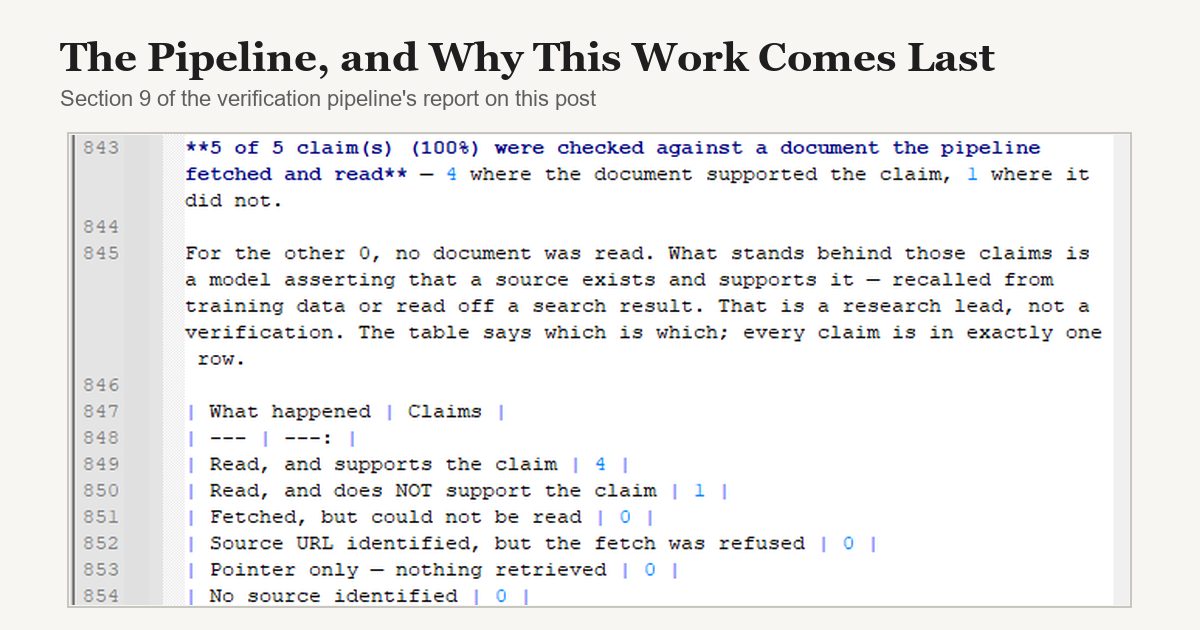
I’m building a verification pipeline, and it isn’t finished yet. That’s why things take longer. Once it’s running end to end, it will check every claim in every draft before anything goes near WordPress. It will check citations against primary sources, not against whether they sound plausible. It will stress-test arguments to find the weak points I didn’t catch. It will flag drafts wherever I stated something with more certainty than the evidence supports.
I’m still building and testing it. It’s not a plugin I installed. It’s a multi-stage review process I designed and directed Claude to build, and it runs each draft past models from six different providers, not Claude alone. A verdict only counts if it comes back with a verbatim quote and a source URL. On the articles here, Claude drafts. I set the voice, correct the facts, and decide what survives. A model drafting doesn’t make a draft verified, and neither does a person drafting. I check the facts against sources, regardless of who wrote the sentence. Before the checker existed, that was all manual: copying and pasting drafts between AI platforms. Some of the eleven likely went through earlier versions of the checker. The code is already public on GitHub, but it isn’t done. Once it’s solid, I’ll say so, and anyone else running a fact-based publication can use it too.
The fast version of this job is prompting an LLM and hitting publish. I’m running the slower version: draft, then verify. That’s on purpose.
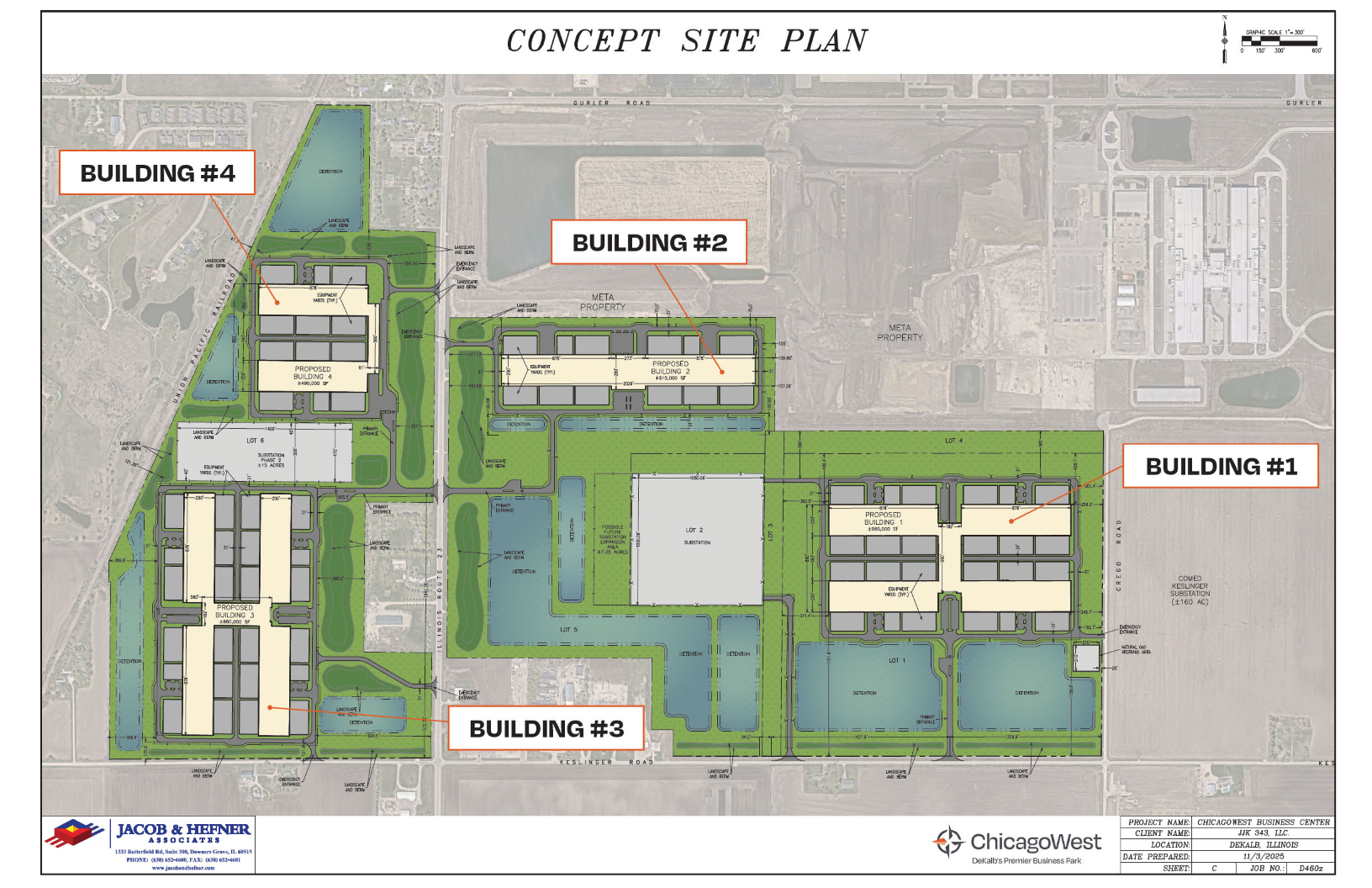
Concept site plan for Edged’s proposed Project Vector, ChicagoWest Business Center, DeKalb, IL. Source: December 1, 2025 Planning and Zoning Commission Agenda Packet.
AI tools were used in the research, drafting, and editing of this article. All factual claims are sourced to primary documents and verified by the author.
How small changes in transparency can prevent delays, diffuse misinformation, and improve community acceptance.
As someone who works adjacent to the data center world – in telecom, fiber, and the broader infrastructure ecosystem – I’ve spent the last few months filling the information vacuum around new data center proposals. Not because I’m in the industry, and not because I attend public meetings (I don’t), but because residents reach out online when they can’t get clear answers from the people actually building these facilities. When a telecom guy becomes the de facto explainer of your projects, it’s a sign that something in your communication approach isn’t matching the scale and impact of the developments themselves.
I’m pro-infrastructure. I want these facilities built. But supporting data centers doesn’t mean overlooking avoidable communication gaps that make your projects harder than they need to be. Consider this tough love – firm because it matters, fair because it’s warranted, and offered because too many good projects are getting delayed or blocked over misunderstandings that never should have taken root.
The Information Vacuum
Most people in any given community are indifferent or quietly supportive of data center development. But when information is sparse, the loudest voices – sometimes just a handful of people – end up defining the narrative. In the absence of clear, early communication from you, residents fill the gaps with whatever they’ve recently read or watched: crypto mines in Tennessee, water disputes in Oregon, diesel controversies in Ireland, AI hype cycles in California, surveillance conspiracies, or grid-collapse speculation that doesn’t apply to PJM territory at all.
These examples aren’t representative of most cloud-style facilities, especially in northern climates, but the public has no way to know that unless you say so. When you wait until the zoning hearing to speak, you’re not guiding the conversation – you’re trying to unwind months of assumptions.
What Communities Need – and What They’re Not Getting
Communities don’t need customer lists or workload diagrams. They understand confidentiality, NDAs, and the operational reality that workloads evolve over time. Customer mixes change, hardware refreshes shift cooling profiles, and what runs in year one may not match what runs in year five. Nobody expects you to freeze your statements in place.
But residents do need basic categorical clarity – enough to distinguish a standard cloud facility from the worst-case examples they’ve heard about. You can safely say:
“This is standard cloud compute.”
“This is not cryptocurrency mining.”
“This is not a large AI training cluster.”
“This supports everyday business and consumer applications.”
These are broad, durable statements. They don’t violate confidentiality. They simply prevent people from assuming that your project is whatever alarming headline they saw last.
Without even this level of clarity, the imagination fills the vacuum – and rarely in your favor.
The Security Inertia Problem
One of the most common complaints I see is what looks like “Fort Knox around a pond.” Site plans often show vast fenced areas protecting empty land, detention basins, or prairie restoration zones far from the operational building. Residents see this and assume something secretive or hazardous is being hidden.
In reality, this is usually design-by-inertia: security measures intended for the building quietly expand outward until they cover land with no operational sensitivity at all. Nobody is trying to compromise national security by accessing your stormwater pond.
Secure the building, loading docks, electrical rooms, and gensets – absolutely. But fencing off dozens or hundreds of benign acres eliminates opportunities to offer genuine community benefit. Those areas could support mixed-use trails, green space, pollinator habitats, agricultural co-use, fishing ponds, or solar co-siting. Instead, they often become unused no-go zones that reinforce the “secret compound” narrative.
This is one of the easiest, lowest-cost opportunities to build goodwill – and it’s consistently overlooked.
The Jobs Story You’re Not Telling
When you say “30 permanent jobs,” residents often assume that’s the entire economic impact. It’s not – not even close.
Direct operational jobs are fewer in number but highly technical: critical-facilities technicians, electrical and mechanical specialists, network engineers, security staff, logistics personnel, and site managers. These roles are well-paid, high-skill, and persist for the life of the facility.
Contractors and construction-phase trades represent the largest share of total employment during the build-out years. Large data center campuses are constructed in phases over nearly a decade, creating recurring waves of work for electricians, pipefitters, welders, plumbers, masons, steel crews, carpenters, crane operators, heavy-equipment operators, HVAC specialists, low-voltage integrators, fiber crews, concrete teams, and many more. These are long, rolling cycles of employment – not short bursts. As Daniel Golding pointed out in a widely read post, many tradespeople deliberately seek out data center work because it’s stable, complex, and long-term.
Ongoing trades work continues after the initial build-out. Facilities still require contractors for electrical modifications, fiber expansions, new circuits, equipment swaps, mechanical upgrades, plumbing work, generator service, cooling adjustments, preventive maintenance, and periodic retrofits. The headcount is smaller than during peak construction, but it never drops to zero.
And the ripple effects matter, too: full hotels, busy restaurants, steady supplier activity, equipment rentals, constant logistics runs, and improved peering/backhaul opportunities for local ISPs.
If you don’t tell this story, people assume a billion-dollar project creates “30 jobs,” and nothing more – a wildly incomplete picture.
Why Operators Must Show Up
Developers often take the heat for decisions they neither make nor control. They get grilled about workloads, cooling strategies, water profiles, power curves, expansion phases, and operational philosophy. But developers don’t own those decisions – operators do.
When operators remain silent due to internal policies or broad NDAs, the developer becomes the face of secrecy. That’s unfair to the developer and unhelpful to the project. To build trust, operators need to participate directly in communication – even briefly – so that answers come from the people who actually know them.
And let’s be honest – this isn’t the Manhattan Project. People move between data center companies all the time. Even if they’re not sharing proprietary documents, the expertise they gained follows them. The things you’re holding back from communities aren’t meaningful competitive secrets. Over-classification doesn’t keep competitors in the dark; it only keeps residents in the dark – and they’re the ones with the power to delay or block your project.
The Role of Utilities and Media
Utilities need to speak plainly. Electric providers should explain load forecasting, substation upgrades, and reliability planning. Water agencies should clarify regional aquifer behavior and seasonal pump profiles. Fiber builders should explain what they’re installing and whether it benefits the community. Natural gas providers should confirm whether anything has changed (often: nothing).
Journalists are part of this dynamic too. Infrastructure is complex, and newsrooms are stretched thin. Reporters aren’t given months to master hybrid cooling systems, grid-planning frameworks, water science, or enterprise architecture. A constructive suggestion: infrastructure reporters should maintain a small bench of trusted technical advisors – the same way health reporters rely on physicians or finance reporters rely on analysts. Advisors don’t tell them what to write; they help ensure the technical context is accurate. Your transparency makes that possible.
Iteration Beats Silence
No one expects perfection the first time. Communication – like software, cooling systems, and operational tooling – improves through iteration. If something doesn’t land, revise it. If a message confuses instead of clarifies, refine it. Communities forgive imperfection when they see honest effort. Silence and defensiveness are what they won’t forgive.
Not everyone is persuadable, but most people are. The goal isn’t to win over the immovable few; it’s to ensure silence doesn’t let them speak for everyone else.
If I’m Wrong About Anything, You Just Proved the Point
I work closer to this ecosystem than most residents ever will. I read zoning packets, utility filings, engineering documents, and planning memos – and even I still have to infer many details because they aren’t publicly explained. If someone like me can’t get a clear picture, residents have no chance.
If I misunderstood anything here, it shouldn’t be taken as bias or malice. It should be seen for what it is: evidence that essential information isn’t being communicated.
You’re building critical infrastructure. Communities deserve to understand it. And you deserve smoother, more predictable, less adversarial project approvals. Those goals aren’t in conflict – but achieving them requires speaking earlier, more clearly, and more consistently, before someone else fills the silence for you.
– Mike Hammett, Author, Data Center Myth-Busting Series
Methods & Transparency
I utilize a range of AI and automation tools, in conjunction with my own research, to organize and verify complex public data – from DeKalb County tax rolls and DevNet parcel records to PJM TEAC maps and ComEd reliability filings. ChatGPT has been the primary workhorse for synthesis, but I also utilize Copilot, Gemini, Claude, and Grok to cross-check facts, refine tone, and develop Python-based tools for analysis. Grammarly keeps the writing clear – I use it for nearly everything I write, even texts.
Over the past several months, I’ve invested well over 100 hours reviewing, verifying, and refining this information. I have also permanently archived more than 100 key source documents in the Internet Archive’s Wayback Machine to ensure transparency and durability. The work is still ongoing as new filings and community feedback come in.
Every figure and citation is sourced from public records that you can verify independently. My goal is to make complex infrastructure and taxation topics accessible and understandable to everyone in the community. I’m just a local guy with a day job and a family, trying to make the public data we already have a little easier for everyone to understand.